Indian Express
India-EU FTA is more than just a trade pact… Both sides have chosen openness over protectionism: EU Ambassador Delphin
Ambassador of the European Union (EU) to India Hervé Delphin said last month that the Free Trade Agreement (FTA) between India and the EU could enter into force in the first quarter of 2027, an outcome of the commitment of both sides to conclude the process at the earliest.
“The work is ongoing, but I think we can confidently look at early 2027 as a moment where the FTA could enter into force,” Delphin said in New Delhi on the sidelines of the Annual Erasmus+ Pre-Departure Event 2026, ANI reported on June 22.
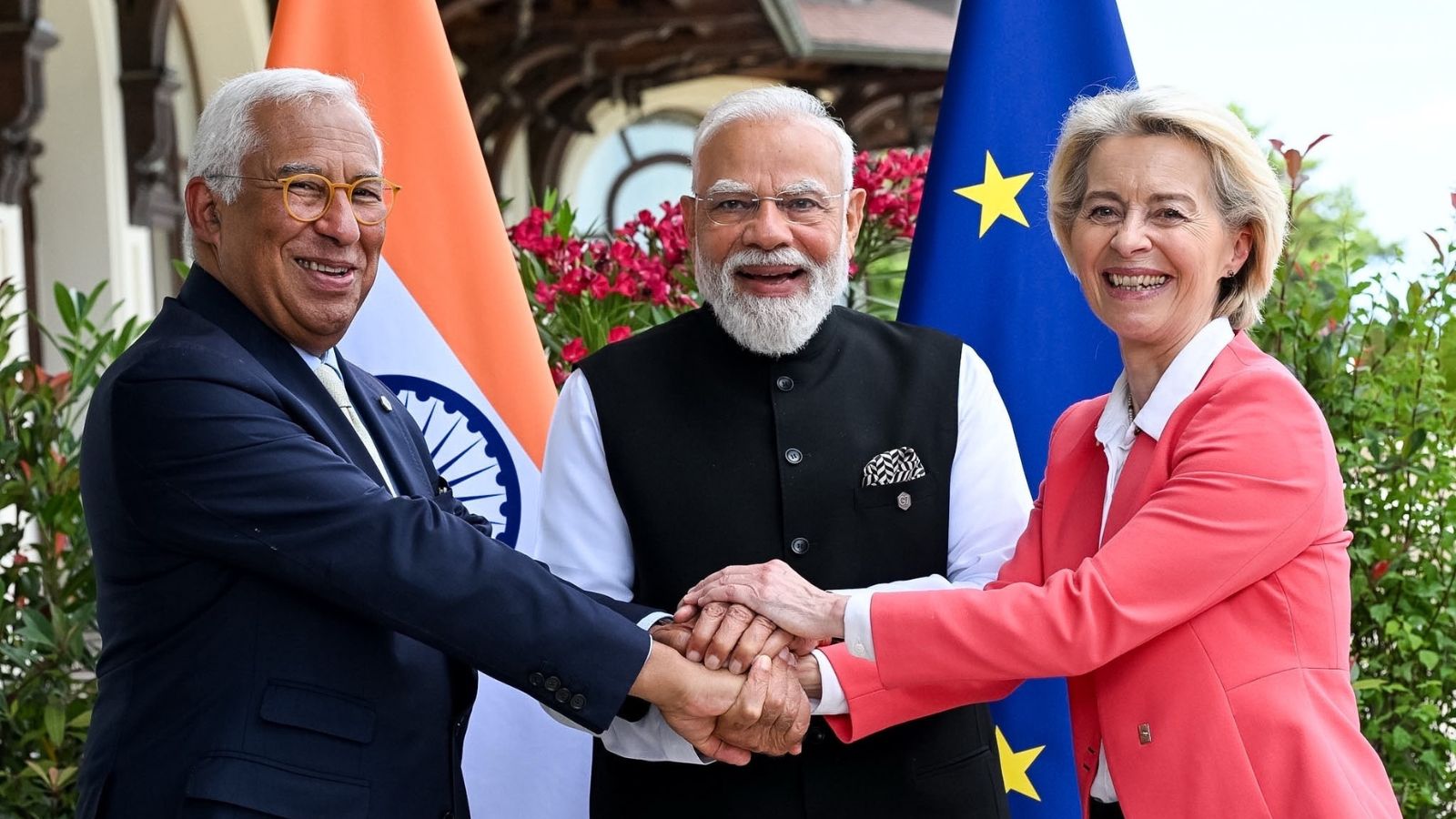
Earlier, on June 17, following a meeting with Prime Minister Narendra Modi on the sidelines of the G7 Summit in Évian-les-Bains, France, the president of the European Commission, Ursula von der Leyen, had posted on X that “We will sign the Free Trade Agreement by the end of the year.”
At the end of negotiations that continued for almost two decades, India and the 27-nation bloc announced the conclusion of the FTA in New Delhi on January 27 this year.
The two sides are currently scrutinising the voluminous text of the FTA – “working very hard to complete the process of the so-called legal vetting of the text”, Delphin said.
The liberalised trade and investment agreement has to be formally approved by the Council of the European Union, the European Parliament, and the Indian government before it enters into force.
In the weeks after the conclusion of the FTA was announced in January, The Indian Express spoke with six EU Ambassadors to India about the agreement, which has been hailed by both sides as the “mother of all deals”, and described by Prime Minister Modi as a “new blueprint for shared prosperity”.
Story continues below this ad
Hervé Delphin, a 30-year veteran of foreign policy and international relations at the EU, took over as Ambassador on October 23, 2023. (Express photo by Abhinav Saha )
What key deliverables with regard to the India-EU FTA can be expected in the coming months?
First of all, let me observe the overwhelming positive assessment received both in India and in Europe and also in many other partner countries about the Summit [in January], and its outcomes, the joint Comprehensive Strategic Agenda, the FTA and other deliverables. This speaks volume about the strategic significance of our partnership, for us and for the world.
We are committed to deliver at speed and scale. Only a few weeks after the Summit, we launched the exploratory talks for the Association to Horizon Europe, which is the largest research and innovation program in the world. Then we had the official launch of the EU Legal Mobility Gateway Office that will facilitate the movement of talent in the ICT (information and communications technology) sector, followed by our first elevated security and defence dialogue. In the coming weeks, we will see the Trade and Technology Council (TTC) ministerial in Europe.
The high pace of these developments implementing the agreed Strategic Agenda is very much part of a reflection of how much we see the partnership as a strategic and a comprehensive one for both sides. Every component of the strategy is working in synergy with each other. We have managed to combine security, economy, technology, and people in mutually reinforcing ways. So whatever we do in one aspect has an impact on the others.
Story continues below this ad
The agreement has come at a time of significant global fragmentation. How does the FTA serve as a strategic hedge for both the EU and India against global supply chain vulnerabilities and rising economic protectionism?
First, it is an enabler for more investment and more business. It is also creating the world’s largest single market. As the EU has removed or reduced duties on more than 99% of Indian exports and India has fully or partially removed tariffs on close to 97% of EU exports, this would have strong benefits for both sides.
In goods and services together, two-way trade is over 180 billion dollars. With the FTA, this will be accelerated. It is fair to assess and assume that with the vibrancy of Indian economic growth along with everything that the EU can bring, we could certainly reach double the volume of trade. The FTA will be great for the competitiveness and economies of both the EU and India.
The second element is the quality of EU FTAs. They are predictable, transparent, generate a level playing field and mutual benefits, and don’t create any potential uncertainties.
Story continues below this ad
Finally, this FTA is more than just a trade pact. It will allow us to build resilient and trusted supply chains between the EU and India. Both sides have made the choice of openness over protectionism, cooperation over fragmentation, and rule-based trade over the unpredictability of one-sided trade arrangements.
How do you see the FTA evolving into a deeper manufacturing partnership? Will it trigger a new wave of European technology transfers?
There are multiple dimensions to the strategic agenda between the two sides. The FTA is one, but we have also agreed to develop innovation hubs and a startup partnership. We have agreed to explore the potential of localized ecosystems where you integrate production lines. We have the trade and technology council. So we have all the building blocks that will lead to greater integration of our ecosystems.
This is driven by the principle of diversification, of complementarity and scale. India and the EU are setting up an environment to develop new tech in a way that we don’t feel a situation where we are over-dependent on other players. Tech transfers, semiconductors and clean tech…our businesses are certainly keen to scale up and increase cooperation.
Story continues below this ad
There is the concern in Delhi that “green” standards can become non-tariff barriers. How does this agreement ensure that sustainability goals remain a collaborative effort rather than a regulatory hurdle for Indian small and medium enterprises?
I think there is a misunderstanding. If you enter the European market, people want to have access to products that are decarbonized, have a low carbon content, or products that have a minimal impact on the environment. These rules apply to every actor, whether EU or non-EU. They are non-discriminatory. They do not put Indian exporters at a disadvantage.
Indian exporters know that the more decarbonized their product is, the more competitive their products will be in the European market. We went through an interim transition and consultation period for over two years. So there is no unilateral, short term, and unpredictable action taken from our side. We did seminars, explanations on deforestation regulations, and CBAM (Carbon Border Adjustment Mechanism). We have also been going through a simplification exercise of CBAM so that the reporting requirements are lower for MSMEs.
We have another element…we take it in bulk, in metric tonnes of carbon. We have also been strong supporters and one of the main partners of India in its efforts to clean energy, clean tech, decarbonization. As part of the discussions, there was an agreement on the EU side to direct over the next two years, 500 million euros, that would help India to reduce its greenhouse gas emission and accelerate industrial transformation.
Story continues below this ad
Why did it take so long to move from the first round of talks to the final conclusion?
Maybe at that time, both sides were not ready to make some of the compromises that would allow them to have a deal. I think at the time, agriculture was a major issue. This time what is different is certainly the geo-economic context.
We had announced the relaunch of the FTA in 2021. The launch started officially in 2022. The teams did the prep work, then at the end of 2023, they were starting to engage. But then 2024 was an electoral year for both sides.
It started really at the end of 2024…, so basically in a year, we managed to clinch it. We cannot look at the negotiation of today through the lens of the past and we should certainly not see it as a continuum.
Story continues below this ad
I always argue that this is FTA 2.0. Both sides quickly said let’s not aim at perfection but let’s make it substantial and meaningful for both sides. Political wisdom on both sides said we have the areas where we are not ready to open up, so there is no point in trying to negotiate in these areas. Both sides had also indicated the so-called red lines from the beginning.
View original source — Indian Express ↗
Related stories

The Punch
WorldJul 8, 2026 · 1 min
Araraume disowns statement on Imo APC primary, denies rift with Uzodimma
The Punch
The Punch
WorldJul 8, 2026 · 1 min
Arrest not proof of guilt, ex-minister Nnaji dismisses academic records reports
The Punch
The Punch
WorldJul 8, 2026 · 1 min
Drug abuse threatens Nigeria’s development, FG warns
The Punch
The Punch
WorldJul 8, 2026 · 1 min
COAS passes out 3,000 Army recruits in Ebonyi
The Punch