Indian Express
UPSC Key: Modern Indian Painting, Narmada Water Disputes Tribunal and Placenta
Missiles, minerals and port: Delhi, Jakarta seal key deals
Syllabus:
Preliminary Examination: Current events of national and international importance.
Mains Examination: General Studies II: Bilateral, regional and global groupings and agreements involving India and/or affecting India’s interests and Indian Diaspora.
What’s the ongoing story: India and Indonesia signed a series of landmark agreements Tuesday covering the supply of BrahMos supersonic cruise missiles and Astra air-to-air missile systems, as well as major defence technology transfers, critical mineral extraction, maritime security, and digital telecom connectivity. The developments came during a bilateral meeting between Prime Minister Narendra Modi and Indonesian President Prabowo Subianto in Jakarta.
Key Points to Ponder:
• India and Indonesia signed a series of landmark agreements -know them in detail
• The President Prabowo conferred the Bintang Adipurna (Medal of Honour) upon Prime Minister Modi-what is the significance?
• What are an key takeaways in India-Indonesia agreement to enhance defence exchanges, disaster management, and industrial cooperation?
• What you know about Prambanan Temple?
• What is special about Prambanan Temple?
• Indian diaspora in Indonesia-know in detail
• What is the history of India-Indonesia relations?
• What are the areas of cooperation and conflict between India and Indonesia?
• Map work: Indonesia
Key Takeaways:
• Modi, who reached Jakarta as part of a three-nation trip from July 6 to 11, said, “The Comprehensive Strategic Partnership we forged in 2018 is taking a new flight today. We are taking important steps forward in every sector—development, security, technology, culture, and education… I am confident that a golden chapter of India-Indonesia partnership begins today.”
• This is PM Modi’s fourth visit to Indonesia and the first bilateral visit since the elevation of ties to a Comprehensive Strategic Partnership in May 2018.
• As a special gesture reflecting deep bilateral ties, President Prabowo conferred the Bintang Adipurna (Medal of Honour) upon Prime Minister Modi. The medal is Indonesia’s highest civilian award, reserved for people who have rendered exceptional service to the nation’s unity, continuity, and prosperity.
• “The growing trust between our countries is strengthening our defence, security, and maritime cooperation. Today, we have reached an agreement to enhance defence exchanges, disaster management, and industrial cooperation,” said Modi, who will visit Australia and New Zealand as well.
• The agreements signed between the two nations included a pact to open an Indian Institute of Management (IIM) Bangalore campus in Indonesia, the supply of medicines and medical products to Indonesia, the provision of telecom technology such as wireless and quantum systems, and efforts for the conservation and restoration of the Prambanan Temple complex in Yogyakarta, among others.
Do You Know:
• Advancing defence and maritime partnership, officials said that India’s defence and security cooperation has seen increased momentum and expanding scope through high-level visits, regular bilateral and multilateral exercises and deeper defence industry cooperation, including the sale of BrahMos.
• As maritime neighbours, both countries adopted the Shared Vision of India-Indonesia Maritime Cooperation in the Indo-Pacific in 2018. “The stationing of an Indonesian Liaison Officer at Information Fusion Centre – Indian Ocean Region (IFC-IOR) will give further impetus to our maritime domain awareness. India will also be earmarking slots for Indonesian cadets and officers in National Defence Academy (NDA) and Defence Services Staff College (DSSC), which will enhance defence capacity building,” said a source.
• Indonesia has emerged as India’s second largest trading partner in ASEAN region with bilateral trade of US$ 24.78 billion in 2025-26. Over 130 Indian companies are invested in different sectors in Indonesia.
• On cooperation in critical minerals, officials said Indonesia dominates the sector, commanding roughly 21% of world’s nickel reserves and ranking among the top global producers of copper, bauxite and tin. On trade and investments, officials said there are “strong synergies between developmental visions of Viksit Bharat 2047 and Emas (Golden) Indonesia 2045”.
Other Important Articles Covering the same topic:
📍‘1.4 bn aspirations in motion’: Modi sums up India’s growth in Jakarta
Previous year UPSC Prelims Question Covering similar theme:
1) Consider the following statements with regard to BRICS: (UPSC CSE, 2025)
I. The 16th BRICS Summit was held under the Chairship of Russia in Kazan.
II. Indonesia has become a full member of BRICS.
III. The theme of the 16th BRICS Summit was Strengthening Multiculturalism for Just Global Development and Security.
Which of the statements given above is/are correct?
(a) I and II
(b) II and III
(c) I and III
(d) I only
The City
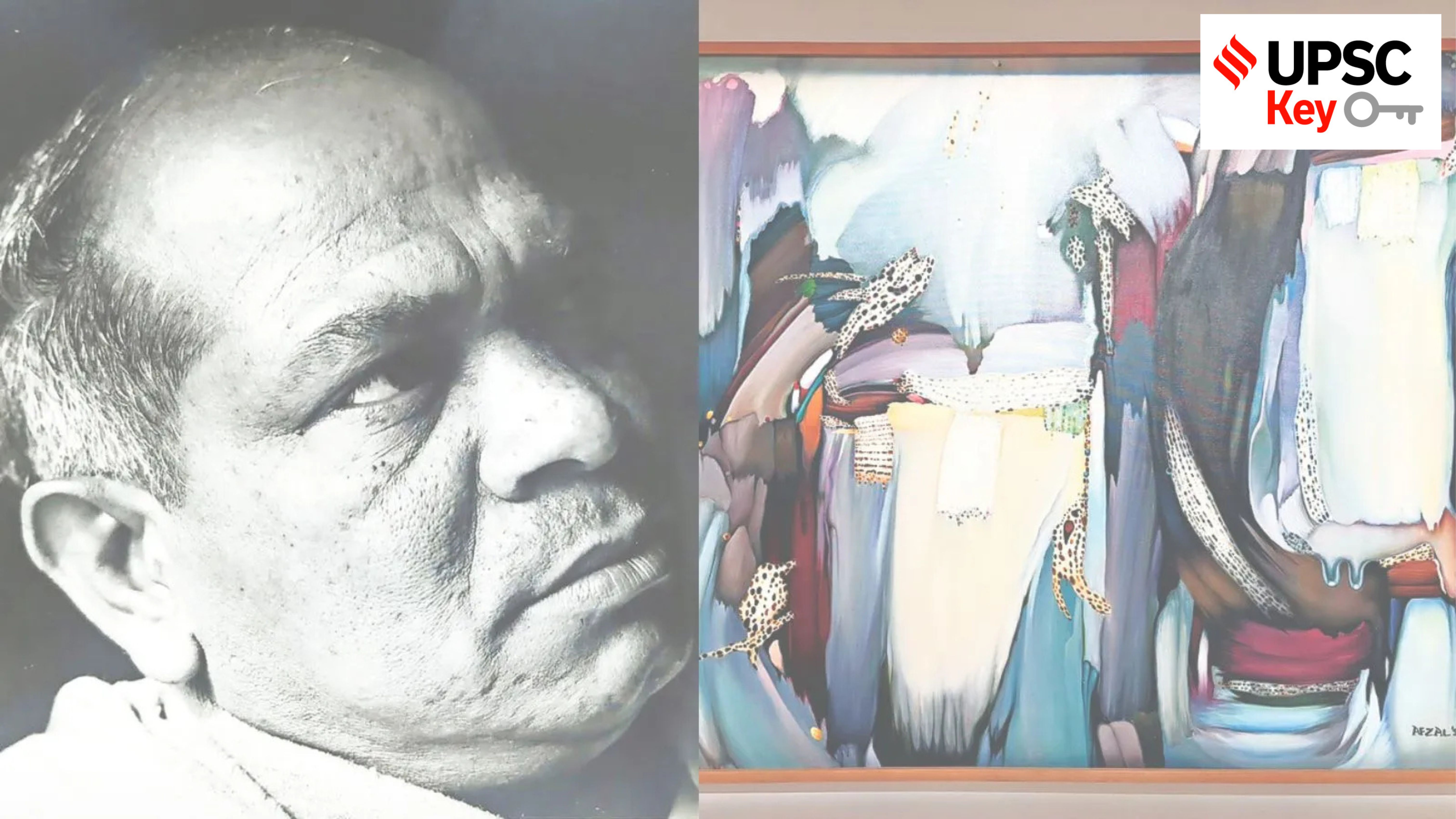
Afzal Pathan, the modernist painter from Madhya Pradesh whom India forgot
Syllabus:
Preliminary Examination: Current events of national and international importance
Mains Examination: General Studies I: Indian culture will cover the salient aspects of Art Forms, literature and Architecture from ancient to modern times.
What’s the ongoing story: Not many know his works, and looking at them you might think he is a rising star in India’s dynamic contemporary art scene – the form is fluid, the palette sombre, the hand light, and the composition experimental.
Key Points to Ponder:
• Personality in News-Afzal Pathan
• Afzal Pathan is primarily known for what type of paintings?
• Modern Indian painting primarily evolved during which period?
• Know the evolution of modern Indian painting after Independence.
• What are the major characteristics of modern Indian abstract painting?
• Know the huge contribution of lesser-known regional artists to India’s modern art movement with reference to Afzal Pathan.
• How does abstract art communicate social realities and human emotions?
• What is the importance of preserving modern artistic heritage?
• How modern Indian painters combined indigenous experiences with international artistic trends?
Key Takeaways:
• The fact is Afzal Pathan was part of the same modernist art revolution that gave India and the world Husain, Raza, Sher-Gil, and Gaitonde. He was born in 1936, passed away in 2000, and has remained largely absent from the storied history of the art of modern India.
• “When I was in Indore last year, I happened to see some of Pathan’s works at an exhibition. I was so impressed. But somehow he has not been part of the larger scene of Indian modern art. I thought that this was an artist who needed to be brought to notice and attention,” poet, literary critic, and editor Ashok Vajpeyi said.
• Vajpeyi is Managing and Life Trustee of The Raza Foundation, an arts and culture non-profit established in 2001 by the modern Indian master S H Raza, which has organised the exhibition.
• Pathan was a prolific painter, and Akhilesh said his repertoire of more than 5,000 works now remain in the care of his family in Dewas. “He wasn’t like other artists who would spend hours or days on a single work. He would finish a painting in half an hour,” said Akhilesh who, like Pathan, went to the Indore School of Art.
Do You Know:
• According to Wikipedia, the modern Indian art movement in Indian painting is considered to have begun in Calcutta in the late nineteenth century. The old traditions of painting had more or less died out in Bengal and new schools of art were started by the British. Initially, protagonists of Indian art such as Raja Ravi Varma drew on Western traditions and techniques including oil paint and easel painting. A reaction to the Western influence led to a revival in primitivism, called as the Bengal school of art, which drew from the rich cultural heritage of India. It was succeeded by the Santiniketan school, led by Rabindranath Tagore’s harking back to idyllic rural folk and rural life.
• Afzal Pathan: Ek Behta Dariya, on at the Shridharani Gallery at the Triveni Kala Sangam complex until July 10, is only his seventh solo show, including those held in his lifetime and posthumously.
Other Important Articles Covering the same topic:
📍On the 75th anniversary of the Progressive Artists’ Group, remembering their seminal role in shaping Indian art
Previous year UPSC Prelims Question Covering similar theme:
2) Kalamkari painting refers to (UPSC CSE, 2015)
(a) a hand-painted cotton textile in South India
(b) a handmade drawing on bamboo handicrafts in North-East India
(c) a block-painted woollen cloth in Western Himalayan region of India
(d) a hand-painted decorative silk cloth in North-Western India
Politics
Four beneficiary states sign pact on Narmada outstanding dues
Syllabus:
Preliminary Examination: Indian Polity and Governance–Constitution, Political System, Panchayati Raj, Public Policy, Rights Issues, etc.
Mains Examination: General Studies II: Functions and responsibilities of the Union and the States, issues and challenges pertaining to the federal structure, devolution of powers and finances up to local levels and challenges therein.
What’s the ongoing story: Chief Ministers of Gujarat, Madhya Pradesh, Maharashtra, and Rajasthan signed an agreement on Tuesday relating to the settlement of outstanding dues of the Narmada Water Disputes Tribunal (NWDT) Award Projects.
Key Points to Ponder:
• What is the Sardar Sarovar Project?
• What you know about Narmada Water Disputes Tribunal (NWDT)?
• Map Work-Narmada River (origin, drainage system), Major west flowing rivers in India and Sardar Sarovar Project
• What were the issues with Narmada Water Disputes Tribunal?
• How Gujarat, Madhya Pradesh, Maharashtra, and Rajasthan ended Sardar Sarovar payment dispute?
• What are the Inter-State water disputes in India?
• What are the Constitutional Provisions for interstate water disputes?
• What Article 262 of the Constitution says about interstate water disputes?
• What is the role of the Union Government under the Jal Shakti Ministry in mediating inter-state water conflicts?
Key Takeaways:
• The “historic agreement” was signed in the presence of Union Home Minister Amit Shah and Union Jal Shakti Minister C R Patil.
• CMs Devendra Fadnavis (Maharashtra), Bhupendra Patel (Gujarat), Bhajan Lal Sharma (Rajasthan) and Dr. Mohan Yadav (Madhya Pradesh), along with senior officials from the Centre and the states, were present on the occasion.
• In a statement, the Ministry of Home Affairs said, “This agreement marks a historic milestone in resolving the long-standing disputes among the States of Madhya Pradesh, Gujarat, Rajasthan, and Maharashtra relating to cost-sharing arrangements for the construction of the Sardar Sarovar Project. Under the agreement, payments to be made towards the final settlement of pending dues have been resolved.”
• Commending Prime Minister Narendra Modi’s leadership, Shah said several historic initiatives have been undertaken to strengthen water security and promote cooperative federalism in the water sector.
Do You Know:
• The Centre had constituted the NWDT in 1969, which gave its Award in 1979. The NWDT Award specified the quantum of water that could be utilised by the four states, as well as determined their share of the net power produced at Navagam at Canal Head and River Bed Power Houses. While most issues were resolved after the Award’s distribution, issues like dues pertaining to the cost-sharing of the Sardar Sarovar Project and the Indira Sagar Project, Resettlement & Rehabilitation (R&R) Expenditure, Compensation for Submerged land, and the interest burden on borrowings during construction remained pending which are now resolved.
• In a statement, the Ministry of Home Affairs said, “This agreement marks a historic milestone in resolving the long-standing disputes among the States of Madhya Pradesh, Gujarat, Rajasthan, and Maharashtra relating to cost-sharing arrangements for the construction of the Sardar Sarovar Project. Under the agreement, payments to be made towards the final settlement of pending dues have been resolved.”
Other Important Articles Covering the same topic:
📍A short history of the Sardar Sarovar Dam on river Narmada
Previous year UPSC Prelims Question Covering similar theme:
3) The Narmada River flows to the west, while most other large peninsular rivers flow to the east. Why? (UPSC CSE, 2013)
1. It occupies a linear rift valley.
2. It flows between the Vindhyas and the Satpuras.
3. The land slopes to the west from Central India.
Select the correct answer using the codes given below:
(a) 1 only
(b) 2 and 3
(c) 1 and 3
(d) None
Previous year UPSC mains Question Covering similar theme:
📍Constitutional mechanisms to resolve the inter-state water disputes have failed to address and solve the problems. Is the failure due to structural or process inadequacy or both? Discuss. (2013)
Nation
Lab-grown placenta to help study how drugs, nutrients pass down from mother to baby
Syllabus:
Preliminary Examination: General Science.
Mains Examination: General Studies III: Achievements of Indians in science & technology; indigenization of technology and developing new technology.
What’s the ongoing story: For decades, doctors have had to prescribe medicines during pregnancy with surprisingly little evidence about whether many of them reach the developing foetus via the placenta, the temporary organ that connects a mother and her unborn baby. Or whether it is indeed an effective barrier against microbes and toxins.
Key Points to Ponder:
• What is placenta?
• What is the difference between stem cell and placenta?
• Why is a placenta model significant?
• What is a placenta-on-chip?
• What makes this model different?
• What did the researchers find?
• How could this benefit mothers and babies?
Key Takeaways:
• Now, researchers from Mumbai’s ICMR-National Institute for Research on Women’s Health (ICMR-NIRWoH) and the Indian Institute of Technology Bombay (IIT Bombay) have developed a placenta-on-chip that closely mimics the human placenta.
• This offers scientists a new way to study how drugs, nutrients, pollutants and infectious agents pass from mother to baby. Although it remains a laboratory research tool that requires further validation, researchers believe it could accelerate the development of pregnancy-safe therapeutics and provide new insights into conditions such as gestational diabetes, foetal growth restriction and pre-eclampsia (high blood pressure that damages organs).
• The human-cell-based platform recreates several key structural and functional features of the placenta and could reduce dependence on animal models, which often fail to accurately replicate human pregnancy. The study was led by researchers Anshul Bhide and Sourav Mukherjee under the supervision of Professor Deepak Modi (ICMR-NIRWoH) and Professor Abhijit Majumder (IIT Bombay).
Do You Know:
• The placenta is one of the most critical organs in pregnancy. Yet it is one of the least understood. It supplies oxygen and nutrients to the foetus, removes waste products, produces hormones essential for sustaining pregnancy and acts as a selective barrier, determining what passes from the mother’s bloodstream to the developing baby. How well the placenta functions influences foetal growth, pregnancy outcomes and the safety of medicines prescribed during pregnancy.
• Despite its name, it is not an electronic computer chip. It is a transparent plastic device containing a porous membrane on which researchers grow human placental cells alongside human endothelial cells, which line blood vessels. Together, these recreate the interface through which nutrients, hormones and other molecules are exchanged between mother and foetus.
• Unlike many existing placenta-on-chip systems that require sophisticated microfluidic equipment, the Mumbai team’s model is a static two-chamber platform that can be used in a standard laboratory, making it simpler, reproducible and more accessible. Explaining the concept, Anshul Bhide, from ICMR-NIRWoH, told The Indian Express: “We tried to recreate the placenta to provide researchers a more humanised platform to better understand pregnancy and improve maternal and foetal health.” The project took more than three-and-a-half years to complete, beginning during the Covid-19 pandemic, and has been built entirely using human cells.
Other Important Articles Covering the same topic:
📍Studies shine light on mysterious placenta, how it goes awry
Previous year UPSC Prelims Question Covering similar theme:
4) Which of the following statements are correct regarding the general difference between plant and animal cells? (UPSC CSE, 2020)
1. Plant cells have cellulose cell walls whilst animal cells do not.
2. Plant cells do not have plasma membranes unlike animal cells which do.
3. Mature plant cell has one large vacuole whilst an animal cell has many small vacuoles.
Select the correct answer using the code given below:
(a) 1 and 2 only
(b) 2 and 3 only
(c) 1 and 3 only
(d) 1, 2 and 3
5) With reference to ‘stem cells’, frequently in the news, which of the following statements is/are correct? (UPSC CSE, 2012)
1. Stem cells can be derived from mammals only
2. Stem cells can be used for screening new drugs
3. Stem cells can be used for medical therapies
Select the correct answer using the codes given below:
(a) 1 and 2 only
(b) 2 and 3 only
(c) 3 only
(d) 1, 2 and 3
The Editorial Page
For the Indo-Pacific, a ‘G Minus 2’ strategy
Syllabus:
Preliminary Examination: Current events of national and international importance.
Mains Examination: General Studies II: Bilateral, regional and global groupings and agreements involving India and/or affecting India’s interests.
What’s the ongoing story: C. Raja Mohan Writes- Every major Asian nation, including India and the three countries Modi is visiting this week, knows that Chinese power in Asia and the Indo-Pacific is a reality that must be managed
Key Points to Ponder:
• What constitutes Indo-Pacific region?
• The Term ‘Indo-Pacific’-What does it mean? Define this term in Geopolitical and in geographical context.
• Know the importance of Indo-Pacific region for India
• India’s Indo-Pacific Strategy-Know in detail
• What is “G Minus Two”?
• G7 and G20-Compare and Contrast
• Free and Open Indo-Pacific (FOIP)-What is the rationality behind FOIP?
• What Does a ‘Free and Open Indo-Pacific’ Actually Mean?
• Do you think that the Free and Open Indo-Pacific is actually meant to contain China?
• India-Japan and USA and China-connect the dots
Key Takeaways:
• Prime Minister Narendra Modi’s eastward journey this week — from Indonesia to Australia and New Zealand — marks the consolidation of a new Indo-Pacific approach that might be called “G Minus Two”. The idea of a US-China condominium in Asia has always made Indian strategists uneasy. President Donald Trump’s occasional references to a G2, along with his administration’s decision to discard the Indo-Pacific terminology, have reinforced those anxieties.
• Delhi is responding to the new dynamic between Washington and Beijing by expanding its cooperation with the rest of Asia. This is similar to the ways in which several Asian powers are dealing with the changes in US-China relations. The unfolding Asian pattern of “G Minus Two” should help shift India’s Indo-Pacific debate away from sterile slogans about American intentions or Chinese ambitions. The more practical question is what India can build with the rest of Asia.
• The visits to Delhi by Japanese Prime Minister Sanae Takaichi this month and South Korean President Lee Jae-myung in April underlined the urgency in Tokyo and Seoul, two key Asian allies of Washington, to widen their Asian ties. Modi’s visits to Jakarta, Melbourne and Auckland point to the same logic — the importance of expanding the geopolitical room for manoeuvre by strengthening cooperation among themselves.
Do You Know:
• “G Minus Two” is not about Asia turning its back on America. Quite the contrary. Most Asian countries recognise that there can be no stable balance of power in Asia without a sustained US strategic presence. China’s rising military weight cannot be balanced by the rest of Asia, even if they act in concert. That is why Japan, South Korea, Australia and New Zealand continue to build on their security partnerships with Washington. If anything, uncertainty under Trump has increased the incentive to bind the US more closely to Asian security.
• India and Indonesia, despite their non-aligned tradition, have reached similar conclusions. As China flexes its military muscle, both have intensified defence cooperation with the US. Their “strategic autonomy” under the shadow of China rests not on keeping America at arm’s length, but on working with it and navigating Trump’s mercurial diplomacy. Both Delhi and Jakarta are now “major defence partners” of Washington.
• If “G Minus Two” is not about distancing from the US, neither is it about containing China. Every major Asian nation, including India and the three countries Modi is visiting this week, knows that Chinese power in Asia and the Indo-Pacific is a reality that must be managed. They also have to deal with the extraordinary economic interdependence with China.
• The Asian objective is to “de-risk” Beijing’s weaponisation of interdependence. India’s annual trade with China is now at $150 billion. Comparable figures for America’s Asian partners underline the same reality: South Korea trades roughly $300 billion with China, Japan more than $300 billion, Australia over $200 billion, while ASEAN’s trade with China has crossed the trillion-dollar mark. Commercial decoupling is simply not a realistic option. The Asian imperative for deeper economic cooperation among the regional powers has been reinforced by Trump’s tariff wars.
Other Important Articles Covering the same topic:
📍The Indo-Pacific is here to stay, with or without Washington
Previous year UPSC Prelims Question Covering similar theme:
6) With reference to “Look East Policy” of India, consider the following statements: (UPSC CSE, 2011)
1. India wants to establish itself as an important regional player in East Asian affairs.
2. India wants to plug the vacuum created by the termination of the Cold War.
3. India wants to restore the historical and cultural ties with its neighbours in Southeast and East Asia.
Which of the statements given above is/are correct?
(a) 1 only
(b) 1 and 3 only
(c) 3 only
(d) 1, 2 and 3
Explained
With CEO post, how Ram Temple Trust is changing
Syllabus:
Preliminary Examination: Current events of national and international importance.
Mains Examination: General Studies II: Government policies and interventions for development in various sectors and issues arising out of their design and implementation.
What’s the ongoing story: The Ram Temple Trust has accepted the resignations of its two most influential office-bearers, General Secretary Champat Rai and trustee Anil Mishra, and announced that it will appoint a Chief Executive Officer for the first time. The move marks the biggest administrative overhaul of the body that runs the Ayodhya temple since it was constituted in 2020.
Key Points to Ponder:
• How did the Trust come into being?
• Know the socio-cultural significance of India’s major temple institutions beyond their religious role.
• How do these temples handle devotees’ offerings?
• What safeguards exist?
• How does the Ram Temple compare?
• Who is responsible for counting the money?
• What are the constitutional provisions relating to the management of religious institutions in India?
• Why is financial accountability important in managing large religious institutions?
• What is the role of technology in improving governance of charitable and religious trusts?
• What are the governance challenges associated with managing large temple institutions receiving substantial public donations?
Key Takeaways:
• The Shri Ram Janmabhoomi Teerth Kshetra owes its existence to the Supreme Court’s November 2019 Ayodhya judgment. The Court directed that the government formulate a scheme within three months for setting up the trust and transferring the disputed land to it. Acting under the Acquisition of Certain Area at Ayodhya Act, 1993, the Centre constituted the Trust on February 5, 2020, and transferred the acquired land to it through a Gazette notification.
• Unlike Tirupati, Jagannath, Vaishno Devi or Kashi Vishwanath, the Ram Temple is not governed by a dedicated statute enacted by a state legislature. Its legal foundation is a combination of the Supreme Court’s 2019 judgment, the 1993 Ayodhya Acquisition Act, the Central government’s scheme and notification, and the trust deed of the Shri Ram Janmabhoomi Teerth Kshetra.
• The trust is therefore neither a conventional private religious trust nor a statutory temple board established by legislation. It occupies a unique institutional position: a public religious trust brought into existence by executive action in implementation of a judicial mandate.
• The 15-member Trust is the temple’s highest decision-making body. It is chaired by Mahant Nritya Gopal Das, although because of age and ill health, day-to-day leadership gradually came to rest with General Secretary Champat Rai, who emerged as the public face of the institution.
• The trust deed provides for a combination of permanent members, nominated members and ex-officio representatives, ensuring representation from the religious community as well as the Centre and the Uttar Pradesh government. Construction has been supervised by a committee headed by former Principal Secretary to the Prime Minister, Nripendra Mishra, as ex-officio member.
The 15-member Ram Temple Trust is the temple’s highest decision-making body.
Do You Know:
• Most of India’s older major temples are administered under dedicated legislation enacted by state governments. TTD functions under the Andhra Pradesh Charitable and Hindu Religious Institutions and Endowments Act, the Jagannath Temple under the Shri Jagannath Temple Act, the Shri Mata Vaishno Devi Shrine under the Jammu and Kashmir Shri Mata Vaishno Devi Shrine Act, the Siddhivinayak Temple under a Maharashtra law governing its trust, while the Kashi Vishwanath Temple is administered under the Uttar Pradesh Shri Kashi Vishwanath Temple Act. These laws create the governing bodies, define the powers of administrators, prescribe financial procedures, provide for government oversight and statutory audits, and in some cases lay down detailed rules for handling donations.
• The Ram Temple follows a different model. The Shri Ram Janmabhoomi Teerth Kshetra functions through a trust deed rather than a dedicated statute governing the administration of the temple. Day-to-day management, including appointments and financial administration, rests with the trust.
• Another point of departure is the composition of the management itself. In several of the older temples, key financial processes involve executive officers, statutory administrators, government nominees, magistrates, auditors, or other public officials whose responsibilities are defined under law.
• At the Ram Temple, many of the key office-bearers associated with donation management — including General Secretary Champat Rai, trust member Anil Mishra, administrator Gopal Rao, and donation supervisor Subhash Srivastava — have long associations with the RSS or its affiliates. Responsibility for administration is therefore concentrated within the trust structure rather than distributed across a broader statutory administrative framework.
Other Important Articles Covering the same topic:
📍How temples deal with donations
Previous year UPSC main Question Covering similar theme:
📍Indian philosophy and tradition played a significant role in conceiving and shaping the monuments and their art in India. Discuss. (2020)
PRELIMS ANSWER KEY
1.(a) 2.(a) 3.(a) 4.(c) 5.(b) 6.(d)
For any queries and feedback, contact [email protected]
Subscribe to our UPSC newsletter. Stay updated with the latest UPSC articles by joining our Telegram channel – IndianExpress UPSC Hub, and follow us on Instagram and X.
View original source — Indian Express ↗
Related stories

TechCrunch
TechnologyJul 8, 2026 · 1 min
Another massive data breach exposed millions of driver’s license numbers
TechCrunch

ZDNet
TechnologyJul 8, 2026 · 1 min
I tried DuckDuckGo's new video player, and it blocks YouTube ads for free
ZDNet

TechRadar
TechnologyJul 8, 2026 · 1 min
5 things to expect at Samsung Galaxy Unpacked — from foldable phones to Samsung’s first smart glasses
TechRadar

The New York Times
TechnologyJul 8, 2026 · 1 min
A License to Make Patriot Defense Systems May Be a Big Boost for Ukraine
The New York Times