Indian Express
What are the potential implications of missing public health metrics in NFHS-6?
India continues to have the highest number of anaemic populations in the world. By definition, anaemia is a medical condition marked by deficiency of red blood cells and disproportionately affects vulnerable groups like children and women. The most common driver of anaemia is estimated to be deficiency of iron caused by a lack of nutritious diet.
But the National Family Health Survey (NFHS-6) has dropped indicators on anaemia, as well as sanitation and clean cooking fuel. A total of 43 important indicators that were part of the earlier NFHS datasets have been omitted in NFHS-6. Among indicators are health and sanitation measures, like estimates of anaemia, child mortality, sex ratio at birth, sanitation, and clean cooking fuel access.
Since reliable data are important for policymakers, how could the omission of these indicators constrain the ability to evaluate the state of public health and social development in India? Before delving into this question, let’s have a brief overview of NFHS.
Significance of NFHS datasets
The National Family Health Survey or NFHS provides information on fertility, family planning, maternal and child health, reproductive health, nutrition, anemia, etc. The history of NFHS surveys reflects a long tradition of debates on India’s growth in social sectors.
First launched in 1992, the NFHS is part of the global cohort of surveys run by the United States Agency for International Development (USAID) under its Demographic and Health Survey (DHS) programme.
The first round of NFHS (NFHS-1) in 1992-93 was conducted under the Ministry of Health and Family Welfare. The Indian Institute of Population Studies (IIPS), an autonomous research institute under the Ministry, became the nodal agency for the survey.
Story continues below this ad
The survey generated national and state-level data on fertility, family size preferences, and family planning. The aim of the database was to help researchers and policymakers evaluate family welfare programmes and family planning strategies.
NFHS-2, conducted in 1998-99, added some new and expanded topics, including reproductive health, women’s autonomy, domestic violence, women’s nutrition, anaemia, and salt iodization. Notably, the second round was to be initiated five years after the first round, but the Pokhran tests delayed it.
The NFHS-3, conducted in 2005-06, continued with similar issues and introduced a men’s questionnaire on family planning choices and health. However, it is to be noted that the approach used in NFHS-3 to measure domestic violence is significantly different and more comprehensive compared to NFHS-2.
The subsequent surveys, NFHS-4 (2015-16), NFHS-5 (2019-21), and NFHS-6 (2023-24), have carried out the same tradition. NFHS data, over the years, have made way for interesting debates on fertility dynamics, family planning, and maternal and child health.
Shift to debates on “fertility crisis”
Story continues below this ad
The fertility debates in India and around the world have shifted towards the “fertility crisis”. Fertility rates across the world have fallen. As per NFHS-6 data, India’s Total Fertility Rate (TFR) – the average number of children a woman can have in her lifetime – had stabilised at 2.0, below the replacement level of 2.1. A replacement level TFR is the number needed to exactly replace one generation by the next.
In urban India, TFR is 1.6 while in rural India, it is 2.1. However, there are regional variations. In states like Bihar and Uttar Pradesh, the TFR is around 2.7 and 2.2, respectively, whereas in states like Assam and Kerala, it is around 1.6 and 1.8, respectively.
Moreover, adolescent fertility remains an important concern. NFHS-6 finds out that 6.7% of women aged 15-19 years were either mothers or pregnant at the time of the survey – a marginal decline from 6.8% reported in NFHS-5. However, the NFHS-6 factsheet does not contain direct information on the adolescent fertility rate for women aged 15-19 years, unlike NFHS-5.
Scholars have pointed out that the “fertility crisis” should not necessarily be about declining birth rates. Rather, it should be about the barriers that prevent people from having the desired number of children, whether by achieving pregnancy or by avoiding one. While women’s sexual and reproductive rights, including access to abortion, have remained a contentious issue, the fertility debates also raise issues like the increasing cost of living, falling wages, and the rising cost of child care.
Story continues below this ad
Child and maternal health
The NFHS-6 factsheet has also given important information on child and maternal health. Data shows that the proportion of stunted children (who are too short for their age as a result of chronic or recurrent malnutrition) has come down from 35.5% in 2019-21 to 29.3%. In addition, the proportion of children who are underweight has come down from 32.1% to 31.8%.
However, regional disparities exist. The number of stunted children remains higher in rural India (30.9%) than in urban India (23.9%). In states like Bihar and Jharkhand, the proportions remain high at 35.6% and 35%, respectively.
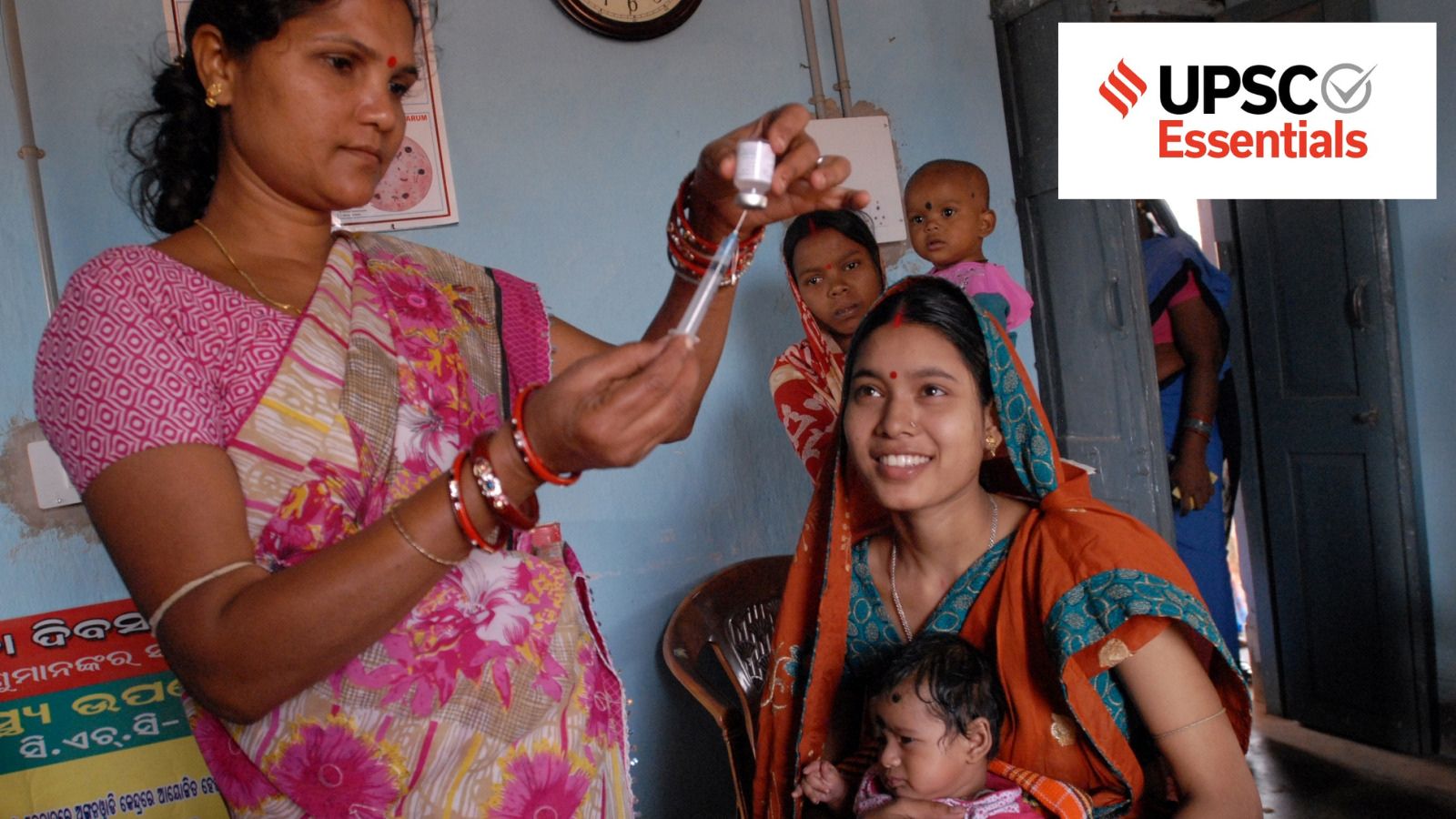
NFHS-6 data also show that institutional births have gone up from 88.6% to 90.6% in the same time frame. Similarly, immunisation for children aged 12-23 months has gone up from 83.8% to 87.1%.
While these figures show improvement, there are concerns over the nutritional status of women and children. NFHS-5 revealed that 67% of Indian children under five were anaemic as compared to 58.6% reported in NFHS-4. For women in the age group of 15-49, the same was 57% in NFHS-5.
Story continues below this ad
Further, more than half of pregnant women in India were anaemic. In total, there were seven indicators of anaemia in the previous round, which have all been dropped in the latest survey. The indicators covered the prevalence of anaemia among children aged 6-59 months, non-pregnant and pregnant women aged 15-49, all women aged 15-49, adolescent girls 15-19, men aged 15-49 and adolescent boys aged 15-19.
Persistence of anaemia and government’s response
As mentioned earlier, India continues to have the highest number of anaemic populations in the world. Scholars have provided various socio-economic and political explanations for the continued prevalence of anaemia. For instance, there have been numerous policies to address nutrition and anaemia, including:
1. The Integrated Child Development Services (ICDS) launched in 1975.
2. The Mid-Day Meal Scheme.
3. The Prime Minister’s Overarching Scheme for Holistic Nutrition (POSHAN Abhiyaan) launched in 2018.
4. The Anaemia Mukt Bharat programme launched in 2018.
Despite these initiatives, nutritional deprivation among vulnerable groups in India persists. One contributing factor could be the reduction in public expenditure on health and rural development. Further, recent debates around the inclusion of food items, like meat and eggs, in the Mid-Day Meal Scheme also imply less consumption of nutritious food items. Finally, gendered hierarchies within households also shape the unequal distribution and consumption of nutritious food items, affecting women and children.
Story continues below this ad
Alongside these initiatives, the government has also heavily relied on fortification of rice with factory-made micronutrients like iron to combat anaemia. However, the Ministry of Consumer Affairs, Food and Public Distribution discontinued it in February 2026. Critics have argued that iron fortification is non-scientific, ineffective, and wasteful. Many traditional varieties of rice are more nutritious and iron-rich. Therefore, addressing India’s nutritional challenges requires a broader policy approach.
Socioeconomic dimensions of access to clean cooking fuel
Indicators on household access to improved sanitation and clean cooking fuel have also been omitted from the recent factsheet. According to NFHS-5, only 58.6% of households in India, including 43.2% in rural areas, used clean fuel for cooking. Research indicates that households with better educated and younger heads of households, smaller family size, higher level of wealth, and located in urban areas are more likely to use cleaner fuel for cooking.
There are also caste and class demarcations on the use of cooking fuel, with marginalised communities more likely to be vulnerable to use informal sources of cooking fuel. The continued use of unclean cooking fuels is linked to numerous health issues like respiratory and heart problems that disproportionately affect women. Initiatives like the Pradhan Mantri Ujjwala Yojana have sought to address this challenge.
With regard to sanitation, NFHS-5 data showed that only 70% of the population live in households that use an improved sanitation facility. But this indicator has been omitted in NFHS-6. While the proportion of the population living in households with an improved drinking-water source has increased from 95.9% to 96.5%, the missing data on sanitation is an important loophole.
Story continues below this ad
Why missing data matters
It is, however, important to read the data and figures on health and sanitation with caution. For instance, evidence suggests that the access and presence of toilets do not necessarily mean they are in use. Many toilets built under government programmes become dilapidated or do not get renovated and remain unusable. Research also highlights that education, occupation, and age of the household can play a significant role in the use of toilets.
The omission of key indicators on anaemia, sanitation, and clean cooking fuel constraints our ability to evaluate the state of public health and social development in India. Reliable data are important for policymakers. For example, the gendered and social nature of anaemia implies that segregated caste-class data would provide better information for policy makers at a time when schemes targeting the same are already in place. The same is true for sanitation as well as cooking fuel.
Post read questions
The National Family Health Survey (NFHS) has become an indispensable source of evidence for public policy in India. Discuss its significance and examine the implications of omitting key health and nutrition indicators from NFHS-6.
Despite decades of policy interventions, anaemia remains a major public health challenge in India. Discuss the socio-economic and gender dimensions of anaemia.
Story continues below this ad
Nutritional outcomes in India are shaped as much by social inequalities as by food availability. Discuss with suitable examples.
Access to clean cooking fuel and improved sanitation is central to sustainable development. Examine the social, economic, and health implications of unequal access in India.
Evaluate India’s policy response to anaemia. To what extent can food fortification complement broader nutrition interventions?
(Ritwika Patgiri is a doctoral candidate at the Faculty of Economics, South Asian University.)
Share your thoughts and ideas on UPSC Special articles with [email protected].
Click Here to read the UPSC Essentials magazine for June 2026. Subscribe to our UPSC newsletter and stay updated with the news cues from the past week.
Stay updated with the latest UPSC articles by joining our Telegram channel – IndianExpress UPSC Hub, and follow us on Instagram and X.
View original source — Indian Express ↗
Related stories

The New York Times
TechnologyJul 8, 2026 · 1 min
Air Canada Chooses a C.E.O. Who Speaks French After Language Backlash
The New York Times

TASS
TechnologyJul 8, 2026 · 1 min
Trump says US received share of Ukrainian land through mineral deal
TASS
ZDNet
TechnologyJul 8, 2026 · 1 min
I tried Claude Cowork on my Gmail inbox after Gemini choked - and it saved me hours of work
ZDNet

The New York Times
TechnologyJul 8, 2026 · 1 min
At End of NATO Summit, Leaders Find Much to Agree on Despite Trump’s Insults
The New York Times