The Guardian
Trump gives Zelenskyy vague promise of licence to manufacture Patriot missiles
Donald Trump has told Volodymyr Zelenskyy that Ukraine may be allowed to manufacture Patriot missile interceptors to counter Russian ballistic attacks. It would be a diplomatic coup for Kyiv, which has been struggling to counter Moscow’s increasing missile threat.
The US president’s commitment, however, was vaguely framed, and he admitted he had not spoken to the US defence and aerospace companies Lockheed Martin and RTX Corporation (formerly Raytheon) that produce the Patriot system. It also remained unclear how quickly manufacturing of the expensive and complex munitions could be stepped up.
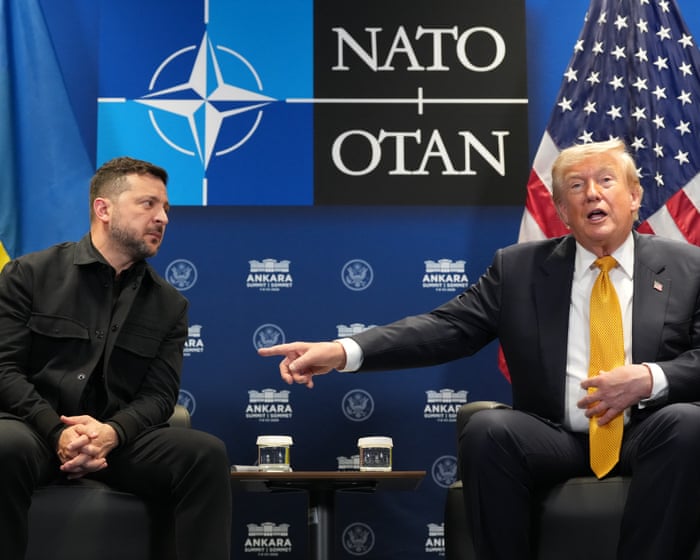
Trump, sitting next to the Ukrainian president at the Nato summit in Ankara, Turkey, said: “A little birdie told me this, about the fact that we’ll give them the right to make Patriots. We’ll show them how to do it, it’s very complex actually. But it’s – you’ll figure out the complexity quickly.”
He clarified: “We’re going to give a license to you to make Patriots. This way, you can’t complain that we’re not giving them enough.
However, in a blow to Ukraine’s air defence capabilities in the short-term, Trump indicated that the US would not be able to supply Ukraine quickly with Patriot interceptors from its own stockpile. “We have Patriots, but we don’t have that many. We need them for ourselves too,” Trump said.
There is a global shortage of Patriot interceptors due to the running down of stockpiles by Ukraine and Gulf states caught up the US-Israel war against Iran.
They are expensive to produce – at about $3m for a single interceptor – and until very recently the US was producing no more than 60 a month, a figure that has recently increased.
Zelenskyy has for years been asking for more of them, and more recently for a license so that Ukraine can manufacture its own. Even at the current increased rate of production it is estimated that the US would not manage to replenish its stockpile for its own use until 2028.
All of which makes it extremely unlikely that Ukraine would be able to deploy locally-produced Patriot interceptors any time soon.
George Beebe a former senior Russia analyst at the CIA who is now the director of the grand strategy programme at the Quincy Institute for Responsible Statecraft, said the “the US decision to license Ukraine’s production of Patriot … will do little to fix Ukraine’s urgent air defence problems”.
He added: “The United States and Europe have no missiles to spare, however. The conflict with Iran has badly depleted US and European stocks of these weapons, and the United States cannot produce them fast enough to meet Ukraine’s needs.
“Russia is firing close to 100 ballistic missiles at Ukraine each month, and the pace is intensifying. The US only manufactures about 50 Patriots each month for itself and all its allies and partners.
“It will take many months for Ukraine to get a production facility built. But Russia will attack that facility as soon as the first cornerstone is laid, and to have any hope of completing that construction, Ukraine will have to divert many existing Patriot batteries from their current locations to that new facility.
“The US should recognise that granting the license to Ukraine is very likely to expose Patriot technology to Russian intelligence collection.”
Perhaps more significant was the tenor of Trump’s bilateral meeting with Zelenskyy on the sidelines of the Nato summit, which was much warmer than some previous encounters and includedpraise from Trump for Zelenskyy’s willingness to reach a deal on ending the fighting in Ukraine.
He said the Ukrainian president has “done an amazing job” and “been very effective” in the war.
“We’ve actually developed a good relationship. It’s hard to believe,” Trump said. He added that he believed a deal on ending the war was on the horizon and that the US would “work on some kind of security package” for Ukraine.
Associated Press contributed to this report
View original source — The Guardian ↗
Related stories

TechCrunch
TechnologyJul 8, 2026 · 1 min
Why this CEO thinks video games make better training data than the internet
TechCrunch

The Punch
TechnologyJul 8, 2026 · 1 min
NCC, stakeholders move to end repeated road digging for fibre
The Punch

The Hindu
TechnologyJul 8, 2026 · 1 min
Drone strikes on civilian vehicles kill at least 20 in Sudan, rights groups say
The Hindu

The Next Web
TechnologyJul 8, 2026 · 1 min
OpenAI’s new GPT-Live lets ChatGPT listen and speak at the same time
The Next Web