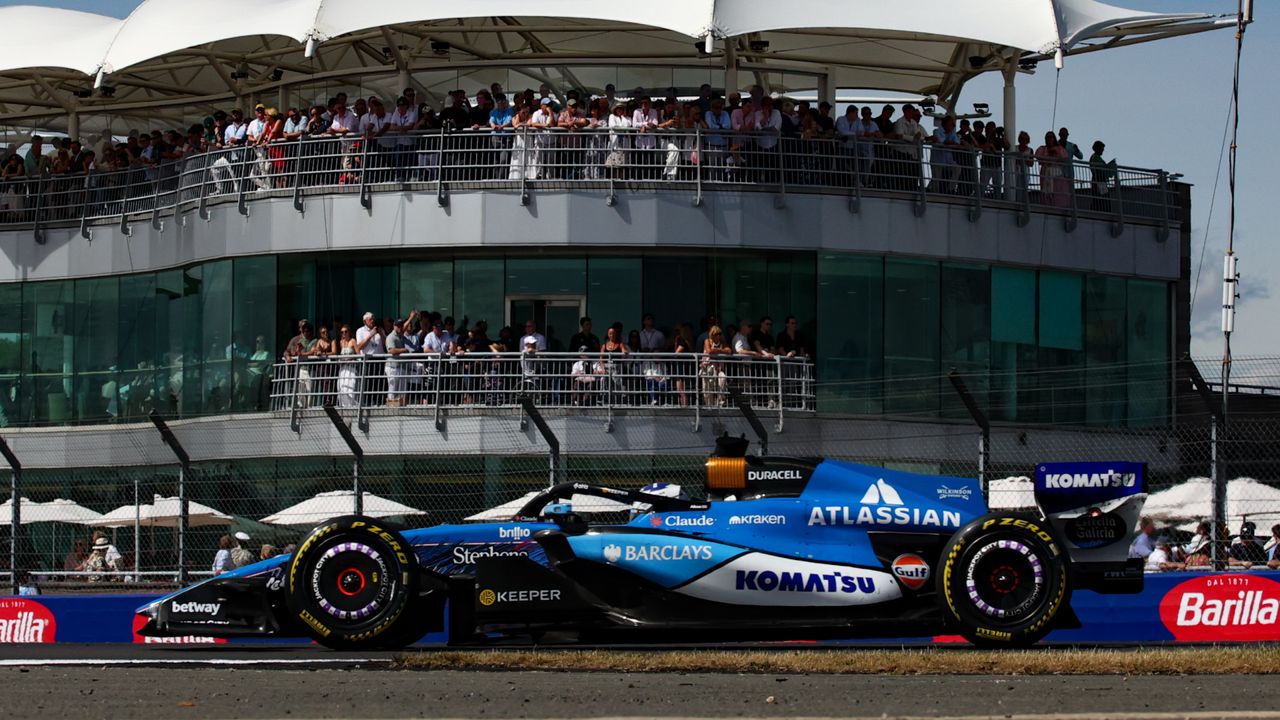
‘In Formula 1, the success goes to the teams that have the best teamwork and the best technology’
Formula 1 has always been a sport where fine margins can make all the difference, with success and failure sometimes coming down to hundredths of a second.
It’s no surprise then that many of the teams have looked to AI for assistance in getting that extra edge, whether it’s through designing new parts, determining race strategy, or simply getting staff to better communicate with each other.
AI giant Atlassian has been working with the Williams F1 team since 2025, signing a title partnership to show its commitment, and at the recent British Grand Prix 2026, I got to speak to the company to find out just how its tools and services are being used.
The best teamwork and the best technology
“We came across the Williams F1 team, and we quickly identified that there was quite a good opportunity for both organizations,” Andrew Boyagi, Atlassian Customer CTO, tells me at Silverstone.
“It’s not a sponsorship, it’s more of a partnership because we can help each other…we had a similar view that in Formula 1, the success goes to the teams that have the best teamwork and the best technology.”
Atlassian’s first season with Williams F1 saw the team achieve a huge jump up the rankings, rising from ninth place overall in 2024 to fifth in 2025, netting it millions of dollars more in prize money.
And although the 2026 season hasn’t been quite as successful so far, Boyagi is keen to highlight how working closely with the team has led to huge improvements in productivity and collaboration.
Sign up to the TechRadar Pro newsletter to get all the top news, opinion, features and guidance your business needs to succeed!
This has primarily been through Atlassian’s AI tools, which have become common sights in businesses and organizations across the globe. AI usage in the team was also fairly low before the Atlassian partnership, but Boyagi points that after using Rovo, 63% of the team now say, “they have more time to work on strategic, innovative stuff, which means they’re delegating a lot of their work, the repeatable low-value stuff, to AI.”
This includes a new Fault Management tool, which monitors for conflict and repetition when mechanics at the track or the factory report issues. Boyagi notes that it can be so busy at the track, the same fault might be logged multiple times, which can lead to wasted time and effort at the factory, which is particularly painful in a cost-cap limited sport like Formula 1 where every second counts.
Another example is in garage setup - Formula 1 is a global sport, with teams travelling to 24 locations across the world, arriving at an empty garage which needs to be quickly transformed into a cutting-edge hub.
Previously, the team used manual checklists, often with pen and notepads, to track what was being done, leaving the door open to error, but Atlassian redesigned the workflow with Jira and Rovo natively built in, so tasks auto-populate in Jira boards by category and assigned employee, meaning everyone can see who is working on what, and work moves across as it is completed, so hopefully nothing is ever missed.
I ask Boyagi what success will look like in terms of the partnership, especially as Williams F1 has struggled in the initial races so far in 2026.
“Success in Formula 1 is about good technology and good teamwork, but it is always a sport where luck comes into it as well,” he notes, “but what we like to see is an improvement in how things are collaborating, and how effective they are in terms of doing their work.”
Boyagi points out that Atlassian took baseline data between October 2025 and March 2026, finding that 92% of the team now say they’re working for the right organization priorities, “so they’re working on the right things.”
Knowledge transfer has also improved, with trust in documentation going up by 200% in those five months, as Boyagi notes, so “in terms of knowledge, in every company, but especially Formula 1, it is a foundation of productivity - being able to find what you need, when you need it, and trusting what you find without asking someone.”
“Teams are now working on the right things, they’re getting that work done faster, they’re having less meetings and they’re delegating the low value, repetitive tasks to AI,” he adds, “and it doesn’t always translate to what happens on track, but I’m 100% confident we are already making a difference.”
The difference isn’t just for the mechanics or workers back at base - Boyagi says that the team’s drivers are also embracing it. He mentions one example where Alex Albon was having a debate with his engineers around different car set ups - to which Boyagi said, why don’t you ask Rovo?
“As it turned out, Rovo agreed with him, not the engineers - that was a nice moment for us,” Boyagi says, adding that what is important is why Rovo can give a solid answer because the platform is underpinned by Atlassian’s Teamwork Graph, which connects various parts of the business and its processes.
“All of these things are connected, so when you ask a question, it connects dots that humans can’t connect, where it would take us too long,” he says.
Getting over the line
As for Williams 1, the team clearly values the partnership, with Matt Harman, Technical Director for Engineering, championing the time and efficiency savings seen by using Atlassian's systems.
"We need to build systems, tools and techniques across the whole team that allow us to be collaborative," he said on a briefing call attended by TechRadar Pro, "we need to give people more insight, more ideas, so that people can not spend as much time on what I call 'business as usual'".
Harman also highlighted the benefits of the Atlassian service causing "less meetings, more insights", as the partnership looks to provide engineers with the insights and the support to do more.
"When we do that, the Atlassian tools just give people that instant access...without having to sit in a meeting."
Boyagi also points out that the partnership between Atlassian and Williams F1 has multiple sides, noting the team is a customer, “so the fact that they’re using all of our products, and they’re choosing to do that, using precious cost cap dollars, really talks about the value they’re getting from the partnership.”
“I’ve led many transformations, and the hardest thing is getting people over the line - implementing technology is easy, but getting humans to change how they work and want to use the technology is a bit of an art," he says.
"But in Williams, there’s such a strong demand, and a pool, that we have to prioritize what we’re going to do, because they want the team to benefit."
Mike Moore is Deputy Editor at TechRadar Pro. He has worked as a B2B and B2C tech journalist for over a decade, including at one of the UK's leading national newspapers and fellow Future title ITProPortal. When he's not keeping track of all the latest enterprise and workplace trends, he can most likely be found watching, following or taking part in some kind of sport.
View original source — TechRadar ↗
Related stories

Can NATO survive Trump's changes of heart?

Nigeria: Reps in Rowdy Session Over Bid to Summon Tinubu to Explain Poor Budget Implementation

Police Raids on Ukrainian Drone Maker Fuel Fears About Press Freedom