The Next Web
ElevenLabs’ CEO on hitting ~$600m revenue and outrunning the AI labs
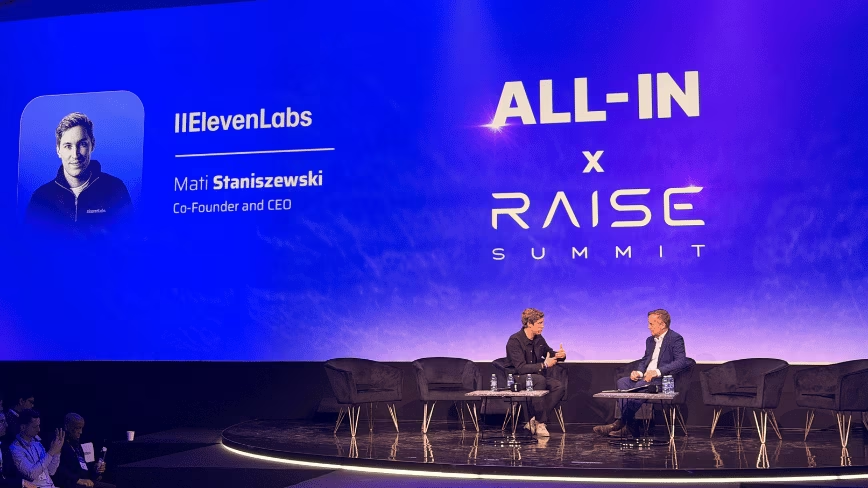
The ALL-IN Podcast took its live show to the Louvre this week for the RAISE Summit. It put ElevenLabs co-founder and chief executive Mati Staniszewski in the hot seat. Host Jason Calacanis opened where it stings: revenue, competition, and whether a voice startup can outlast OpenAI and Anthropic. “It’s the best time to be building,” Staniszewski said.
A revenue ramp few can match
The numbers set the tone. Staniszewski said the company shipped its first genuinely human-sounding text-to-speech model in early 2023. It then took roughly 20 months to reach $100m in annual recurring revenue.
The next jumps came faster. He put it at about 10 months to $200m, then five months to $300m by the close of last year. Calacanis pegged the current run rate near $600m, and Staniszewski did not dispute it. That climb tracks the startup’s soaring paper value, recently in talks at a $22bn valuation.
No product managers, engineers everywhere
Growth has not softened the structure. Staniszewski said ElevenLabs runs on small teams of five to 10 people, and it has never employed product managers. Instead, it embeds engineers in nearly every function, including legal, talent and go-to-market.
Those engineers carry two jobs. They build internal automations, and they help colleagues adopt AI safely, with a security check on whatever ships. Give a marketer or a lawyer the right tools, the pitch goes, and they jump from amateur to advanced in skills that once belonged to someone else.
People tell the machine the truth
Staniszewski argued that voice has quietly turned a corner. Enterprises and sales teams drove much of the recent growth, he said, as real-time, interruptible voice agents finally felt reliable enough to trust.
One detail stood out. The company works with financial firms like Revolut and Klarna on payment reminders. There, it found people are often more honest with an AI than with a human. The shame drops away, so callers share their real situation. They also talk to the machine differently, snappier and quicker to cut it off.
The cloning tightrope
Voice is identity, which makes misuse the constant risk. Calacanis described finding his own cloned voice running a joke podcast built from his show’s archive. Staniszewski said ElevenLabs now moderates everything it generates. It checks samples at the voice and text level, and blocks commercial or scam misuse. It also built a classifier that flags AI-generated audio, for its own models and open-source ones.
The same technology opens doors. A creator marketplace lets voice actors licence their voice and earn from it, and Staniszewski said the company has paid out more than $22m to that community.
ElevenLabs has also licensed multilingual versions of Matthew McConaughey’s voice. It powered an interactive Darth Vader in Fortnite through Disney. And it has helped people who lost their voice to illness speak again. One was a US congresswoman; another, a bride who redid her vows.
The frontier-lab problem
Then Calacanis went at the real threat. ElevenLabs pays to use models from OpenAI, Anthropic and Google, yet those same labs increasingly want its market. Staniszewski leaned on being model-agnostic: customers pick any model and build their voice agents without locking to one vendor.
His moat, he argued, sits in the voice layer itself. The research bet favours architecture over raw scale. More than 1,000 contractors label its audio data. Industry-specific products and an ecosystem of voices and integrations round out the defence. He acknowledged that some players keep trying to distil ElevenLabs’ data, and said the company has ways to slow that down. It is also exploring its own models as insurance.
The subtext was hard to miss. ElevenLabs ships tens of millions of dollars a year to the very labs racing to replace it. For now, its bet is clear. This is one of Europe’s most valuable AI startups, part-owned by Poland and led by a Polish founder. It thinks owning the conversation beats owning the model.
View original source — The Next Web ↗
Related stories

TechCrunch
TechnologyJul 8, 2026 · 1 min
‘Slow-cial’ app Roost forces you to slow down to the speed of a carrier pigeon
TechCrunch

TechCrunch
TechnologyJul 8, 2026 · 1 min
This startup thinks robotics is about to have its ChatGPT moment
TechCrunch

Times of Israel
TechnologyJul 8, 2026 · 1 min
Arkia employees vow to fight potential Haredi buyout that would halt Shabbat flights
Times of Israel

Philippine Daily Inquirer
TechnologyJul 8, 2026 · 1 min
Marcos backs Amazon’s $5-billion Digital Infrastructure Investment in PH
Philippine Daily Inquirer