The Guardian
Marine Le Pen ‘wants to talk politics’, but can she drown out the legal noise?
Marine Le Pen’s decision to run for French president in 2027, despite her legal woes, has drawn comparisons from her opponents to Donald Trump.
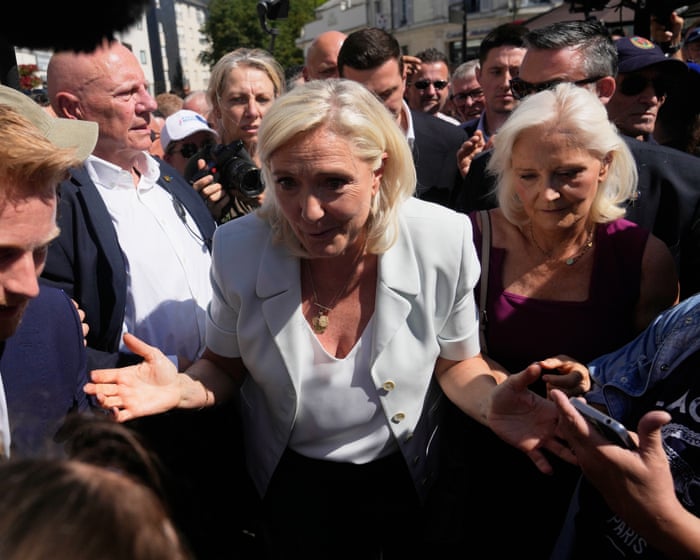
Just as the US president felt his voter base cared little about legal investigations against him, the French far-right leader shrugged off the leftwing protesters who shouted “criminal!” as she launched her presidential campaign at a market walkabout in western France on Wednesday. The previous day, an appeal court had upheld her conviction for the embezzlement of European parliament funds.
The centrist Gabriel Attal said Le Pen was taking the presidential campaign hostage. “This seems like the same reflexes, the same rhetoric as Donald Trump,” he said. “Here we have a politician convicted twice [at her first trial in 2025 and on appeal this week] for embezzling public funds and who is now engaging in a kind of judicial guerilla warfare in order to stand.”
Le Pen, the 57-year-old figurehead of the far-right, anti-immigration National Rally party (RN), said she would run for president because the election was all that mattered. “The French people will decide,” she said.
On Tuesday Le Pen had been found guilty by appeal judges of playing a central role in orchestrating a fake jobs scam of unprecedented size and duration.
But the appeal judges also shortened Le Pen’s original ban on running for office, allowing her a window to make a fourth bid for the presidency. With her party polling high, she feels she has fair chance after she was twice beaten in the final round by Emmanuel Macron in 2017 and 2022.
The real difficulty for Le Pen is that the appeal court also handed her a form of custodial sentence of one year wearing an electronic tag that would monitor and limit her movements to and from her home. This would clearly have hampered her ability to campaign, preventing late-night rallies or limiting her ability to travel outside France.
Le Pen’s response was to lodge an appeal to the highest court, questioning a point of legal process. This move effectively puts her sentence on hold, ensuring no tag is fitted before the next court decision in several months.
But it leaves a cloud of uncertainty over the two-round vote in April and May. The question remains whether Le Pen might lose her appeal and end up with an electronic tag in the final stages of the campaign.
For decades Le Pen’s far-right, anti-immigration party has been seen by its critics as a danger to democracy that promoted racist, antisemitic and anti-Muslim views. Now her opponents said the embezzlement case would add another level of criticism and pollute the campaign.
Le Pen, who has for 15 years tried to detoxify party’s image while maintaining its hard line on immigration, feels her base will stand by her. Snap polls found a majority of her party’s core voters approved her running.
But she would need to reach far beyond her voter-base to have a chance in the presidential final-round run-off. She needs the bourgeois, higher-income voters of the traditional right that have been won over by her market-friendly 30-year-old protegé and party president, Jordan Bardella. This might now be harder. Bardella had been expected to replace Le Pen if she could not run, but he will now campaign with her as her potential future prime minister.
When Le Pen was convicted and banned for running for office after her first trial 2025, Trump backed her, calling it a “witch-hunt” by “European leftists”. Le Pen had said that a “tyranny of judges” wanted to stop her running in a presidential race that she could otherwise win.
Le Pen’s phoenix-like return as candidate this week was portrayed by her party as proof of her strength at battling against the odds. But she could now struggle to set her own election agenda.
Her market walkabout on Wednesday was punctuated by a barrage of reporters’ questions about the embezzlement case. “I’m not going to spend the campaign on legal analysis, I want to talk politics,” she said. But it remains to be seen whether her hardline policies can drown out the constant commentary about the case.
View original source — The Guardian ↗
Related stories

The Punch
PoliticsJul 8, 2026 · 1 min
Reps move to expand SSDC funding
The Punch

The Hill
PoliticsJul 8, 2026 · 1 min
‘We do not believe them’: Family, advocates want answers after fatal ICE shooting
The Hill

The New York Times
PoliticsJul 8, 2026 · 1 min
Iran Truce ‘Over,’ Trump Says, as He Threatens More Strikes
The New York Times

The Guardian
PoliticsJul 8, 2026 · 1 min
Police investigate £37,500 donation to Jenrick leadership campaign
The Guardian