The Next Web
Meta’s AI campus flushed a rare bacterium into Cheyenne’s water. The city hit back
A Meta contractor flushed a rare, potentially deadly bacterium into Cheyenne’s wastewater system. The Wyoming city has now suspended all data centre discharge, a fresh flashpoint in the fight over AI’s thirst for water.
Officials in Cheyenne, Wyoming, have stopped accepting industrial wastewater from data centres. The trigger was a contractor building Meta’s new AI campus, which flushed a rare bacterium into the city’s water system, the Guardian reported.
The Cheyenne Board of Public Utilities named Goat Systems, a Meta contractor, as the source. The company discharged water carrying Cupriavidus gilardii, a rare and multidrug-resistant pathogen. It reached the city’s reuse system, which cleans water for irrigating parks and golf courses. It did not enter the drinking supply.
A rare bug in the pipes
Lab staff first spotted the bacterium in February during routine testing. Tracing it took months. “This isn’t something we normally test for,” Frank Strong of the utilities board told the Wyoming Tribune Eagle, which first reported the incident. “We actually had to go through quite a process to figure out what it was.”
Cupriavidus gilardii rarely infects people. When it does, it can be dangerous. One review put its mortality rate at 31 per cent across 32 known cases since 2009. The board revoked Goat Systems’ discharge privileges in March. This month it went further and suspended all data centre fill-and-flush and closed-loop discharge until it works out how to prevent a repeat.
Fill-and-flush is a one-time step. Crews flood a data centre’s cooling pipes with water to clear debris before the site powers up. Meta says the finished campus will use a closed-loop system that recycles the same liquid.
Meta points to its contractor
Meta says it is working with its general contractor, Fortis, to resolve the issue. “When the board shared that it found a substance in the city’s wastewater, not public drinking water, Fortis immediately stopped discharging industrial wastewater and began hauling it offsite,” a spokesperson told Business Insider. Fortis ran its own tests and says it found no trace of the substance.
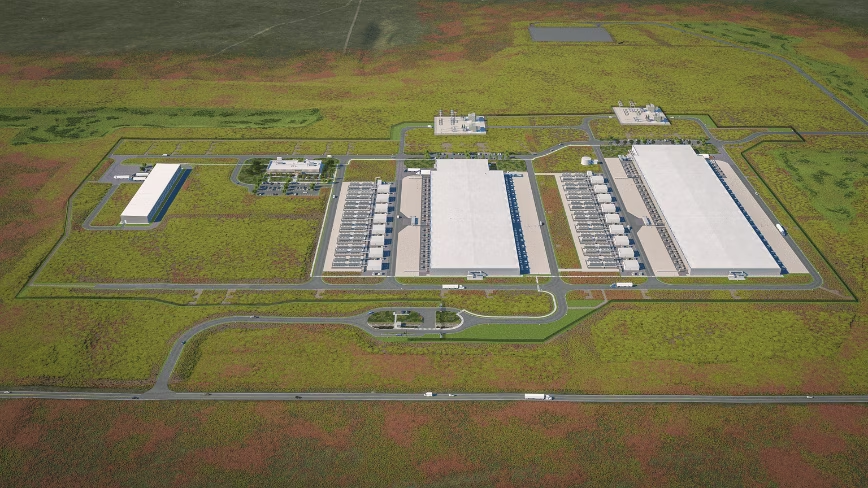
The $800m campus, known during planning as Project Cosmo, spans nearly 800,000 square feet south of the city. Meta announced it in 2024 and says it aims to be “water-positive” by 2030, restoring more water than it consumes.
Why it matters
The clean-up was heavy. The board drained and disinfected the entire reuse system, and switched affected irrigation to drinking water in the meantime. “It’s a very, very unpleasant surprise,” city councilman Pete Laybourn said.
Cheyenne’s freeze is small, but it fits a bigger pattern. Residents elsewhere fight new sites over rising power bills and noise. People are packing planning meetings to block them, and pressing lawmakers to make big tech carry the cost. Some places have reached for a moratorium. Senators Bernie Sanders and Alexandria Ocasio-Cortez have floated a federal one for AI data centres.
By the end of 2025, more than 1,400 sat built or approved across 45 states. One rare bug in Wyoming shows how fast local goodwill can drain.
View original source — The Next Web ↗
Related stories

Wired
TechnologyJul 8, 2026 · 1 min
I Built a Self-Improving AI, and So Can You
Wired

TechCrunch
TechnologyJul 8, 2026 · 1 min
Autonomous drone delivery startup Manna plots major U.S. expansion
TechCrunch

Engadget
TechnologyJul 8, 2026 · 1 min
FTC reaches settlement that brings right-to-repair to John Deere farm equipment
Engadget

The Verge
TechnologyJul 8, 2026 · 1 min
Get a $30 credit when you reserve Samsung’s upcoming Galaxy phones
The Verge