Engadget
Valve Steam Machine review: This would've been perfect five years ago
The Steam Machine isn't worth the price that Valve is asking.
Engadget
RATING : 6.5 / 10
When I appeared on the Engadget Podcast last week, I casually compared the Steam Machine to the Steam Deck, essentially calling my review unit a beefed-up version of Valve's handheld. Now that I've spent a few more days with the box in my living room, and Valve has rolled out additional updates, I'm willing to admit that was a too-harsh comparison. In truth and totality, I'd compare the $1,049 Steam Machine to an entry-level ninth generation console, or perhaps a decent gaming PC back in 2021.
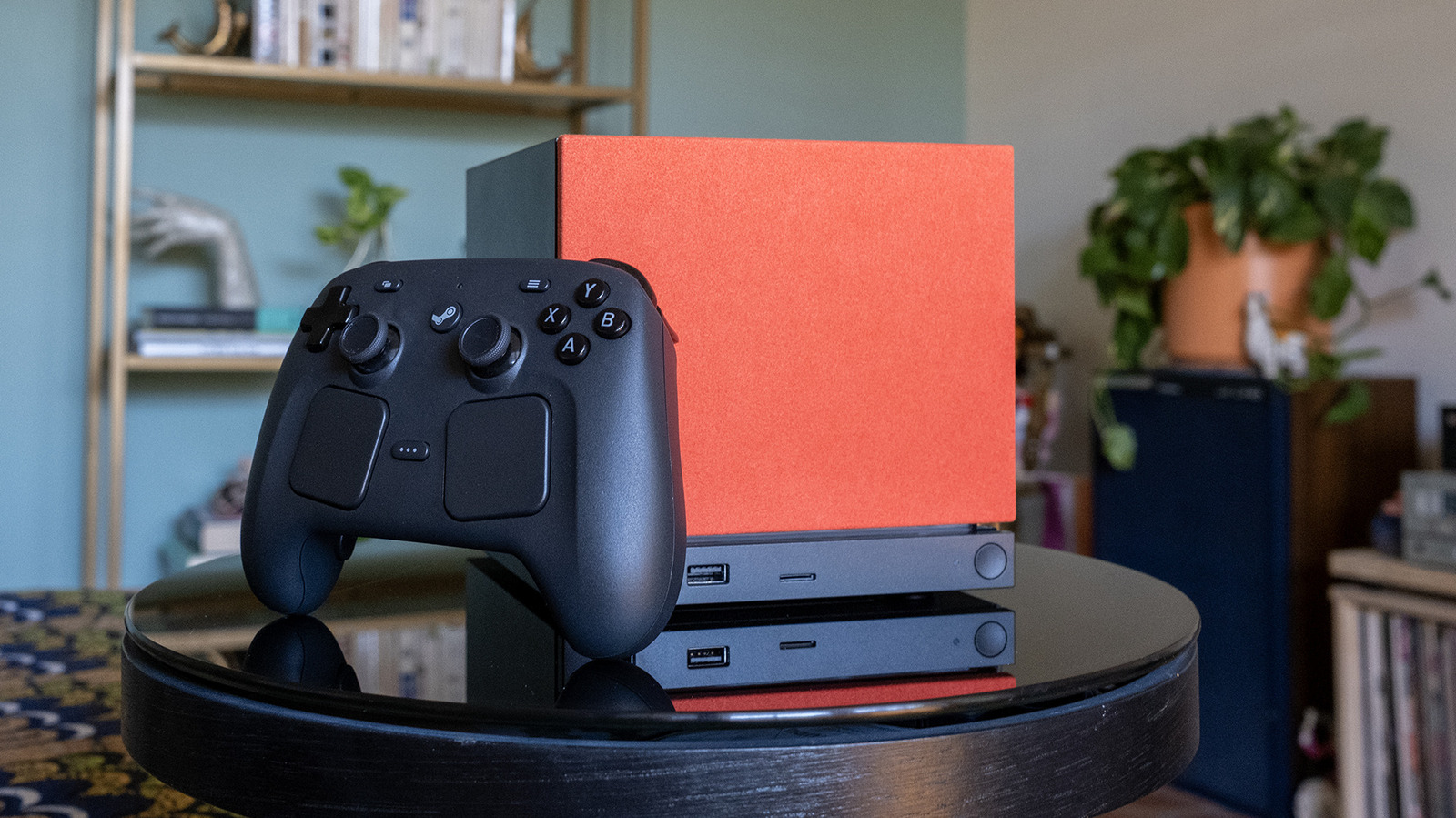
As a contemporary living room console, the Steam Machine is fine. It's not quite good and it's not particularly impressive, but it will be able to run most games at reasonable framerates and resolutions. The Steam Machine is powered by semi-custom AMD hardware, much like the PS5 and Xbox Series consoles or, of course, the Steam Deck. It has a Zen 4 CPU with six cores, an RDNA3 GPU with 28 CUs, 16GB of RAM and 8GB of VRAM. It runs SteamOS, though you're free to install Windows if a game you want to play requires it. Though its hardware setup is different from Sony's console, its raw ability to push pixels falls just short of a PS5's.
Benchmarking games
Engadget
Hopefully that provides a framework for the types of games the Steam Machine can handle. Specifically, I played Mixtape in full without issue, and the Steam Machine and Steam Controller handled all of its oddball interactions beautifully. The Machine also seamlessly runs titles like Forbidden Solitaire and Balatro, though Balatro's HDR settings required some tweaking in my playthroughs. If you have a Steam library of indie titles and less-demanding experiences, the Machine should serve you well — but then again, so would a Steam Deck, or an old PC, or a laptop, or a phone with Steam Link.
If you're looking to play Black Myth: Wukong, avert your gaze. Benchmarking Black Myth, the Steam Machine struggled with native 1080p high, averaging 43 fps, and only managed to hold 60 fps when upscaling from far lower resolutions. That's playable, of course, but it doesn't perform as well as the current-gen consoles, and ray-tracing features weren't feasible at all. Besides that, the Steam Controller added a layer of clunkiness, as the software automatically used the gamepad's gyro as a mouse but mis-mapped the click. It's easy to switch profiles and customize inputs for each game, but needing to do that to get past a game's terms and conditions screen is not a great experience. The Steam Machine also supports keyboard and mouse controls, of course, but since I'm using it as a living room device, I'm solely interested in the gamepad configuration.
As a console running Black Myth, the Steam Machine was crappy. As a $1,000+ PC, it was just disappointing. Putting the Machine through its paces did reveal one positive feature: It's whisper-quiet, no matter how hard you push it. In the Phoenix summer my house has a high noise floor, and it was impossible to hear the Steam Machine's fans over the HVAC without holding my ear directly to it.
Cyberpunk 2077 fared a little better than Black Myth, running shy of 60 fps in 1080p ultra, which could be cleaned up to a 60 fps lock with some settings tweaks or upscaling. Adding in "low" ray tracing immediately tanked the framerate, and with FSR in performance mode it could just about lock to 30 fps. If you want to play Cyberpunk 2077 for the sixth time, you'll be better served with a PS5, Xbox Series X or S, Switch 2 or whatever PC you've already played it on — because obviously you already own a piece of hardware that can run these types of games, so why the hell do you need to drop more than $1,000 on a Steam Machine right now in the first place?
Expensive and underpowered
Engadget
Perhaps it's obvious, but I'm still psychically searching for Valve's intended market with the Steam Machine. Yes, even after 12 long years of contemplation. To be clear, I have fond memories of using a PC as a TV and gaming hub in my shared living room during college, and I've been completely sold on the basic concept of a console-like PC that plugs into a TV. It's the timing that's making my head spin today. Fanboys and Richie Rich aside, it's difficult to make a case for most people to invest in this box, at this price point, with the harsh economic and social realities of 2026.
It's clear why Valve wants the Steam Machine on the market: It's a new entry point for Steam fanatics and console players to build out their Valve-dependent libraries, expanding Valve's monopolistic influence beyond solely the PC space. The timing is simply atrocious. In the middle of a storage and memory crisis driven by unchecked corporate investments in AI infrastructure, at a time when hardware prices are skyrocketing and financial security is more tenuous than ever for a majority of people, Valve said, release the Steam Machine. It's impossible to make a great computer for $1,049 right now, so of course Valve is unable to produce a great Steam Machine for $1,049. I've been testing the 2TB model, priced at an even more outrageous $1,349. Neither of those prices include a Steam Controller, which adds $79 when bundled and $99 when purchased separately.
The Steam Machine simply isn't worth the price that Valve is asking. This is especially true with a fresh generation of consoles on the horizon, and the promise of falling RAM prices (at some point) in the future. The market right now won't be the market forever, and it's worth asking yourself whether you'll regret spending more than $1,000 on a living room PC once prices finally drop. The Steam Machine is underpowered compared with modern consoles like the PS5 Pro or even the Xbox Series X; it has just 8GB of VRAM, plus a GPU/CPU combo similar to an RTX 3060 and Ryzen 3600, which you could find in many sub-$1,000 PCs in 2021. It can't really handle any ray tracing, which is, whether you like it or not, becoming a required feature in some PC games.
At launch, the Steam Machine can handle anything you throw at it, so long as you're willing to tweak some settings and upscale from low resolutions. It is years behind the competition, though, and since it's a locked system that can't be upgraded like a PC, it doesn't feel like it will be able to run demanding games in only a couple of years.
That said, it's nice to be able to access my Steam library from my couch, at the push of a button, and the Steam Controller is still an excellent gamepad with a satisfying click to its connector puck. The Steam Machine has also improved in my short time with it. When I first booted it up and connected the box to Wi-Fi, I couldn't reach download speeds past 180Mbps. A post-launch update improved these speeds massively, and I can now hit a steady 1Gbps over Wi-Fi, which is fantastic for a console-like piece of hardware. An update to Proton that will bring AMD's superior FSR 4 upscaling tech is also imminent (it's currently in the "experimental" phase). Valve is only going to push out more updates to improve the Steam Machine on the software side of things, and the OS itself is easy-to-use, familiar to anyone who's messed around with Steam Link or Big Picture mode. An update can't magically give it a stronger GPU, CPU or VRAM pool to play with, though.
But I already have a Steam Deck
Engadget
I've been dreaming of a tiny living room PC for over a decade, but I encountered an unexpected existential barrier with the Steam Machine. I am fortunate enough to have modern consoles and a good gaming PC (that's far more powerful than the Steam Machine and cost less to upgrade just last year, I might add), and I'm able to purchase different types of games specifically for my various setups. I collect games that I want to play at my desk on Steam, and I buy games that I want to play on a big screen on consoles. Handhelds like the Steam Deck and PlayStation Portal have expanded the boundaries of PC and console gaming, respectively, but I still think about how I want to play my games before I decide where to purchase them, and my Steam library is full of desk-first experiences. I simply don't want to play these games on my couch — and the ones that I do, I already bring along on my Steam Deck.
The Steam Machine doesn't naturally fill any gap in my video game lifestyle, and on top of that, it costs a shocking amount of money. In order to properly enjoy it, I'll have to adjust how I think about playing games, and in its current state, I'm unconvinced that the Steam Machine is attractive, powerful or useful enough to force this mental shift.
In a hypothetical future where the price of a Steam Machine falls to something more reasonable, like $600, it would still be a tough sell due to its built-in hardware limitations. Whether a gen-two Valve console nails it, or another company takes advantage of SteamOS and builds a box with the right balance of specs and price, the Steam Machine remains a good idea. At the moment, however, it requires better execution.
View original source — Engadget ↗
Related stories

Wired
TechnologyJul 8, 2026 · 1 min
I Built a Self-Improving AI, and So Can You
Wired

TechCrunch
TechnologyJul 8, 2026 · 1 min
Autonomous drone delivery startup Manna plots major U.S. expansion
TechCrunch

Engadget
TechnologyJul 8, 2026 · 1 min
FTC reaches settlement that brings right-to-repair to John Deere farm equipment
Engadget

The Verge
TechnologyJul 8, 2026 · 1 min
Get a $30 credit when you reserve Samsung’s upcoming Galaxy phones
The Verge