The Next Web
A tritium ‘nuclear battery’ just reached orbit for the first time
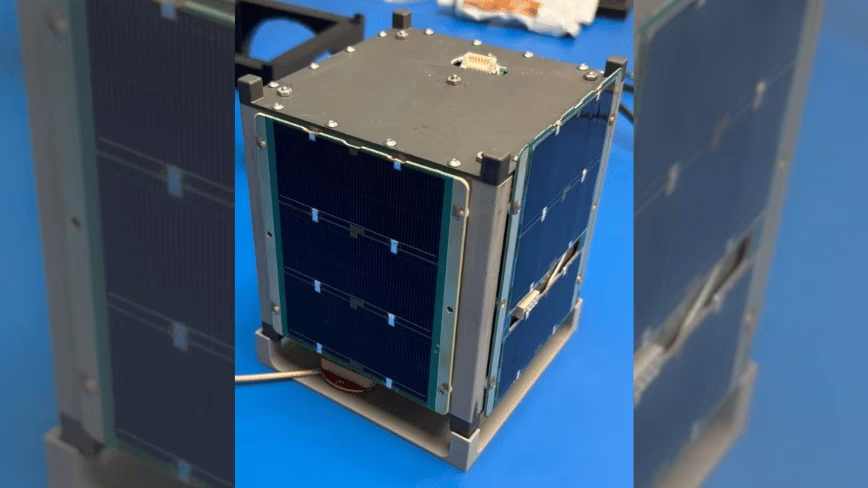
The nuclear age has quietly reached commercial spaceflight. City Labs, a Miami firm, has launched BOHR, which it calls the world’s first commercial nuclear-powered satellite and the first nuclear CubeSat. The craft is about the size of a softball. It flew on a SpaceX Falcon 9 rideshare on 7 July, alongside 80 other payloads, the company announced.
The claim needs a caveat. No reactor powers BOHR. Its satellite bus still runs on ordinary solar panels. The nuclear part, a small “betavoltaic” battery, powers only a payload. The mission aims to prove that battery works in orbit.
How a nuclear battery works
The battery draws on tritium, a radioactive form of hydrogen. As the tritium decays, it gives off beta particles. Those particles strike a semiconductor and knock loose a trickle of electric current. City Labs calls the technology NanoTritium.
The output stays minute, from nanowatts to microwatts, far below what a phone draws, as Ars Technica notes. In return, it lasts. A betavoltaic cell can run for decades, needs no sunlight, and keeps going in deep cold and dark. That flips the solar trade. Solar delivers plenty of power, then dies in shadow.
Why it matters
The timing tracks a bigger push into commercial space. As NASA’s Artemis programme aims to return people to the Moon, engineers need power that survives long lunar nights and permanently shadowed craters, where solar cannot help. Long-life sensors in deep space face the same problem.
Until now, only governments like NASA and the US military have flown nuclear power in space. City Labs pitches BOHR as the first commercial answer.
“This is a historic step for commercial nuclear power in space,” said chief executive Peter Cabauy. He said the mission shows “safe, compact, and regulatory-approved nuclear power systems are ready for routine commercial deployment”, free of the limits of sunlight or battery life.
Cleared by the regulators
The regulatory path may matter as much as the hardware. BOHR became the first commercial nuclear mission to use the US Federal Aviation Administration’s approval pathway for launching nuclear material, set out under a 2020 national security memorandum. The FAA signed off in September 2025, after Sandia National Laboratories reviewed the safety case.
City Labs stresses that tritium sits at the low end of the radiation scale and handles safely. The firm joins several others chasing safer nuclear designs for a new set of uses. The US Department of War funds much of the BOHR work, alongside NASA and Air Force research arms, and the firm recently won a $1.5m DARPA contract for the next generation of the technology.
BOHR serves as a pathfinder, the company said, for both civil and defence missions to come.
View original source — The Next Web ↗
Related stories

TechRadar
TechnologyJul 8, 2026 · 1 min
Of course Samantha Morton will be the best part of The Odyssey
TechRadar

South China Morning Post
TechnologyJul 8, 2026 · 1 min
Anthropic hits back after China warns of Claude Code ‘backdoor’ risks
South China Morning Post

TechCrunch
TechnologyJul 8, 2026 · 1 min
Google’s deepfake detector system used to debunk McConnell hoax pic
TechCrunch

BBC
TechnologyJul 8, 2026 · 1 min
UK heatwave spreads further north and west as temperatures continue to climb
BBC