CNA
Pasir Ris lightning death prompts safety review among outdoor sports operators
SINGAPORE: At least three outdoor sports operators are reviewing their safety procedures after a man was killed by lightning while paddleboarding last Sunday (Jul 5), even though existing protocols already require activities to stop at the first sign of dangerous weather.
Operators told CNA that while Category 1 lightning warnings are clear "no-go" signals, instructors also rely heavily on what they see and hear on the ground, since conditions at sea can shift faster than official alerts.
Fish On, which rents kayaks and runs guided kayak tours, said it is in talks with another kayak fishing operator on how to improve its protocols.
Founder Mohammad Nordin said the company relies on both the National Environment Agency's (NEA) lightning alerts and its own observations to gauge how close lightning is.
"Once we see the flash of lightning, we start counting to see when the thunder reaches us, and that's how we know how far it is," he said.
"Ideally, when lightning is 6km away, we need to start heading to the nearest shelter. If it's 3km away, we should be close to a shelter and if it's 1km, we should all be under the shelter. But in reality, at 6km, the lightning is usually quite faint, so we might not see it."
On-site lightning warning systems, which use both lights and sirens to alert people at sea, may also be less effective for those farther offshore, he said.
"We can hear the alarm if we're nearby but if we're more than 300m from shore, you can't really hear it. Even though they have lights, you can't see them from the sea because there are so many trees blocking it."
Mr Nordin plans routes that let participants reach shelter within 30 minutes if weather deteriorates, and issues every customer a walkie-talkie to stay in contact while on the water.
Sunday’s incident appears to be a one-off situation, he said. "In my many years of kayak fishing, I have never come across this, so it was really a surprise.
“I don’t know if there’s much we can improve on but I want to talk to other operators to see if there’s anything we can do,” he said.
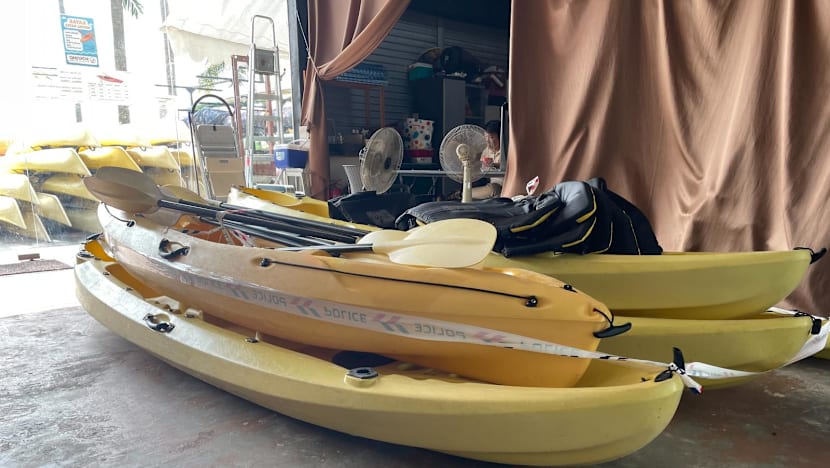
Mr Mikhail Benyamin, a freelance sea sports instructor who worked with Outdoor Adventures, died in the lightning strike off Pasir Ris Beach last Sunday. He had borrowed paddleboards and kayaks from Kokomo Beach Club, a brand under Outdoor Adventures, for an outing with family and friends.
It comes less than two months after a worker at a Lim Chu Kang fish farm died after being struck by lightning, adding to questions about how outdoor activities should respond to fast-changing weather.
REVIEWING SAFETY MEASURES
The day after Mr Mikhail's death, Outdoor Adventures chief operating officer Berwin Tan said the company would step up instructor training, particularly on weather awareness and navigating changing conditions at sea.
Another company that organises guided kayaking, cycling and nature experiences said it reviewed its safety measures almost immediately after learning about the incident.
Adventures by Asian Detours said its review covered instructor training, emergency protocols, evacuation procedures and participant briefings, including ensuring participants know their route, nearest landing points and who to contact in an emergency.
Operations staff and instructors independently monitor conditions before participants head out, with instructors reporting back before activities begin. If conditions deteriorate, activities are postponed or cancelled, the company's head of operations Samuel Tan said.
“We did revisit our protocols to ensure that something like that doesn't happen, but because it happened in a very clear sky, that is something that we cannot predict. That would become a case where even if the sky is clear, we can’t go out and paddle, which is not possible,” he said.
“So as much as we can, we control with the amount of data we gather … and rely on what we see and feel to decide whether to go on with the programme.”
Participants are briefed before every trip on designated evacuation points along the coastline, so they know where to land quickly if the weather turns, he added.
The incident has not led to a noticeable rise in cancellations, but has heightened awareness within the industry, Mr Tan said.
"It's really a reminder to revisit your protocols. Are you doing everything correctly? Does everybody know what they are supposed to do?"
WEATHER TRIGGER POINTS
The Singapore Canoe Federation, the national sports association for paddle sports, said its code of practice requires paddling activities to stop, or not start, when authorities issue Category 1 weather or lightning warnings.
Activities must also stop whenever coaches or safety officers assess conditions to be unsafe because of strong winds, rough waters, rapidly changing weather or poor visibility. During sudden hazardous weather, paddlers are expected to return to the nearest safe landing point and seek shelter without delay.
The Outdoor Learning and Adventure Education Association said activity providers should establish clear "weather trigger points" before programmes begin, continuously monitor forecasts and actual conditions, and be prepared to modify, suspend or evacuate activities if conditions become unsafe.
On-site observations and professional judgment should take precedence when actual conditions appear riskier than forecast, it added.
Providers should also conduct risk assessments covering lightning alerts, weather forecasts, wind, tides, water conditions and environmental hazards, while reviewing programmes and learning from incidents and near misses, the association said.
Singapore Sailing Federation chief executive Leslie Tan said coaches are instructed to return immediately once lightning enters their training area.
“Once it's clear that lightning is within our training area, then we start calling people in. We ... get on the radio and tell the coaches, come on in, it's a lightning warning. We also have a public address system, and we blast it out to tell everybody, come back, stay out of the open,” he said.
CLEAR SKIES DON’T ALWAYS MEAN IT’S SAFE
Associate Professor Wang Xian Feng from NTU's Centre for Climate Change and Environmental Health said Singapore experiences around 170 lightning days a year, making it one of the world's more lightning-prone regions.
Lightning can travel up to 10km, he said, meaning dangerous strikes are possible even when skies overhead appear clear.
"Even clear skies overhead do not always mean it's safe," he said, adding that a simple rule is that if thunder can be heard, lightning is close enough to pose a danger.
People at sea are especially vulnerable because they are more exposed and have few places to seek shelter, while seawater readily conducts electricity, he added.
If caught outdoors during a thunderstorm, the safest option is to get inside a building or a fully enclosed vehicle. If neither is available, people should avoid tall trees and, as a last resort, crouch with feet together and head down rather than lie flat on the ground, he said.
Additional reporting by Aldrina Thirunagaran
Related stories

Straits Times
WorldJul 8, 2026 · 1 min
Two more Guatemalan men plead guilty in smuggling deaths of 55 migrants in Texas
Straits Times

BBC
WorldJul 8, 2026 · 1 min
No crude proposals on disability benefits, minister leading review says
BBC

Stuff
WorldJul 8, 2026 · 1 min
One player pockets $1m Lotto prize as Powerball rolls to $25m
Stuff
RNZ
WorldJul 8, 2026 · 1 min
Westpac lifts floating rates: The OCR lifted from 2
RNZ