BBC
Andy Burnham's path to becoming prime minister
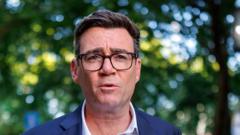
This is the most likely scenario - so far, no other candidate has emerged as a likely challenger and most MPs are working on the assumption Burnham will become the next prime minister.
Wes Streeting, Sir Keir's former health secretary, had been seen as the MP most likely to throw his hat in the ring.
But that changed shortly after Sir Keir's resignation, when he instead endorsed Burnham and indicated he would not fight for the leadership.
If Burnham secured 323 nominations, it would be mathematically impossible for a rival to reach the 81-MP threshold needed to run against him.
If no other MP emerges as a challenger, Burnham could be the Labour leader by 17 July. However, he would not become the prime minister until three days later.
That's because Sir Keir Starmer would need to formally tender his resignation to King Charles III at Buckingham Palace. The King would then invite Burnham to form a new government.
As the leadership declaration would take place on a Friday, this official handover wouldn't happen until the next working day - Monday 20 July.
If he becomes PM, Burnham has already ruled out an early election, telling an online forum last week: "I'm going to work to the 2024 manifesto."
By September at the latest, the UK will have had seven prime ministers in the past decade.
Four prime ministers took over mid-term without having fought and won a general election: Theresa May in 2016, Boris Johnson in 2016, and Liz Truss and Rishi Sunak, both in 2022.
In each of these cases, there have been questions from opposition parties about their legitimacy in office.
But the next prime minister, like their predecessors, is under no obligation to call a general election before the scheduled end of the Parliament in 2029.
The current system sees the electorate vote for their MPs and a party, and those MPs and that party choose their leader.
The last general election was held on 4 July 2024, with Labour winning a landslide majority, meaning the next election must legally be held by August 2029, though a prime minister can choose to call one at any point before this.
A PM calling an early election depends on a number of factors - how the party is performing in the polls, and whether the prime minister wants to seek a new mandate from the electorate to set out his own agenda in government.
So while Burnham has ruled out an immediate election, there may still be one before the end of 2029.
Related stories

The New York Times
PoliticsJul 9, 2026 · 1 min
Trump Says He’ll Ask Supreme Court to Rehear Citizenship Case, an Unlikely Event
The New York Times

The New York Times
PoliticsJul 9, 2026 · 1 min
Who is Troy Jackson, a Democrat running for Senate in Maine?
The New York Times

The New York Times
PoliticsJul 9, 2026 · 1 min
Who is Nirav Shah, a Democrat interested in running for Senate in Maine?
The New York Times

The New York Times
PoliticsJul 9, 2026 · 1 min
Who is Shenna Bellows, a Democrat interested in running for Senate in Maine?
The New York Times