Indian Express
What propelled Norway’s ship into quarter-finals after 28-year World Cup absence
“Norway used to be an almost team,” Morten Gamst Pedersen tells The Indian Express. “But almost is never enough.”
He would know. Pedersen played 83 times for Norway and lived through three separate World Cup qualifying campaigns, 2006, 2010, 2014, that each ended the same way: agonisingly short. This time there were no almosts. Norway held off a grandstand Brazil finish, Haaland’s second goal only arriving in the 90th minute before Neymar pulled one back in stoppage time, to reach the World Cup quarter-finals for the first time ever, 28 years after they last made a World Cup at all, having scored 37 goals in an eight-from-eight qualifying campaign, eight more than any other team in the world.
No one could have been prouder than the man who spent a career on the wrong side of Norwegian football’s near-misses.
ALSO READ | The making of Haaland: How a tiny boy became football’s ultimate predator
He credits it to what he calls the team’s superpower: togetherness. “This is an unbelievable generation of footballers. Of course Erling is a superstar, who bangs in goals for fun and then laughs about it. But he’s also a humble guy, like the rest of the team.” Pedersen, who was the last Norwegian to score against Brazil, in a friendly, before Haaland’s two in the last 16, points out that a squad stacked with talent, Haaland, Martin Odegaard, Alexander Sorloth, has somehow avoided anyone acting bigger than the team itself. “That’s their superpower. Watching this team, it feels like this is a boys’ holiday.”
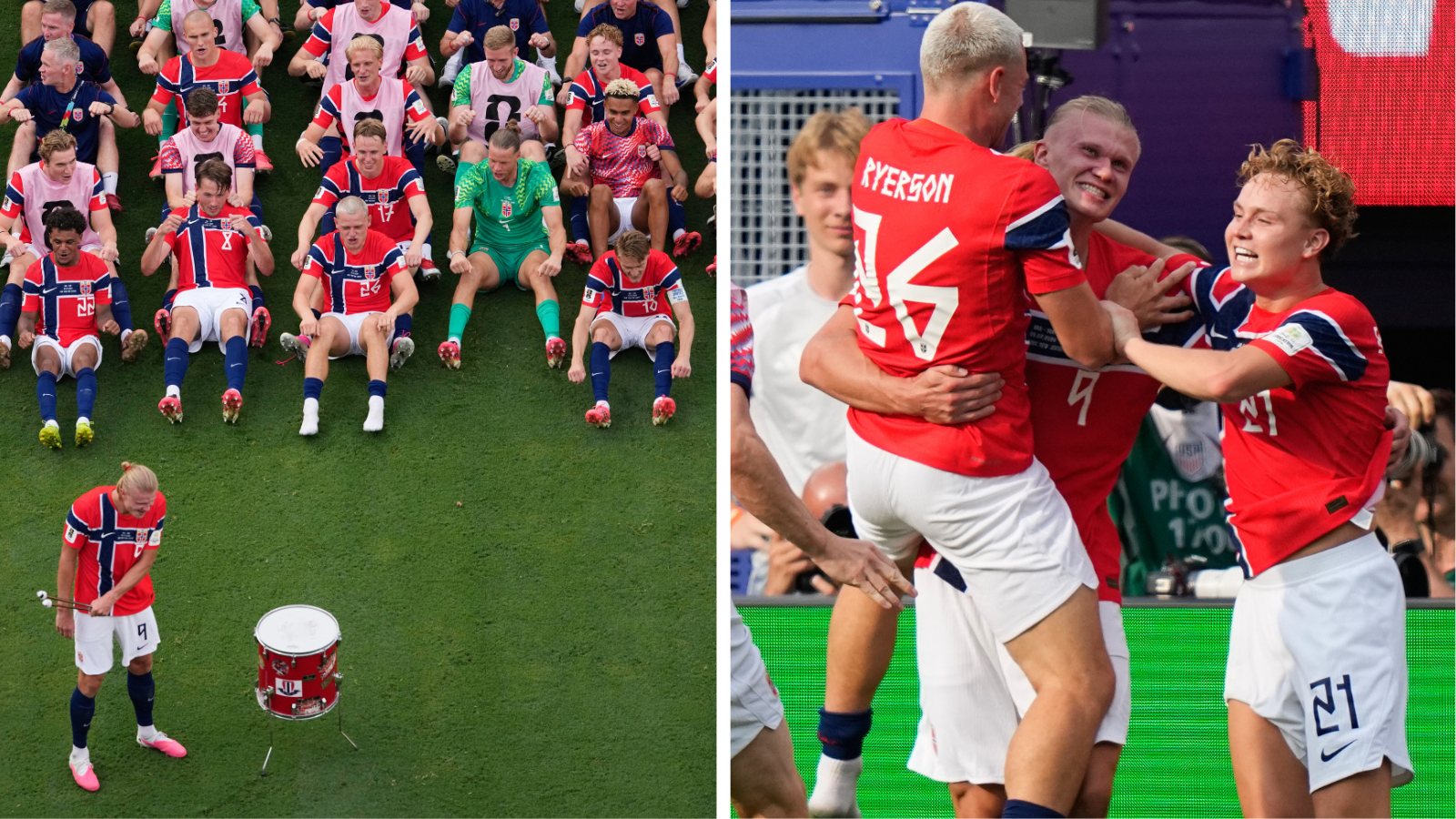
That collectivism has found its way home too, in a form nobody could have scripted. The supporters’ club Oljeberget turned the Viking Row into a global celebration from the stands in America, and back in Norway the same gesture has spread to retirement homes, airports, children’s nurseries, even military bases. The clearest sign of how far it travelled came recently on Oslo’s Karl Johans Gate, where an estimated 100,000 people sat down in front of the Royal Palace to row together as one. Partway through, Crown Prince Haakon walked out of the palace and joined them, royalty and commoners shoulder to shoulder, doing the same silly, joyful thing at the same time. “There is a sense of euphoria back home,” says Pedersen, who was in the US to support the team recently and will be travelling back again for the England quarter-final.
Norway’s Erling Haaland (9) leads the team as they participate in a viking boat row after the World Cup round of 16 match against Brazil. (AP Photo/Frank Franklin II)
***
Story continues below this ad
None of this happened by accident. Pedersen credits some of it to FIFA’s expansion to 48 teams, but the deeper engine has been running for two decades inside the Football Association of Norway, known locally by its Norwegian name, Norges Fotballforbund, or NFF.
Its grassroots pathway starts with six-year-olds: a published, age-by-age curriculum, broken into detailed chapters for coaches and clubs, spelling out not just the format but what to groom at each stage. Six- and seven-year-olds play three-a-side, built around giving kids plenty of time on the ball; eight- and nine-year-olds move to five-a-side, with passing becoming the emphasis; the plan keeps evolving, stage by stage, from there. Since 2011, UEFA figures show, more than 17,000 coaches have completed Norway’s full grassroots coaching pathway, and almost 2,000 have gone on to complete the UEFA B diploma.
ALSO READ | Erling Haaland, and the leap that felled an empire
At the top of that pyramid sits the Landslagsskolen, the national team school for players aged 12 to 16, fed by 1,800 clubs spread across 18 football districts, each nominating talent into a standardised development system. Many of this current squad came through it. Somewhere in that process, Pedersen says, the federation made a deliberate shift, away from defensively sturdy sides and toward technically gifted players who could cut through opponents “like longboats through fjords.” “There is plenty of focus on the grassroots in Norway,” he says. “This led to young players playing for the national team earlier in their careers than previous generations.” Norway’s brutal winters forced a parallel investment: 539 new artificial pitches built between 2016 and 2025, with 586 more renovated, so the weather stopped deciding who got to develop.
Story continues below this ad
On Sunday, Norway face England in the quarter-finals, a team with its own long history of almosts, the country that invented the game and has spent decades not quite winning it since. Pedersen doesn’t sound worried. “England will have much more pressure. Football was born there. Norway? No pressure at all,” he smiles.
An almost-team knows better than anyone what pressure does to a side that hasn’t learned to handle it. Norway, finally, has.
View original source — Indian Express ↗
Related stories

BBC Sport
SportsJul 9, 2026 · 1 min
Idolises Ronaldo, plays like Saka - meet £40m Chelsea winger Quenda
BBC Sport

BBC Sport
SportsJul 9, 2026 · 1 min
Weekly quiz: How many European teams are in World Cup quarters?
BBC Sport
Sky Sports
SportsJul 9, 2026 · 1 min
Jansen set for debut as Ireland make nine changes for Japan clash
Sky Sports

BBC Sport
SportsJul 9, 2026 · 1 min
ECB block Lord's plan for Euro Nations Cup
BBC Sport