Indian Express
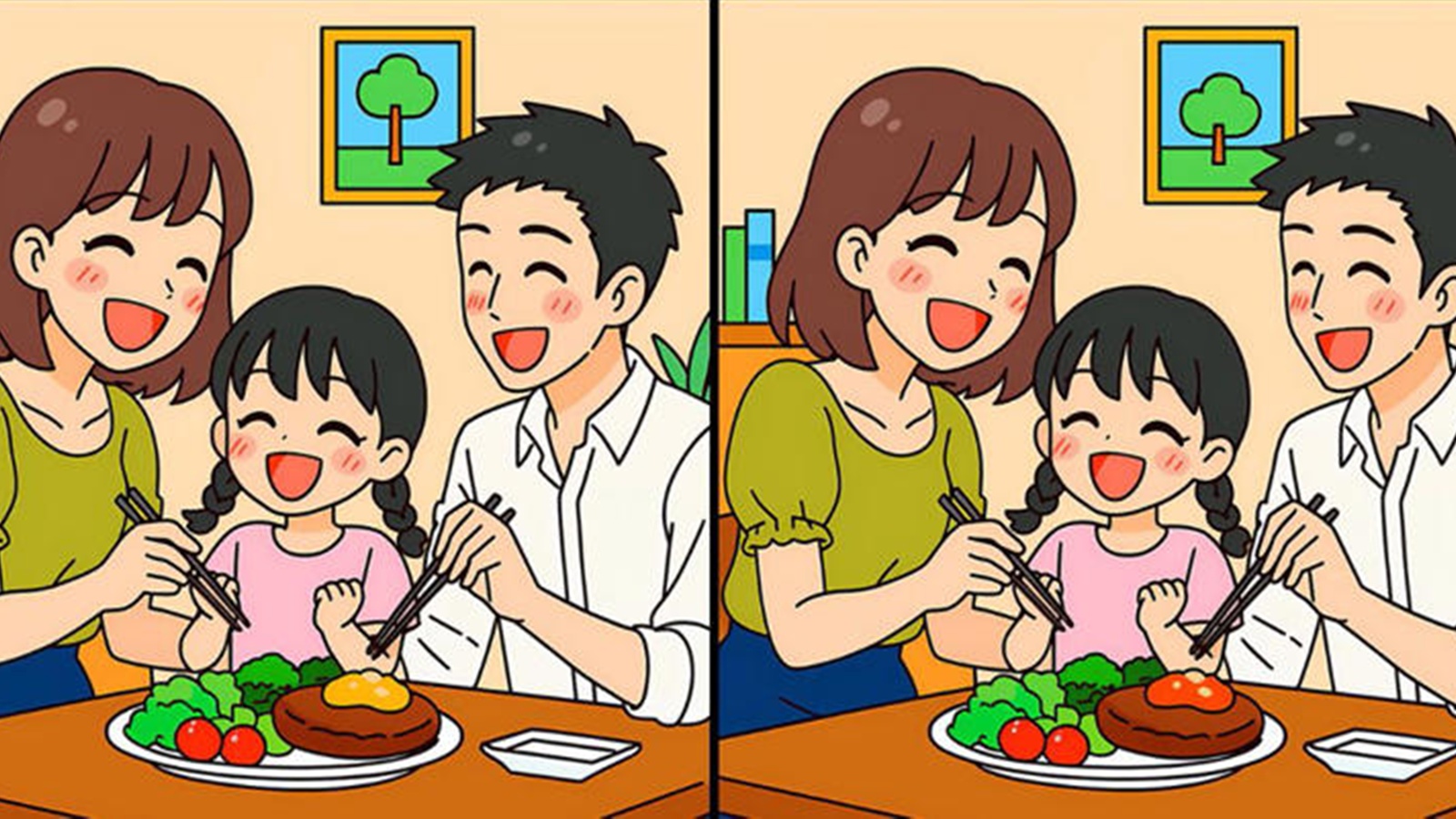
Can you spot all the differences in this family dinner scene within 20 seconds?
Find the hidden differences in this family dinner scene | Source: Great Detective Cookie
Click to see the answer to last week’s challenge
Did you manage to find all five differences in our previous kitchen puzzle? If not, here’s the solution:
One of the stove burners is missing in the lower image.
The bottle of oil has changed position, moving from the far right side of the counter to a spot closer to the chopping board.
A salt/pepper shaker near the frying pan is missing in the lower image.
One of the tomatoes on the plate has changed (the arrangement differs between the two pictures).
The wall clock has disappeared in the lower image.
How many did you spot before checking the answer? If you found all five within the time limit, congratulations—you’ve got an impressive eye for detail. If not, don’t worry. Today’s challenge is another opportunity to put your observation skills to the test.
DISCLAIMER: This article is based on information from the public domain and/or the experts we spoke to.
Think you have sharp observation skills? Here’s today’s visual challenge that may be trickier than it first appears.
At first glance, these two illustrations look identical. A happy family is gathered around the dining table, enjoying a meal together. Everyone is smiling, the food looks delicious, and the scene feels warm and cheerful. But hidden within these nearly identical pictures are a handful of subtle differences waiting to be discovered.
Can you spot all the differences in this family dinner scene? (Source: Great Detective Cookie)
The catch? Your brain is wired to focus on the overall story of an image rather than tiny details. That’s why many people can stare at a puzzle like this for several minutes and still miss changes that seem obvious once they’re pointed out. The more familiar a scene feels, the easier it is for our minds to fill in the blanks and overlook small alterations.
Need a little help? Don’t focus only on the people. Carefully scan the objects around them, too. Take a closer look at the food on the table, items in the background, and even decorative elements on the wall. Sometimes the most noticeable clues are hiding in plain sight.
Story continues below this ad
If you’re struggling, try comparing the image section by section instead of looking at the entire picture at once. Start from the top and work your way down, or move from left to right. This method often helps reveal details that your eyes might otherwise skip over.
⏱️ The challenge: Set a timer for 20 seconds and see if you can spot all the differences before time runs out. Think you’ve found them all? Double-check—there’s usually one that catches even the most observant readers off guard.
How countdowns affect puzzle-solving
Sonal Khangarot, licensed rehabilitation counsellor and psychotherapist, The Answer Room, tells indianexpress.com, “When we work against a countdown, the brain shifts into a state of heightened alertness. A challenge like a 19-second puzzle tends to narrow attention, helping us focus intensely on the most relevant information while filtering out distractions. This can improve speed, but it may also reduce our ability to notice details that would be obvious under less pressure.”
In terms of concentration, Khangarot says that moderate time pressure can increase engagement and mental energy, often creating a sense of excitement or challenge. However, if the pressure feels too high, concentration can become fragmented, with anxiety competing for cognitive resources.
Story continues below this ad
Decision-making also changes under a countdown. People are more likely to rely on intuition, pattern recognition, and mental shortcuts rather than deliberate analysis. This can be advantageous when the task is familiar, but it may lead to impulsive errors when a puzzle requires careful reasoning. Without a time limit, individuals generally have greater capacity for reflection, accuracy, and strategic problem-solving,” concludes Khangarot.
Think you’ve cracked it? Don’t miss the answer. Come back next Thursday for the next edition of our Spot the Difference brain teaser, where we’ll reveal all three hidden differences from today’s puzzle and challenge you with a brand-new visual mystery.
DISCLAIMER: This article is based on information from the public domain and/or the experts we spoke to.
View original source — Indian Express ↗
Related stories

Rio Times
EntertainmentJul 9, 2026 · 1 min
African Filmmakers Take Centre Stage at Locarno 2026
Rio Times

The Hollywood Reporter
EntertainmentJul 9, 2026 · 1 min
‘Little House on the Prairie’ Review
The Hollywood Reporter

Variety
EntertainmentJul 9, 2026 · 1 min
Netflix’s ‘Little House on the Prairie’ Is a Charming Reimagining of Laura Ingalls Wilder’s Beloved Adventure: TV Review
Variety

Indian Express
EntertainmentJul 9, 2026 · 1 min
Sarathkumar reveals 50-year fitness habit and current no-solids fasting routine
Indian Express