The Guardian
‘It makes your heart sing’: can a pioneering project show that rewilding really works?
In the silent countryside south of Grantham, three vast steel barns rattled in the breeze. Gathered in a loose circle beside them were 15 landowners, land agents and a couple of young investors; all expensively dressed men, many with a sceptical mien. It was June 2022, and Sir Charles Raymond Burrell, 10th Baronet, was explaining how the purchase of 1,525 bleak acres (617 hectares) of prairie fields of wheat and beans could revolutionise farming and nature conservation, not just in South Lincolnshire but across Britain and beyond.
Burrell, known by everyone as Charlie, led the group on a walk from the barns beside the unlovable modern farmhouse, a red-brick behemoth with small windows like piggy eyes. We began by crossing a field of broad beans. Less than a century ago, it had been a patchwork of 10 fields. As we walked over the hard, cracked ground, we encountered not a single insect. Later, by a verge, a couple of butterflies flew. As for humans, we didn’t meet a single other person in our two-and-a-half-hour stroll across a range of footpaths and field edges. “This is a ruined landscape,” said one of the guests, the architectural historian Matthew Rice. “Not because of the soils. Because there are no people here. I’m sorry there are not enough stoats but I’d like there to be some children here, too.”
What is a farm? Most of us still picture a storybook image from childhood: cows, pigs, wheat, a pond, a farmer, a family. The farm that had, until recently, operated on this site was more typical of today’s “hard-arsed” farming, as Burrell put it. Boothby Lodge Farm had been a business owned by an absentee landlord. No one lived off the land, or on it. Tenants rented the farmhouse and worked elsewhere. More than 92% of the land was ploughed field. A contract farmer simply drove in with big machines several days each year to produce wheat and beans in relatively poor clay soils. Pheasants were released on the 3% of the farm that was woodland. For a few days each winter, men would pay to shoot them.
Boothby Lodge Farm made £250,000 profit each year but half of this came through the “basic payment”, a simple and generous subsidy for land owned that the government planned to halt by 2027. Beyond that date, thanks to reforms introduced by Michael Gove during his stint as environment secretary, farmers would only receive “public money for public goods” – that is, if their land provided clean water, or healthy soils, or wildlife-rich hedgerows, none of which Boothby appeared to be doing.
Hard-arsed farming has been the main driver of Britain’s contribution to the global extinction crisis. Over the past century, England and Wales have lost 98% of wildflower meadows. We have also destroyed half of Britain’s ancient woodland, half of lowland ponds, 90% of freshwater wetlands and 62% of all “farmland” wild birds.
As we walked, Burrell explained how we might reverse this, on this farm at least. In late 2021, the company he co-founded, Nattergal, had bought the farm for £13.8m. It intended to ditch 6,000 years of farming history on this land. No crops would be sown. No fertilisers or pesticides would be added to the fields. They planned to smash up the drains that had been painstakingly installed by generations of farmers to remove rainwater from their fields. The soils would spring up with weeds. Boothby Lodge Farm was to become Boothby Wildland.
The landowners listened intently to a prospectus that would horrify most farmers. They did so because Burrell, with his relaxed charm, sturdy good health and strong hands, looked and sounded like the pragmatic farmer he had once trained to be. This deceptively radical aristocrat also had a great success behind him. On his 3,500-acre estate of Knepp in West Sussex, he and his wife, Isabella Tree, had reversed farming history in 2000. Having been derided by neighbours for a decade and a half, the couple now presided over the poster child for British rewilding, a farm that had become a hotspot for rare nightingales, turtle doves, white storks and purple emperor butterflies; a hugely popular ecotourism destination that still produced free-range meat and vegetables and employed dozens more people than standard farms. Most pertinent to today’s audience, by rewilding his estate, Burrell had turned a loss-making business into a highly profitable one.
Emboldened by this transformation, Burrell hoped to expand the Knepp model. He intended to show that we could farm wildlife, and make a profit from doing so. Our environmental crises could not be tackled by governments or grassroots action alone. We must, he said, show financial markets that restoring nature is good for business. We must make nature profitable, because it is only by attracting vast investment from the private sector that we can reverse the catastrophic decline of the planet’s other species.
Burrell’s project in Lincolnshire was his pioneering attempt, and one of the largest and most dramatic examples of reversing conventional land management in the country. Abandoning farming in a county known as the bread basket of Britain was almost provocative. It was hard to imagine restoring nature in a landscape so devoid of life. But that is what Burrell set about doing. And so, for the past four years, I have followed what has unfolded in and around Boothby Wildland, to see whether it really could deliver on Burrell’s ambition and his unusual blend of idealism and business-minded realism. And over that time, some answers have hoved into view.
2022
The desolate feeling of Boothby never quite left me that first day. I had arrived late and missed the introductions so it took me several hours to work out who was who. A sharp-eyed northerner called Jim who sounded like a self-made businessman turned out to be William James Lowther, 9th Earl of Lonsdale, resident of Lowther Castle and the owner of 30,000 acres in Cumbria. A trendy young man represented several pop stars looking for an investment that came with the right optics.
Burrell was an affable guide. Assured without being cocky, he allowed his guests to speak and listened respectfully. His vision for Boothby was to stop farming its fields over the next three years. After five to seven years, he would bring in free-ranging herbivores. It could be cows, ponies, Tamworth pigs or even bison. Herbivores were crucial to rewilding projects, he explained, because their dung restored soil life and their grazing stopped the land becoming a dark woodland, which is unsuitable for a wide range of plants and invertebrates.
Burrell was on sure ecological ground but there were sharp questions about the sums. His company, Nattergal – Danish for nightingale – already had a slick website, which announced that its purpose was “to create serious focused investment into the restoration of terrestrial and marine ecosystems across the planet”. The company was backed by Peter Davies of Lansdowne Capital, an investment house in London; the multimillionaire Ben Goldsmith, who ran a green investment company; and Jeremy Leggett, a solar entrepreneur. The company promised to deliver at least a 4.5% return for investors. “We’re hoping to expand the idea throughout Europe. We’re thinking about a billion-dollar project,” said Burrell, casually. His funders tended to be those putting a tiny portion of their fortunes into “something nice,” said Burrell. “They feel safe because it’s land and if it goes pear-shaped they’ll sell the land and get their money back.”
Instead of flogging wheat for a modest profit, Boothby Wildland’s business model revolved around selling Biodiversity Net Gain (BNG) units. From 2024, the government would oblige housebuilders and infrastructure projects to create 10% more nature than was on their site before the development. If developers were unable to add nature to their building sites, they could buy credits that would guarantee that nature was restored elsewhere. Boothby would also sell carbon credits, for the carbon sequestered by stopping ploughing and allowing scrub and trees to regenerate. Like all farmers, Burrell still hoped to harvest some government subsidies but this time the grants would be for environmentally friendly land management, including payments for ecosystem services such as reducing flood risk by better managing the small river that ran through the farm. In the long term, his pitch was that the returning nature would create a sustainable ecotourism business, just as it had at Knepp.
“What about land decreasing in value when it’s rewilded?” asked one landowner.
“The old model of land value being linked to what you can grow on it is completely gone,” answered Burrell.
“Why not set aside 50 acres for a housing estate?” suggested another.
“Not interested,” said Burrell, firmly.
“So you’re not going to work the asset at all?”
“No.”
“Why would you do that?”
The value of land is not important when you aim to hold it in perpetuity, argued Burrell.
“There is no ‘in perpetuity’,” scoffed another landowner.
Burrell had endured two decades of hostility from his landowner fraternity over Knepp. “The principle is, this is about the recovery of nature to this land,” he said. “Then everything else follows.”
One lesson he had learned, he said, was to involve local people. Boothby appeared to be empty land but it was surrounded by three pretty villages, Boothby Pagnell, Ingoldsby and Bitchfield, and Burrell and Nattergal’s head of natural capital, Ivan de Klee, had wisely hosted village hall meetings before they revealed the purchase to the media. Compared with the bafflement that met his “rewilding” project in 2000, by 2022 there was enthusiasm for the idea, galvanised in Britain by writers such as George Monbiot, and Isabella Tree’s book and documentary, Wilding, which told the story of the Knepp revolution.
“Everyone said: ‘Don’t say rewilding. People in Lincolnshire hate it.’ I’m calling it rewilding,” said de Klee, a tall young man who shared Burrell’s knack of remaining unflustered when challenged. De Klee had attended the first village hall gathering with Burrell. “In the opening half hour there were two very loud, very angry people, talking about the loss of food production,” he said. “Then someone from the farming community stood up and said: ‘We might not all rewild but farming is going to change and we need innovation’ and half the room applauded quietly and it became much more of a conversation.”
It felt like there was an element of bloodymindedness in Nattergal’s purchase of Boothby. The land appeared to be completely emptied of wildlife, and yet so many locals were deeply attached to the intensive farming that had made it so. If Nattergal could make an ecological and financial success of rewilding here, it really could happen anywhere.
A few months later, the barns were still rattling when I joined an autumnal walk around Boothby to which locals had been invited. Thirty mostly retired people turned up, a good turnout for a sparsely populated area. The wildland had scored an early success, winning a bid to become one of the government’s first 22 Landscape Recovery Schemes in England, a new subsidy supporting nature restoration in prime wildlife areas, and Boothby had its first employee based at the farm, Lizzie Lemon, site and community coordinator, a friendly local woman who had once worked for the RSPB. Lemon was spending much of her time trying to alleviate local suspicion that Nattergal was a front for a solar farm. “Local people see these hedgefund guys coming in and think it’s all going to go wrong and then they will carpet it with solar panels,” she said. Locals viewed fields of solar as the unwelcome industrialisation of their landscape.
It did not help that Nattergal’s then chief executive, Neil Perry, who joined the walk, had a background in solar. Perry saw the emerging “natural capital” market as similar to solar. “No one was listening to pleas to invest in solar – and then suddenly in 2008-09 mainstream money poured in. All the manufacturing rapidly disappeared to China.” But now, he said, the UK could seize the opportunity to build a domestic industry around biodiversity and carbon credits.
“No solar farms?” asked a visitor.
“No, definitely not,” said Perry. “We’re not doing that here.”
A storm blew in and we sheltered under a tree. There were so many acorns beneath the oaks, it felt like walking on marbles. Some of these acorns would soon become the wildland’s first naturally regenerated trees. As we waited for the storm to subside, the walkers interrogated de Klee.
“All your weed seed is going to blow into our village,” said one woman.
“There will be weed drift,” said de Klee, not missing a beat. “We have a 50-metre buffer between us and our neighbours, as at Knepp. That won’t stop every seed drift but it will stop a large proportion of it. We have plenty of gardeners around Knepp and their gardens are all very clean and tidy.”
The locals were divided. A quarter were very enthusiastic (“like winning the lottery” said Clive and Sarah Carr; “Our little girl is five. To have it on your doorstep and grow up with it – it’s going to be amazing for her,” said Jo Elston-Moscrop). A quarter were implacably opposed. (“People think it’s a load of woke nonsense,” said one. “There’s a lot of romantic ideas,” said Jan Worts. “A lot of the young mothers with children in the village have this idea they will be skipping through the daisies.”)
To these sceptics, Perry quoted a fact from the Dimbleby report, an influential government paper that set out a national food strategy in 2021: take the least 20% productive farmland out of production and the calorific value of the food produced in the UK would fall by just 3%. Perry argued that cereal farms such as Boothby did not directly produce food for human consumption. The grain was fed to cows and chickens, while the beans ended up as fish meal for Norwegian salmon and came “back to our tables in M&S salmon packets. If biodiversity loss continues and all our pollinators disappear we’re going to have a much bigger food crisis globally in 10 years’ time.”
Roughly half of local people appeared to be on the fence. One man I met, Paddy Turner, described himself as “politely suspicious … I don’t like to see it going out of agricultural land but equally, I see the benefits,” he said. “People don’t like change, that’s the problem.”
“I’ve forgotten more about this land than they are ever going to know, frankly,” declared Amanda Dixon, an elegant, white-haired woman. Dixon and her ex-husband used to own 1,000 acres of Boothby. She still lived on the fringes of the farm, in a converted cart shed, with 11 acres including a field of beloved sheep (hated by the rewilding movement). They had farmed the land well, she said: they innovated, raised yields and did what they could for nature. They planted 20,000 trees in small woods. On some of the better fields, they could grow four tonnes of wheat an acre, “which was then the holy grail of farming”. She felt the land’s productivity was being “talked down” by its new owners. “I do think it should be used for food because we’re going to have to feed ourselves.”
Still, she was persuadable. Thirty years ago, nightingales sang from the hedges of Boothby but they had vanished with the loss of bushy habitat. Dixon had told Burrell that she would forgive him for the loss of the farmland on one condition: he got the nightingales back.
2023
It was a wet autumnal evening in 2023 when I returned to Boothby. The barns were still rattling in the wind, bleakly. Two-thirds of the fields were now out of production; only 150 hectares would be sown with wheat for the final crop year, in 2024. The agronomist employed by the wildland to oversee its last crops had obtained yields of 9.2 tonnes of wheat a hectare (3.7 tonnes an acre) using 40% fewer “inputs” – ie, fertiliser – than the previous regime. “It turns out we’re quite good at farming this land,” said Lorienne Whittle, the new site manager based at Boothby.
The rewilders’ messaging had changed because locals had been angered by media portrayals (including my own) of this as nature-depleted but also rather rubbish farmland. “We have to be careful not to say this is bad land. This is resilient farming land,” said Whittle, although she also pointed out that they’d been lucky with the weather over the past two seasons, and the cereals had failed to make a profit in many recent years. (In 2024-25, British cereal farmers actually lost, on average, £27,400 on their crops; they only made profits because of subsidies and diversification – solar panels, barn rentals, farm shops.)
I met Boothby’s new ranger, Lloyd Park, at the door. Park was a passionate birder who had worked in traditional conservation for 14 years before switching to rewilding. “Ten years ago, I started thinking conservation has got to go in a different direction,” he said. He thought this could be it. Conservation tended to identify a special habitat, with a certain suite of species, and then micro-manage the land to preserve those species. Rewilding did not have a specific target, its mantra was to allow more natural processes to flourish, and celebrate abundance and whatever wildlife turned up.
As nice as that sounded, Boothby was also a pragmatic project. To earn income from BNG and other schemes, it had to deliver rising biodiversity as well as abundance, and so Park and the Boothby Wildland team were intervening to speed up restoration. Brash – dead tree branches – was being dumped in the middle of fields so birds perched there and their droppings sowed tree seeds. The riverbed would be filled in, so the stream would be forced out across its former floodplain, bringing water and life to the little valley. The team had also dug eight new ponds, funded in part by Network Rail, which was obliged to provide additional habitat for great-crested newts when its work damaged ponds elsewhere. Three PhDs were being undertaken on site, including examining how rewilding boosts insects and aquatic life.
The Boothby Wildland mission was also to bring people back to the land; future ecotourism revenues would depend upon that, and Lizzie Lemon had been busy: 150 people attended a dance and open day on the hottest day of the summer and 30 locals were given a free day out at Knepp (and a copy of Tree’s book). I had arrived to watch the latest workshops where local views were canvassed. Under “strengths”, local people had listed: getting kids back to nature, paths and disabled access, and “beavers please!”. “Weaknesses” was a larger pile: footpaths need to be managed, footpaths mown too late, weeds, greenwashing, sign at gate too small, “what about food production?” and “looks a mess”.
Did it look a mess? I took a tour with Whittle in a shiny new four-seater all-terrain vehicle imported from China. Boothby was certainly showing a different face from typical British lowlands. Most fields were filled with weeds that farmers typically hate: tall rosebay willowherb with its bright purple-pink blooms, yellow-flowering ragwort, dock and most of all, thistle. To their detractors, these are thuggish, pasture-murdering plants (and ragwort can be poisonous to horses). Whittle recounted how Boothby’s contract farmer said: “I’m not taking my combine off your land without washing it down thoroughly,” as if the rewilding site was an infectious place of weeds.
The dumped brash gave it an abandoned look, though if you looked closely, you could see signs of life. A maze of vole runs were etched into the long grass. A stoat ran into the field before us and there was a small murmuration of starlings overhead as well as a kestrel, a buzzard and two red kites. Already, there was a lot more food for all these animals.
More conventionally, one area was being planted with trees, under a scheme where the government provided generous subsidies for new native woodland, and another field was being managed as a hay meadow. They had spread green hay in 2022, and it was already full of yellow rattle – a flower that parasitises grasses, creating space for more floral diversity. “It’s our Lincolnshire steppe grassland,” said Whittle proudly. When we stopped, swallows swooped around our vehicle. “This is lovely,” said Whittle. “We’re actually having a wildlife moment! It’s quite rare on the Boothby site.”
2024
A few months later, in February 2024, Boothby hosted another workshop, attended by 18 farmers and landowners, about its controversial next step: bringing back beavers. The wildland team planned to use a digger to rewiggle the river – recreating “natural” meanders that had been removed by years of intensive farming, which had turned it into a canalised drainage channel. They would also build the largest beaver enclosure in Britain (because the government did not yet allow the release of this returning native species into the wild in England). They were braced for hostility. Many farmers were very wary of beavers: they had heard how their dams had flooded valuable arable land in Scotland and didn’t want them let loose anywhere else.
Nattergal’s purpose, in the bloodless language of finance, was “to make nature an investable asset class”. On the ground, however, it felt like a cosier place to be. The farmhouse windowsills were now piled with treasures found on the land: fossils, Roman pottery, coins, horseshoes, musket balls, pipes, cows teeth, a child’s toy lead horse. The kitchen bustled with staff and volunteers. And that winter, ranger Lloyd Park was delighted to have seen a big flock of fieldfares, woodcocks, waxwings, two short-eared owls, regular barn owls and had heard a kingfisher for the first time.
De Klee gave the farmers the low down on beavers. Their benefits were plentiful: they would make dams, create new wetlands on Boothby’s 2km stretch of river, and slow the flow, ensuring a steady supply of river water in summer and reducing floods in winter.
With his winning brand of brisk honesty, de Klee noted that there had been 27 beaver releases into fenced enclosures across England during the previous year, and half of them had a beaver escape. He paused. The farmers looked amused. “Every one has been caught and taken back,” said de Klee. “We’ve no interest in beavers escaping on to your land because we need them here to do this work.” One landowner also happened to have a 60,000-acre estate in Scotland. They’d shot 120 beavers because they were flooding good cattle grasslands. But the other farmers were keen to learn more about the beavers: how much they breed? (Every year.) How do they affect fish? (Studies show their dams and pools increase fish abundance.) Do they eat eggs of ground-nesting birds? (No.) What about otters? (They live together.)
“What about the hat trade coming back?” laughed one.
“My mum would be delighted,” said de Klee. “It would go with her mink coat.”
The farmers were walked down to the river to see where the beavers would be released. They seemed reassured by what they heard but also by what they saw, which included hedge-laying, mink-trapping and restoring a wildflower meadow. These were pleasingly familiar interventions: management and control, pragmatic custodianship, not freewheeling rewilding.
“Years ago we were ripping hedges out,” said one farmer. “We were told to rip them out,” added Dixon. I asked what she thought of the beavers. “It’s a very good idea. The fencing will be quite something,” she said diplomatically. “I can’t imagine why anybody would be anti the beavers if they are going to be fenced in. It’s not as if you’re releasing a monster.”
Dixon complained that the weed seeds from Boothby were blowing on to her land but she found that by mob-grazing her sheep in small blocks in the paddocks and letting the grass grow longer the seeds didn’t get in. “We have adapted,” she said. “You know what people are like. Something happens and we all go: ‘Weurrrgh!’ Now it’s happening, people are not worried about it any more. Of course it becomes more interesting when they put animals on it.” She was looking forward to livestock arriving. “The moment the animals arrive it will be, ahhhh. People will start to think it’s not such a bad idea after all.”
In September 2024, 12 people, bent double on a recently cultivated field, tending to the land, presented a scene from a century earlier. Except in previous centuries, these labourers would have been pulling out weeds from between newly sown rows, manipulating nature to produce food. The volunteers at Boothby, however, were putting the weeds back in.
It was another windy day. If you squinted, you could have imagined Boothby’s fields as a trendy garden, with a muted palette of sculptural forms. Statuesque teasels held their grey heads high. Docks were as rusty red as corten steel. The wildland’s final ever meagre wheat harvest had been brought in the previous month.
This particular field caused controversy earlier in the year because Boothby didn’t use the toxic weedkiller glyphosate on the arable weeds before sowing a wildflower mix (more acceptable “weeds” because they were less aggressive and usually carried prettier flowers). “It meant we had this real growth of rosebay willowherb, ragwort and thistle, which has caused a lot of upset with the locals,” said Park with a grimace. They had promised wildflower fields. What had sprouted up were the aggressive annual weeds so disliked by many locals. So the field has been cut, ploughed again, and resown with a £6,000 wildflower mix. Now volunteers were spreading green hay, collected from Lincolnshire road verges, which would introduce the right kind of floral weeds: perennial wildflowers of local provenance.
Every week, Lemon and Park were working with a regular group of volunteers on various tasks across Boothby. One of the volunteers was Tabitha Thompson, 19. After she did “terribly” in her A-levels, Thompson was directed her to Boothby by her mother. She was initially tasked with removing the old plastic guards from the small plantations dotted around the farm. Then she dismantled old pheasant pens. Her favourite was learning how to lay a hedge. Her volunteering had led to a good permanent job in the county’s flood management team. But she still spent holiday days at Boothby. “Beavers coming here – I would love to be involved in that,” she said. The beavers were due next spring.
2025
The beavers did not arrive in 2025. Consultations dragged on, expensive fencing was slow to be installed, and I wondered if Nattergal had lost their nerve, or funding. Meanwhile, the wildland’s first glamping offer had not been a success. “A field of thistles in Lincolnshire had limited appeal,” grimaced de Klee. Nattergal promised it would relaunch the ecotourism once there was more wildlife to see.
That summer, I decided to test the experience in an August heatwave, and turned up with my son, Ted, and our tent for a wild camp on Boothby’s glowing fields of thistles. Thistledown lay like a spilt duvet on the dry ground, which was riddled with cracks as if we might be swallowed up.
Locals were still complaining about the spread of weed seed from Boothby’s spectacular crop of thistledown, but this was just the ugly duckling phase of a rewilding site. “It’s the Marmite phase. People either love it or hate it,” said Park. He was in the former camp. But it was only a phase, he said. When pigs are introduced, they will rootle up thistle roots. Trees and scrub will soon shade the thistles and ragwort into insignificance.
Ted and I circled this still empty, still rather unlovable but now strikingly unusual landscape of shoulder-high thistles, teasels, ragwort and dock. In the distance, at one point, Ted spotted a very strange weed, poking out from the burnt prairie land of tall brown and bleached gold grasses. It was the antlers of a fallow deer, watching us, ears turning like satellites in the hot wind. Further on, spreading hedgerows of hawthorn and blackthorn resembled exhausted shoppers, laden with produce: reddening haws and purpling sloes. Beside the river were barren-looking new ponds dug into the clay and sand by a digger driver whom de Klee had nicknamed “the Picasso of ponds”. These groundworks had cost £100,000 – cheaper than many comparable schemes but not as cheap as leaving river restoration to the beavers.
Fortunately, Boothby had scored some financial successes in recent months. Nattergal had signed a major deal with engineering consultancy Arup, which agreed to purchase £1m of high-quality carbon removal credits over the coming three decades at Boothby. This price was around three times the market rate for such credits, because the wildland would also deliver biodiversity, flood retention and community engagement. After many delays by the authorities, Nattergal had finally signed a BNG agreement with the local council to offer 338 BNG units. It later added another 1,075 units. BNG prices vary depending on habitats lost, but typically a 20-house development might only require 1.5 units, for which the developer might pay £25,000 a unit. At that price, Boothby’s 1,413 BNG units could be worth more than £35m. With major infrastructure planned for Lincolnshire – including pylons and battery storage as well as housing – BNG was likely to provide a steady income over the next 20 years.
There was no storybook-style cockcrow to wake Ted and me, but we were roused at 5.30am by a roe deer barking outside our tent. We ate breakfast as the sun rose over a peaceful but still-bleak field of thistles.
2026
On a sunny day in February, a family of four arrived at Boothby in a white van driven from Scotland, keen to explore their new home. “It’s an exciting day,” said de Klee, who now looked like a young colonial explorer with his impressive new moustache. “It doesn’t get better than releasing beavers into this landscape.” Lemon put out a “quiet” Facebook post seeking beaver volunteers. “It went crazy.”
It was amazing, said de Klee, how that B-word “can supercharge interest”. As a very young man, he’d worked on an Indian tiger reserve. “Your job was the prevention of destruction,” he said. His work now was so different: “Enabling recovery. That psychological shift is so wonderful and powerful.” That said, the fencing contractors had churned up the ground during the sodden winter, and there were local complaints about the ugliness of the fencing and the virtually impassable footpaths. On the other hand, this section of the West Glen valley was full of water again, for the first time in a century or more, glinting silver in the sunlight. Volunteers had planted scores of willow whips, which would give the beavers something to eat in the future. Otters had already returned.
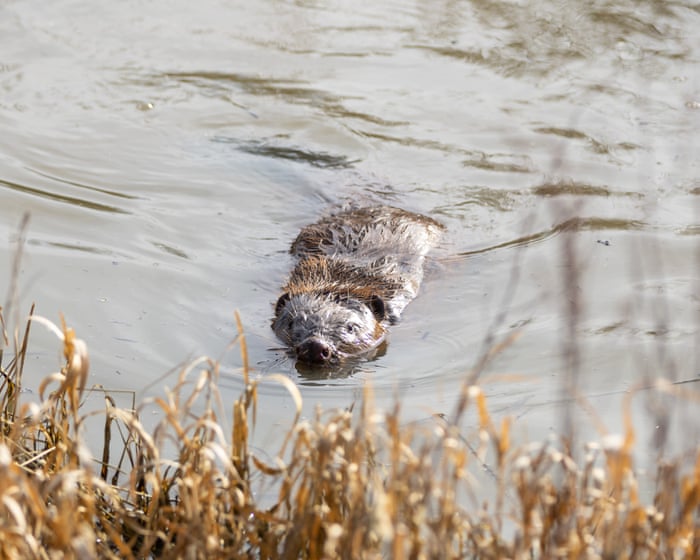
Four volunteers had their names picked out of a hat to help release the beavers. Covered crates were heaved to a spot beside a brown pond surrounded by bulrushes and trees. Metal hatches were opened, and the family of beavers padded out and slipped into the water. They looked instantly at home. The Boothby team hugged. Some looked close to tears.
The beavers would deliver wildlife but they were also delivering money. Boothby had created 12 “watercourse” BNG units for developers building beside rivers elsewhere. These units were rare, in high demand and the beavers were generating a third of them. “It’s the beaver-created ones that I’m most proud of,” said de Klee. BNG sales had picked up recently. “The last quarter of last year was anxious and slow,” said de Klee. “This year there’s a bit of confidence and certainty.”
Last month, I returned to Boothby to see how the beavers were faring. Amanda Dixon was worried. “Is there enough water for them?” she wondered. “These streams down there don’t run all the time.”
When I’d met her in previous years, Dixon had sounded as if she was adapting, and perhaps even learning to love Boothby Wildland. But that had changed. “Feelings are running very high,” she said. It was the weeds – she pointed to the weeds between Boothby’s deer fence and her sheep pasture – and the fencing. “We’ve been lied to and lied to about what they were going to do and everybody is getting very angry. They told us we were going to have cattle, which is fine. I know they have them at Knepp. I learned the other day they weren’t going to buy any cattle.” Instead, graziers will bring in cattle on a temporary basis, she said, and there’s currently not enough grass for them to graze because there are so many weeds. For Dixon, the return of livestock to the land was a form of farming again; that it wasn’t happening as originally billed looked like a profound disappointment for her. (When I spoke to Burrell, he said that they’d always been clear that it might take as long as seven years before livestock such as cattle could be permanently introduced.)
“Do you know what really makes me sick?” said Dixon. “They’ve been cultivating that land for 1,000 years. We’re surrounded by three churches. Bitchfield has Saxon foundations. They couldn’t have raised those churches if they hadn’t been farming that land. One thousand years of hard labour by generations of people has gone in four years, and they are never going to get it back. Charlie Burrell said: ‘Think of the purple emperors!’ You can’t eat butterflies.”
I spoke again to Paddy Turner who, like Dixon, had been initially cautious about the wildland. Four years on, he seemed largely convinced. “It’s been an absolute pleasure seeing it evolve and change,” he said. “Some people might argue it’s not the most attractive view at the moment but I don’t see that. There’s a lot of docks and thistles, but look at what else is sat on them.” For all that, Turner said he was still “an avid sprayer” of weedkiller in his garden, particularly if the wind is blowing the weed seeds on to his land. “But that’s a first-world problem, it really is. I can’t wait to see the next stage.”
A few minutes later, I found Park at the farmhouse, almost jumping for joy about the ring ouzel – an extremely rare thrush – that had been spotted bathing in a beaver pool. That, and gorse and birch bursting out all over one field. “It makes your heart sing! – seeing a little spiny gorse bush in a once-wheat field,” he said. And local complaints? “You’ve got to be thick-skinned. I’m a rewilding rhino,” he joked, saying his approach was to “kill them with kindness”. When a neighbour complained about the ragwort the other day, the Boothby team offered to send over their volunteers to pull up all the offending “weeds”.
Charlie Burrell was at Boothby farmhouse too, attending a board meeting in the old dining room. Inside, it was all talk of the shortcomings of carbon credits and investor confidence. Outside he sat in the sunshine on a bench and grinned when I asked if he was surprised by what’s happened here since 2022. “It all looks exactly how I thought it was going to look. I spent every spare hour at Knepp studying the transition. It all looks so familiar to me. I love it when the staff are surprised – when hen harriers are seen – that excitement.” He remembered his conversation with Dixon about nightingales. “They haven’t bloody come, have they?” he said. “I reckon they’ll arrive in another four years. If they haven’t disappeared from England altogether.”
He admitted he had been taken aback by the slowness of the financial deals required for their business model. “Everything takes much longer than I thought,” he said. Over the past four years, the political landscape had also been transformed, and Burrell thought it no longer looked so rosy for rewilding. When they raised the initial funds to buy Boothby in 2022, he said, every City of London CEO seemed to be saying: “I have children, I worry about the future and the climate and what biodiversity we had left.” They talked about their responsibilities and working out “the real cost of using the environment in our lives”. These days, he said, the typical corporate line was: “We’ll just wait until others are doing this.” There is so much uncertainty about the future, and Burrell noted the backlash against the kind of environment-oriented businesses he championed. But, he said, “it will come good because it will have to, as the true bite of climate change hits”.
On paper, Boothby’s numbers looked impressive. Nattergal’s 2026 “impact report” mentioned the 1,413 BNG units added to the national register; 138,000 tonnes of carbon to be sequestered over the next 50 years; a 58% agreed increase in public rights of way; an 108% increase in overall biodiversity and many more figures besides.
But how did that actually translate on the land? I went for a wander with Park down to the river. The sun broke through and, suddenly, there was a bewildering tumult of life in every direction. I’ve experienced these moments before, but only in special, protected nature reserves – often such tiny fragments of land that they represent simulacra of abundance. Here, however, we were standing on a large slab of ordinary countryside that until three years ago had been an arable field. Now it was a wetland, roiling with life.
There was the flap of a grey heron and a grey wagtail calling. A black-tailed skimmer dragonfly whizzed over the water. A great spotted woodpecker landed on a dead sycamore. The rank grass and thistles bounced with meadow grasshoppers and jinked with dozens of butterflies. It was overwhelming; movement everywhere, surround-sound buzzing, chirping, calling. To say the land was singing might be fanciful but something was happening here. Something very alive.
Listen to our podcasts here and sign up to the long read weekly email here.
View original source — The Guardian ↗
Related stories

Rio Times
BusinessJul 9, 2026 · 1 min
Tony Elumelu to Step Down as UBA Chairman After 12 Years
Rio Times

Rio Times
BusinessJul 9, 2026 · 1 min
Ivory Coast Wins $80 Billion in Pledges for Its 2030 Plan
Rio Times

Rio Times
BusinessJul 9, 2026 · 1 min
Abu Dhabi Buys Shell’s South African Network for $1 Billion
Rio Times

Rio Times
BusinessJul 9, 2026 · 1 min
Ethiopia Passes a Record $14.6 Billion Tax-Financed Budget
Rio Times