OnlineKhabar
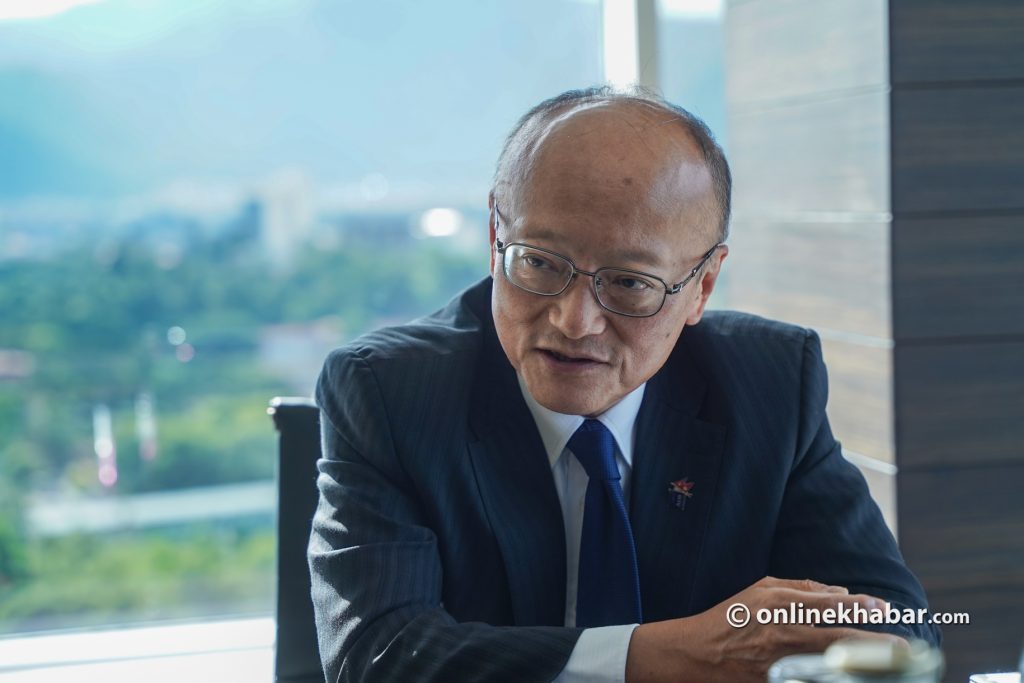
Masato Kanda: ADB is strongly committed to supporting the Government’s reform agenda
Marking six decades of partnership, Asian Development Bank (ADB) President Masato Kanda recently concluded a milestone visit to Nepal. A former Special Advisor to Japan’s Prime Minister and Minister of Finance, Kanda used his trip to signal a bold new chapter for ADB’s engagement in the country under the new political landscape.
During his stay in Kathmandu, he held high-level talks with Prime Minister Balendra Shah (Balen), committing to support the government’s ambitious reform agenda and scale up ADB’s assistance, cementing this pledge by signing two major loan agreements totalling $165 million.
Against this backdrop, Onlinekhabar spoke to ADB Chief for an exclusive interview. The conversation revolved around the core purpose of his visit, the enduring Nepal-ADB alliance, and Kanda’s vision for driving tangible economic growth in the years ahead.
Excerpts:
Mr. Kanda, as ADB President, you are visiting Nepal for the first time since Takehiko Nakao in 2016, shortly after the 2015 earthquake. What is the main purpose of your visit, and what concrete achievements should Nepalis expect from it?
Personally, this is a great opportunity for me because the last time I visited this great country was in 1990 as a backpacking student. The transformation this country has undergone during this period is quite remarkable, and I wanted to see it firsthand.
On a more serious note, there are many purposes for this visit. Most importantly, we are truly grateful for our close partnership with Nepal over the past 60 years. Building on this strong collaboration, I am here to further strengthen and expand our partnership for the future, particularly to take advantage of the current momentum for reform, stability, and resilience.
Secondly, I want to ensure that our commitments are translated into tangible results on the ground. In fact, the Government of Nepal, led by Prime Minister Balendra Shah, has consistently emphasised the importance of remaining close to its citizens and delivering real, measurable results.
To expand our cooperation, I have committed to both the Prime Minister and the Finance Minister that ADB will provide $2.4 billion in concessional financing through 2029. This support will be fully aligned with the government’s priorities, including its reform agenda. During my meetings with the Prime Minister and Finance Minister, one thing I strongly committed to was a closer partnership and stronger support for their reforms. We also confirmed that our strategies and the government’s priorities are fully aligned.
Regarding results on the ground, I was fortunate to visit the Nepal Electricity Authority to see the renewable energy network, which has been modernized with cutting-edge technology. I also visited Vishwa Niketan Secondary School, which has been reconstructed with safer infrastructure and is being equipped with AI and digital technology.
Additionally, the Minister and I jointly witnessed the signing of a $165 million loan agreement. Of this amount, $115 million is allocated to water supply and wastewater management, while the remaining funds are dedicated to customs and logistics modernisation, which is crucial for facilitating more efficient trade.
As you know, Nepal is a founding member of the ADB, and our partnership began in 1968 with a technical assistance grant, followed by a concessional loan in 1969 for air transport development. Today, the ADB is Nepal’s largest development partner. How do you assess the partnership between Nepal and the ADB, and what do you consider to be its single biggest achievement?
It is difficult to single out just one achievement, as there have been many. We are very proud to be Nepal’s largest development partner. Our cumulative commitment now exceeds $9 billion, and we have an active portfolio of $3.9 billion.
While we support almost every sector, answering your question is not easy. However, our greatest achievement has probably been working alongside Nepal to build a strong foundation for future growth, particularly by supporting underserved populations through resilient and inclusive infrastructure, such as transportation and energy, that benefits the poorest communities.
Of course, there are many other areas where we have made important contributions. Investments in sectors such as education have created powerful synergies for the country’s overall development. We will continue to prioritise infrastructure that directly benefits people while also supporting other areas that are essential for resilient, inclusive, and sustainable growth.
Nepal is a new federal republic, and following the youth-driven movement of September 2025, the country’s political landscape has changed significantly. How do you see Nepal’s economic transformation over the next decade, and can we expect a substantial increase in ADB support in the near future?
I am very excited to see the great opportunities ahead. I think Nepal is currently looking at an unprecedented and very unique window for transformation, particularly following the landslide election victory of the ruling party. The government has a very strong policy mandate for the reforms necessary for the future of this country.
Compared to my home country, the youth of this country are highly engaged in social activities. I think this gives the country great potential and momentum for transformation. However, there are some risks. If you cannot provide quality jobs for young people, it could potentially lead to further social unrest.
Therefore, our priority is to help the government create good jobs for the younger generation through better infrastructure, education, and skills training. Private sector development is probably key to this effort. There are many areas in which this country needs to reform the enabling environment to attract private capital.
We are very happy to support the government’s efforts to promote a vibrant market economy and private sector development. One of our flagship policy-based lending initiatives is called RAISE (Reforms to Accelerate Investment and Scale Employment). This program aims to increase market attractiveness, create an enabling environment for private capital, and accelerate the digitalisation of the country’s entire economic structure.
ADB and the World Bank have prepared a joint Country Partnership Framework for Nepal and are increasingly collaborating at the project level. Such joint and deep engagement by two major MDBs likely creates major benefits for Nepal. What do you expect to achieve through this collaboration?
This is the first time in Nepal that ADB and the World Bank have collaborated on preparing our respective Country Partnership Strategy and Country Partnership Framework through a joint strategic approach which is fully aligned.
ADB and the World Bank together account for 70% of total development financing in Nepal, and this combined effort will lead to significant efficiency gains.
I mentioned the RAISE project. This project operates under a “full mutual reliance framework” between ADB and the World Bank, which is probably the first such arrangement in the history of global development finance. This approach eliminates redundancy and duplication in processes, meaning that the host country only needs to deal with one institution.
For instance, in the case of RAISE, ADB is leading the project. We are responsible for its design, execution, implementation, and supervision. We have another project under the same framework focused on digital transformation. Through this approach, we are working together in a much more efficient way.
I think this will dramatically reduce transaction costs for countries. As the current Chair of the MDB (Multilateral Development Bank) Heads Group, which includes all major multilateral development banks, including the World Bank, the Inter-American Development Bank, and the European Bank, I am committed to advancing this agenda.
I am determined to make the MDB community more efficient and effective for our clients by acting as a cohesive system, eliminating duplication, and working together to create greater synergies.
View original source — OnlineKhabar ↗
Related stories
ABC News
PoliticsJul 9, 2026 · 1 min
Angus Taylor says One Nation would 'send us broke'
ABC News

TASS
PoliticsJul 9, 2026 · 1 min
South Korea’s top court sentences former country’s president to seven years in prison
TASS
The Guardian
PoliticsJul 9, 2026 · 1 min
Angus Taylor warns of ‘eternity of pain’ if One Nation win government in strongest attack yet on Pauline Hanson
The Guardian
Straits Times
PoliticsJul 9, 2026 · 1 min
French foreign minister blames Iran for US attacks
Straits Times