The Guardian
UK housing market downturn eases but sentiment remains ‘fragile’, surveyors say – business live
Key events
24m ago
Introduction: UK housing market downturn eases but sentiment remains ‘fragile’, surveyors say
Jefferies analyst Mohit Kumar says:
Geopolitical tensions were the main driver of the market yesterday. US and Iran traded fire with US reportedly striking 90 targets in Iran and Iran retaliating with strike on US air bases. Trump later stated that Iran has asked for a continuation of talks, though it is not clear whether the request actually originated from the Iran side. Oil prices have moved sharply higher with US crude close to $74 and Brent close to $79 a barrel.
The renewed tensions show the fragile nature of the truce between US and Iran. In our view, the latest escalation is Iran’s attempts to control the Strait by attacking ships that try to pass through the Oman side. Iran wants ships to pass through its designated route on the Iran side which would enable it to charge tolls. Any tolls or fee for passage through the Strait would be unacceptable to the West.
Question remains whether this would prove to be a short term escalation or we go back to full scale war. We do not believe that either the US or Iran want to go back to full scale war and the latest escalation is about deciding who controls the strait. Our base case is that cooler heads will prevail and both will go back to the negotiating table. But we think that the Middle East situation is more unstable today than it was before the war. Near term, we think that we will get some version of a deal, even if it’s a fudge, that would enable oil to flow. But medium term, tensions may flare up again.
Ipek Ozkardeskaya, senior analyst at the financial group Swissquote, has summed up the flare-up in Middle East tensions, and looked at the implications.
Donald Trump declared the ceasefire over, and the US continued bombing Iran last night. Washington also revoked the recent easing of Iranian sanctions, meaning that Iran will not be able to sell the tens of millions of barrels currently at sea, while Tehran said it will launch a “large-scale retaliatory” operation against US bases across the Gulf region, she notes. Meanwhile, Russia is limiting some energy exports to avoid domestic shortages amid Ukrainian attacks on Russian energy facilities.
What a wonderful world.
The latest turn of events in the Middle East has reversed the short-term bearish outlook for oil prices. US crude has risen as much as 13% since last week’s dip and is now testing the $75 a barrel level to the upside, with an increasing possibility of the barrel reaching and breaching the $80 a barrel mark. Brent crude briefly traded above $80 a barrel yesterday. Both are slightly lower today, but the short-term risks remain tilted to the upside.
But the immediate upside pressure could be less severe than what we saw in the first weeks of the war. First, the market has become accustomed to the tensions and the disruptions in the Strait of Hormuz. The surprise factor is much smaller than it was at the beginning, and the market’s overreaction is therefore more limited. Second, a number of ships have already transited through the Strait of Hormuz, delivering oil to key markets. A few days ago, Saudi Arabia significantly cut the price of its oil for Asian buyers to ensure that millions of barrels would be absorbed quickly. Third, we have seen the oil market swing from supply shortages to supply surpluses in the blink of an eye over the past three months, meaning that once tensions de-escalate and traffic through Hormuz is restored, oil will continue to flow. And finally, China seemingly has ample reserves and a relatively high pain threshold, as it waited weeks before beginning to replenish its strategic reserves; it is unlikely to rush in if prices rise again.
On the other hand, if tensions persist beyond a few weeks, it will spell trouble. We don’t know how much oil China is sitting on or when the situation could become critical — that’s a real suspense. Second, if Iran starts attacking energy infrastructure across neighbouring Gulf countries, the long-term damage could quickly erase the current supply glut by reducing future supply. Third, global oil reserves were drawn down sharply during the first three months of the war, leaving the market with a much thinner cushion.
Introduction: UK housing market downturn eases but sentiment remains ‘fragile’, surveyors say
Good morning, and welcome to our rolling coverage of business, the financial markets and the world economy.
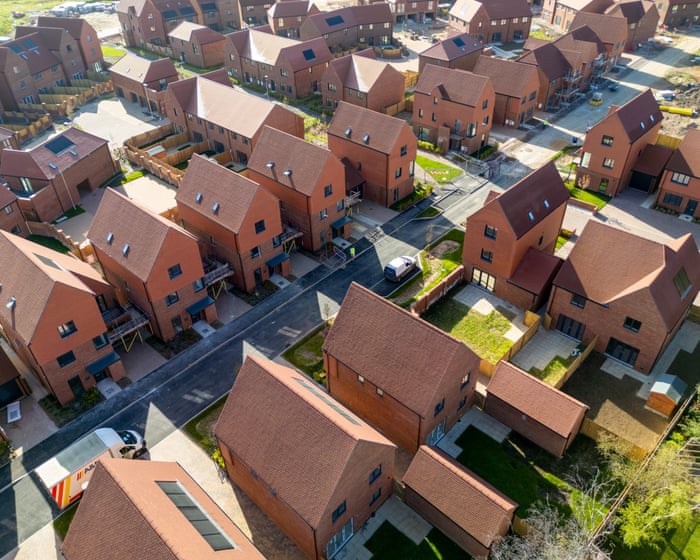
The UK housing market remains subdued but the downturn eased last month, while sentiment remains “fragile,” according to surveyors and estate agents.
They expressed ongoing concerns about the impact of inflation, the cost of living, UK political uncertainty and global conflicts, with some sharing hopes that the recent ceasefire in the Iran war will boost market conditions.
The survey’s headline house price balance was little changed at -33%, from a revised -34% in May, while price expectations rose to +8% from +6% according to a monthly survey from the Royal Institution of Chartered Surveyors (RICS). The balance subtracts those who say demand fell from those who report it rose.
New buyer enquiries remained negative, with a headline net balance of -29%, but this was a slight improvement on the -34% recorded in the previous two months and marks the least negative reading since February.
Newly agreed sales also remained subdued, with a net balance of -32%, but a small improvement from -35% previously.
Near-term sales expectations improved to -16%, from a recent low of -34% in March. Looking further ahead, respondents expect sales volumes to remain broadly flat over the next twelve months, with a net balance of +1%.
However, new instructions to put properties on the sales market moved further into negative territory, dropping to -23% from -10%, the weakest reading in more than a year. Market appraisals also declined, suggesting the pipeline of homes coming to market may remain limited in the months ahead.
RICS head of market and analysis Tarrant Parsons said:
June’s survey results offer some cautious encouragement that the worst of the slowdown in market activity may be beginning to pass, with several key indicators moving in a less negative direction for a second consecutive month. That said, any nascent improvement remains fragile and is now being tested by renewed political uncertainty on the domestic front.
While the Bank of England left interest rates unchanged, uncertainty around the outlook for inflation and borrowing costs continues to weigh on sentiment, even if the recent decline in oil prices is a welcome development.
Until there is greater clarity over both the political backdrop and the path of interest rates, housing market activity is likely to remain relatively subdued in the near term.
In the lettings market, tenant demand picked up, with the headline net balance rising to +18%, the strongest reading since May 2025.
Landlord instructions remained negative at -18%, pointing to continued supply constraints. Against this backdrop, rents are expected to continue rising, with projected rental growth over the next twelve months standing at around 2.5%.
The north of England continues to express more positive sentiment than the south generally.
Dan Stocks, a surveyor in Guildford, said:
Market uncertainty remains due to Labour leadership changes, cost-of-living pressures, fuel prices, the ongoing Russia–Ukraine war and the recent conflict involving Iran, all of which continue to weaken confidence.
After Wednesday’s jump in oil prices, where Brent crude briefly went above $80 a barrel, crude is little changed on Thursday.
Brent dipped 0.3% to $77.78 a barrel.
Asian stock markets mostly bounced back following Wednesday’s losses. Japan’s Nikkei rose 1.4% and China’s CSI 300 advanced 1.9% while South Korea’s Kospi gained 1%.
China’s producer price inflation has risen to the highest in four years, piling pressure on manufacturers as weak domestic demand restrains their ability to raise prices.
China’s economy is showing a two-track dynamic as a global AI boom lifts advanced manufacturing while weak household spending and the property downturn weigh on domestic activity.
The producer price index rose 4.1% year on year to the highest since July 2022, according to the National Bureau of Statistics. This is up from a 3.9% gain in May and reflects the impact of soaring energy prices because of the Iran war.
The Agenda
12.30pm BST: ECB account of June meeting
1.30pm BST: US Initial job less claims for week to 4 July
3pm BST: US Existing home sales for June
View original source — The Guardian ↗
Related stories

Bloomberg
BusinessJul 9, 2026 · 1 min
Odd Lots: Man Group’s Massive Growth in Token Spending (Podcast)
Bloomberg

Rio Times
BusinessJul 9, 2026 · 1 min
Guyana Development Bank Offers $14,400 Free Loans, If You Qualify
Rio Times

Rio Times
BusinessJul 9, 2026 · 1 min
Police Ask If Banco Master Bought Protection With Party Videos
Rio Times

Rio Times
BusinessJul 9, 2026 · 1 min
Guyana and Trinidad Build a Trade Desk to Unblock Honey and Peppers
Rio Times