Indian Express
‘Shariat can’t override child marriage law’: Court says puberty not legal age
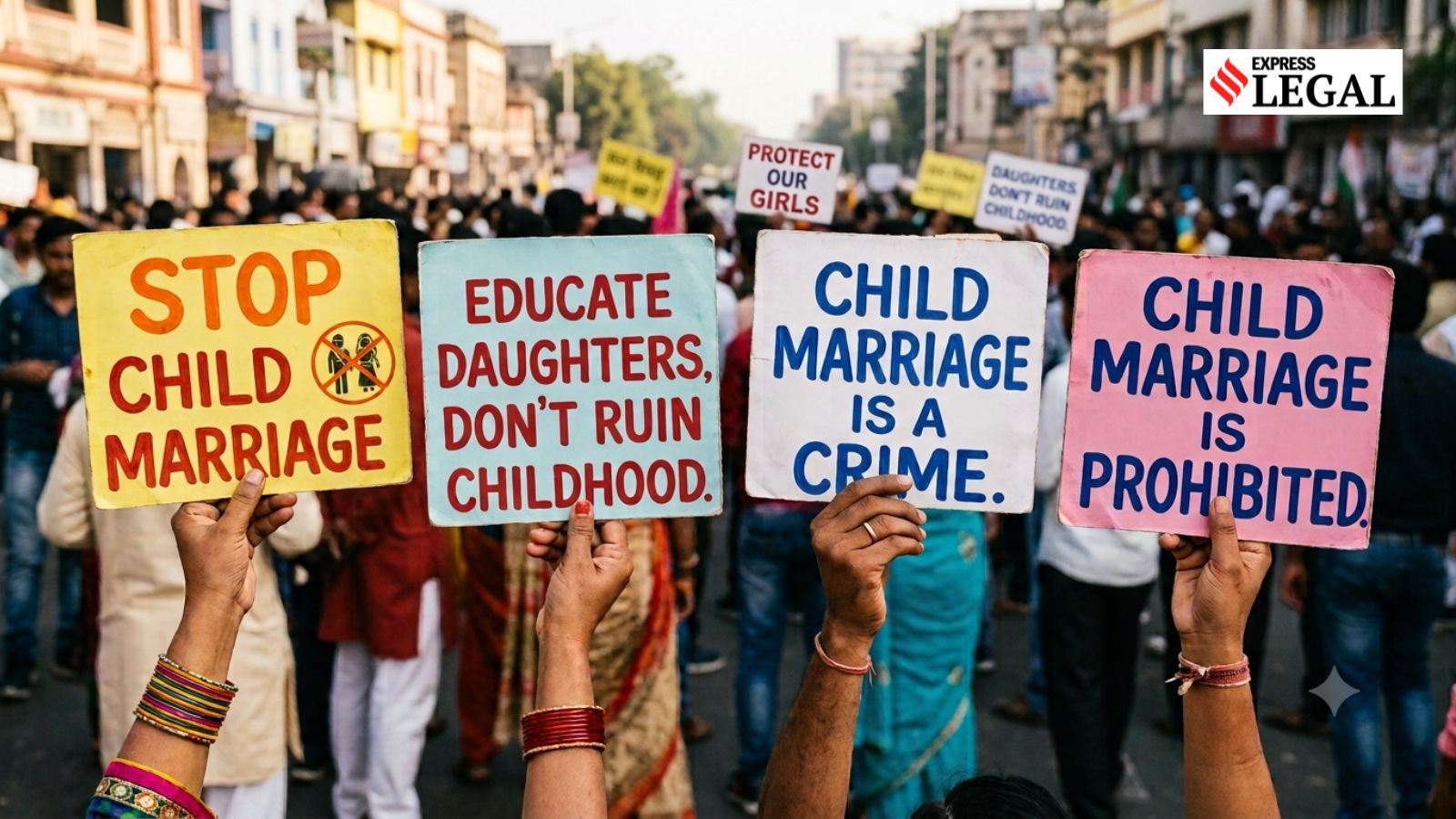
The Allahabad High Court recently ruled that the Shariat law allowing marriage after puberty cannot override the provisions of the Prohibition of Child Marriage Act (PCMA) and the Protection of Children from Sexual Offences Act (POCSO), which set 18 as the minimum age of marriage for girls.
“The Shariat Law providing for puberty as the competent age…for a girl to marry or be married runs clearly in the teeth of the PCMA as well as the POCSO Act,” the bench said on July 1.
A division bench of Justices J J Munir and Achal Sachdev was dealing with a plea filed by 19 petitioners seeking to set aside an FIR registered against them for allegedly trying to conduct the marriage of a 16-year-old girl under Muslim Personal Law (Shariat). They were booked for reportedly assaulting police officers and the members of the Child Welfare Committee (CWC) during the girl’s rescue.
The court dismissed their plea, holding that the allegations disclosed cognisable offences requiring an investigation. It also upheld the police and Childline’s intervention to stop the child marriage, vacated the interim stay on the investigation, and directed that its order be communicated to the police authorities concerned.
The court noted that the age of marriage for every citizen of the country, irrespective of religion, is mentioned under the Prohibition of Child Marriage Act, 2006. If the marriage of a person below 18 years is permitted, physical relations within such a union would be in violation of the POCSO Act, it held.
The bench pointed out that PCMA and the POCSO Act are based on public health and national policies. They have a scientific basis and no one can be excluded from it.
FIR challenged in court
On receiving information that a 16-year-old Muslim girl was about to be married, police officers and a Childline team reached her house on February 15 this year to stop the wedding and produce her before the CWC.
Story continues below this ad
Justices J J Munir and Achal Sachdev said that PCMA and POCSO Act are based on public health and national policies.
During the intervention, the girl’s family members and other villagers abused, threatened and assaulted the officials, and forcibly took the girl away from Childline’s custody.
An FIR was registered against 19 persons and around 50 unidentified individuals for obstructing public servants and other offences under the Bharatiya Nyaya Sanhita (BNS). The accused approached the high court seeking quashing of the FIR, contending that under Muslim Personal Law, a girl who has attained puberty can legally marry.
Appearing for the petitioners, advocate Pooja submitted that under Shariat, a girl who attains the age of puberty, generally regarded as 15 years, is competent to marry. She argued that PCMA would not affect the Muslim Personal Law. She stated that while the Majority Act, 1875, generally fixes the age of majority at 18 years, under Section 2 of the Act, it does not apply to laws relating to marriage, divorce and adoption.
Offences clear: Court
The court stated that although the Majority Act does not fix 18 years as the marriageable age, that argument is no longer relevant because the PCMA and the POCSO Act were enacted later. The newer laws clearly prohibit child marriage and sexual relations with anyone below 18 years, overriding any other provision.
Story continues below this ad
It may be noted that a marriage performed in violation of PCMA may be voidable and not void, but the act of performing such a marriage is punishable by law. The offences under PCMA are cognisable and non-bailable.
The court said it was informed during the hearing that the Prohibition of Child Marriage (Amendment) Bill, 2021, which proposed to raise the legal age of marriage for women to 21, had lapsed with the dissolution of the 17th Lok Sabha. Nothing has been shown indicating that the Bill is still pending before the Parliament.
There was a determined attempt to marry a girl below 18 years by her parents and the community, in violation of the PCMA, the court observed. The marriage would have led to a violation of the POCSO Act. “The submission is that there is no independent witness to the incident. We regret that we cannot agree. The offences are clearly disclosed,” the bench stated.
View original source — Indian Express ↗
Related stories

CNA
WorldJul 9, 2026 · 1 min
Malaysia and Thai PMs resolve fisheries issue, to work on special economic border zone
CNA

Euronews
WorldJul 9, 2026 · 1 min
EU should make 'individual assessments' before returning migrants, says UNHCR representative
Euronews

Philippine Daily Inquirer
WorldJul 9, 2026 · 1 min
PBA: John Amores returns after signing with Titan Ultra
Philippine Daily Inquirer
Indian Express
WorldJul 9, 2026 · 1 min
No child should face stigma of jail birth like Lord Krishna, says court, granting Nida Khan bail in TCS Nashik case
Indian Express