Times of Israel
Anti-Israel Democrat in Maine ends US Senate campaign after rape accusation
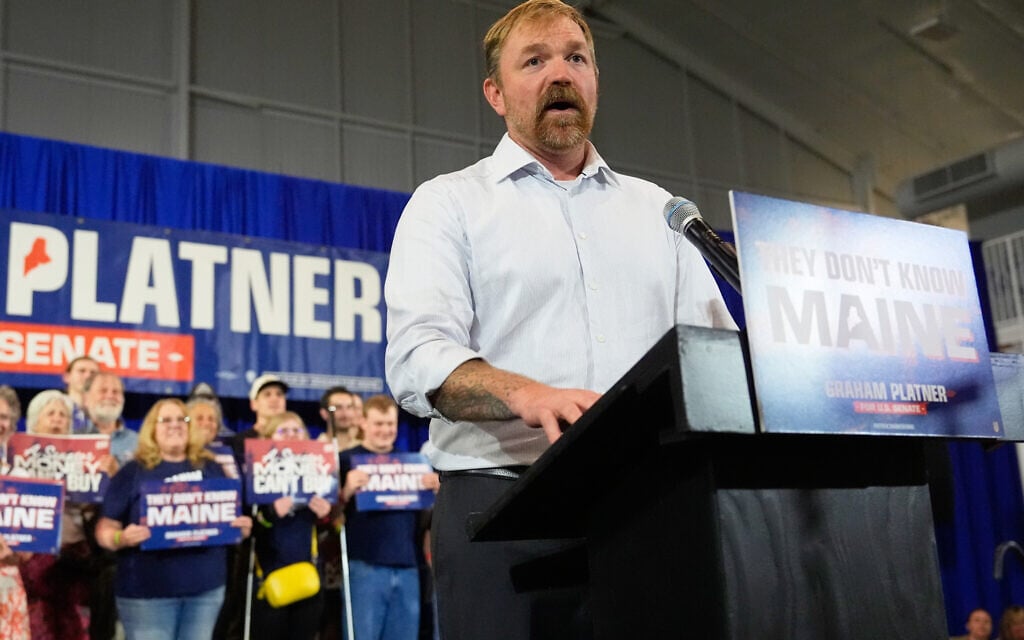
Graham Platner, a scandal-plagued Democratic Senate nominee whose insurgent rise was fueled in large part by his opposition to Israel, announced Wednesday that he will end his campaign after a rape allegation threatened to derail his run, which was seen as one of his party’s best chances of flipping a Republican-held seat.
“We are suspending campaign operations,” said Platner, who prior to the rape accusation, faced criticism for long having a Nazi SS Totenkopf tattoo, and for other allegations of mistreating women.
“This is incredibly difficult, because I know that some will think it’s an admission of guilt, and it most certainly is not. We’re not doing it because of the allegations, we’re doing it because of the structures that are being taken away from us by those in power,” he added in a video posted on X.
Platner said the process to replace him needs to be “open, transparent and democratic” and to reflect the will and values of people who supported him. He also lashed out at Democratic leaders in Washington, DC.
“People in DC need to stay in DC,” Platner said. “Decisions should not be made by people in places of political power.”
Get The Times of Israel's Daily Edition
by email and never miss our top stories
By signing up, you agree to the terms
Platner’s exit could exacerbate divisions between the party’s moderate and progressive factions, as Democrats debate who should replace him on the ballot and struggle to unify ahead of this year’s midterm elections.
My name might be on the ballot right now, but that ballot line belongs to the people of Maine. pic.twitter.com/RKVyLU76tm
— Graham Platner for Senate (@grahamformaine) July 9, 2026
Maine is considered a key state for control of the narrowly divided Senate, and Democrats were desperate for a candidate capable of defeating Republican Sen. Susan Collins while US President Donald Trump is broadly unpopular.
Although Platner had never before held elected office, progressive leaders promoted him over Gov. Janet Mills, who was favored by the Democratic establishment. Mills dropped out of the race in late April as Platner, a military veteran and oyster farmer, consolidated support from primary voters who were eager for a more combative candidate and were willing to overlook his checkered past.
Known for anti-Israel rhetoric, he has called for cutting US military assistance to Israel and has accused the Jewish state of genocide in Gaza. He said his Republican rival, Susan Collins, was “bought and paid for by Benjamin Netanyahu” due to her support from AIPAC — a comment that drew accusations of antisemitism.
Shortly before Platner clinched the Democratic nomination in the June 9 primary, there were reports that he had exchanged sexually explicit messages with other women while married and that he had become physical with a previous girlfriend during an argument.
But Platner’s support didn’t crater until Monday, when Politico reported that a woman said he drunkenly forced her to have sex after she told him to stop.
Jenny Racicot, who lives in Maine, told Politico she had been in an on-and-off relationship with Platner but cut off contact with him after that night in 2021 and told him the encounter wasn’t consensual. In a CNN interview, she said she had been raped “by definition.”
After the story was published, Platner in a video released on social media denied the allegation as “categorically false” but said he would be “taking the time to reflect on the best path forward” for his campaign. High-level backers pulled their support, including Vermont Sen. Bernie Sanders, who said the next day that he spoke with Platner and that “in light of these very serious allegations, I have recommended that he step aside.”
State law includes a provision for Democrats to replace Platner before the general election. The state Democratic Party held an emergency meeting Wednesday, where more than 100 state committee members signed off on holding a nominating convention, in the event of Platner’s withdrawal.
Platner announced he would do just that less than an hour later.
According to the statute, party officials may select a new nominee if a candidate who won the primary withdraws by 5 p.m. on July 13. The replacement candidate must be named by July 27.
Democrats must net four Senate seats to gain control of the 100-member chamber, and party leaders viewed Maine as a critical piece of the puzzle, along with Alaska, Ohio and North Carolina.
View original source — Times of Israel ↗
Related stories

South China Morning Post
TechnologyJul 9, 2026 · 1 min
Xiaomi preps for fierce EV race with new SUV line, long-range battery tech
South China Morning Post

Wired
TechnologyJul 9, 2026 · 1 min
The Best Food Dehydrators for Self-Sufficient Kitchens (2026)
Wired

Wired
TechnologyJul 9, 2026 · 1 min
Federal Investigators Say Certain DOGE Records Were Deleted
Wired

Indian Express
TechnologyJul 9, 2026 · 1 min
Was Nashik ring road realigned to benefit a few? Maharashtra orders 15-day probe after Oppn charge
Indian Express