Indian Express
Surat demolition: Gujarat High Court grants state more time to reply amid flood situation
3 min readVadodaraUpdated: Jul 9, 2026 02:10 PM IST
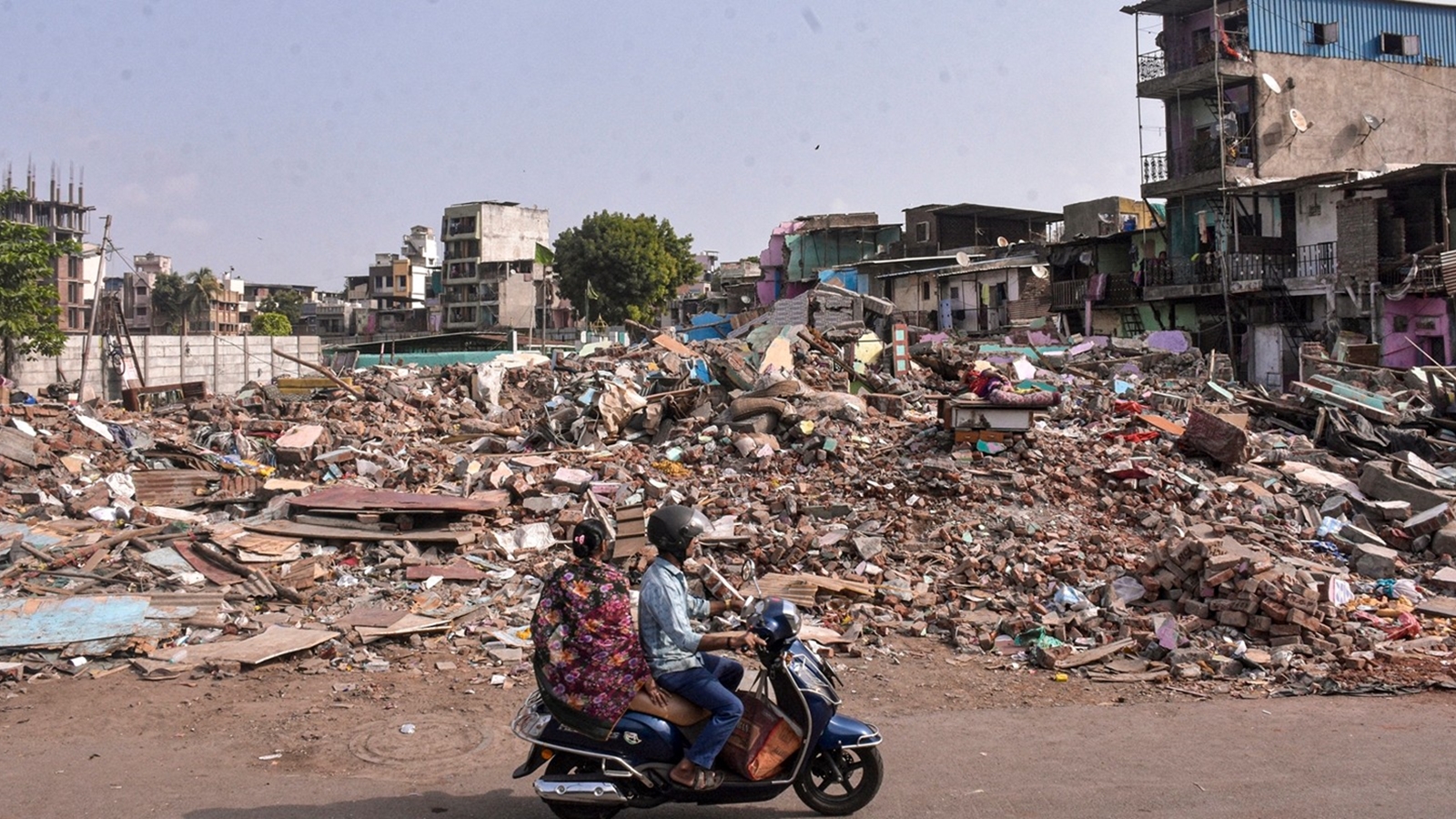
Over 100 houses in Nasirnagar area were demolished in May. (PTI/File)
The Gujarat High Court Thursday granted additional time to the state government and the Surat city police to file their responses in the proceedings arising from the May 30 demolitions in Surat’s Nasir Nagar, where over 100 families were displaced after what the civic body has since acknowledged was an unauthorised demolition.
When the matter came up before Justice Nikhil Kariel on Thursday, Government Pleader G H Virk sought a few days to file the affidavit of the Surat Commissioner of Police, citing the prevailing flood situation in Surat. Advocate General Kamal Trivedi, appearing for the SMC, also requested a week to examine the affidavits already placed on record before filing the corporation’s response.
The court accepted the requests and adjourned the matter to July 20.
During the hearing, three private advocates informed the court that five Surat Municipal Corporation (SMC) officials, who have been impleaded in the petition in their personal capacity, had engaged separate legal representation. The officials include Executive Engineer (Road Development Department) Sujal Prajapati, Urban Development and Town Planning Department official Naresh Galchar, Junior Engineer Monik Gadhiya and Assistant Engineer Jainish Patel.
The advocates sought the court’s intervention, stating that the court Registry had directed them to obtain the civic body’s seal to file their respective vakalatnamas. Observing that the officials had been arrayed as respondents in their individual capacities, the High Court directed the Registry to accept the vakalatnamas of the three advocates.
More than 100 families displaced in demolitions
The case stems from the demolition carried out by civic officials on May 30, during which houses in Nasir Nagar were razed without prior notice or demolition orders, displacing more than 100 families.
At the previous hearing on July 1, the High Court had made significant prima facie observations after taking on record an affidavit filed by the Surat Municipal Commissioner. The affidavit acknowledged that the demolition occurred during what was intended as a physical demarcation exercise and that there was no underlying decision authorising the demolition, leading the court to observe that the civic body itself had accepted that the action was “completely illegal”.
Story continues below this ad
The court had then held that it was the corporation’s duty to ensure the displaced residents were appropriately rehabilitated, either by reconstructing their homes at the original site or by accommodating them elsewhere through alternative arrangements. It directed the Municipal Commissioner to place a concrete rehabilitation proposal before the court through an affidavit.
The High Court had also directed the Gujarat government to clarify its stand on the incident after observing, prima facie, that once it was evident the demolition was unauthorised, the police were duty-bound to act on complaints made by the affected residents rather than merely protect the exercise.
The Municipal Commissioner’s affidavit had further disclosed that a preliminary inquiry committee constituted by the corporation found that the officials concerned had not been forthcoming about the events leading to the demolition, necessitating a deeper inquiry. Based on the committee’s findings, five SMC officials were suspended.
The petition has been filed by 26 residents affected by the demolition, who have challenged the action as illegal and sought accountability and rehabilitation.
Aditi Raja is an Assistant Editor with The Indian Express, stationed in Vadodara, Gujarat, with over 20 years in the field. She has been reporting from the region of Central Gujarat and Narmada district for this newspaper since 2013, which establishes her as a highly Authoritative and Trustworthy source on regional politics, administration, and critical socio-economic and environmental issues.
Expertise:
Core Authority & Specialization: Her reporting is characterized by a comprehensive grasp of the complex factors shaping Central Gujarat, which comprises a vast tribal population, including:
Politics and Administration: In-depth analysis of dynamics within factions of political parties and how it affects the affairs in the region, visits of national leaders making prominent statements, and government policy decisions impacting the population on ground.
Crucial Regional Projects: She consistently reports on the socio-economic and political impact of infrastructure projects in the region, especially the Statue of Unity, the Sardar Sarovar Project on the Narmada River, the Mumbai-Ahmedabad High Speed Rail bullet train project as well as the National Highway infrastructure.
Social Justice and Human Rights: Her reporting offers deep coverage of sensitive human-interest topics, including gender, crime, and tribal issues. Her reports cover legal proceedings from various district courts as well as the Gujarat High Court (e.g., the Bilkis Bano case remission, POCSO court orders, Public Interest Litigations), the plight of tribal communities, and broader social conflicts (e.g., Kheda flogging case).
Local Impact & Disaster Reporting: Excels in documenting the immediate impact of events on communities, such as the political and civic fallout of the Vadodara floods, the subsequent public anger, and the long-delayed river redevelopment projects, Harni Boat Tragedy, Air India crash, bringing out a blend of stories from the investigations as well as human emotions.
Special Interest Beat: She tracks incidents concerning Non-Resident Gujaratis (NRIs) including crime and legal battles abroad, issues of illegal immigration and deportations, as well as social events connecting the local Gujarati experience to the global diaspora. ... Read More
Tags:
Gujarat High Court
View original source — Indian Express ↗
Related stories

The Punch
WorldJul 9, 2026 · 1 min
Nothing must happen to Peter Obi, Atiku warns Presidency
The Punch
The Punch
WorldJul 9, 2026 · 1 min
Canada extends proof of citizenship processing time to 19 months
The Punch
The Punch
WorldJul 9, 2026 · 1 min
Ebola death toll in DRC hits 600, WHO reports
The Punch
The Punch
WorldJul 9, 2026 · 1 min
Police kill two kidnappers, recover firearm after rescuing Ogun prince
The Punch