Antara News
Lahadalia said B50 to save US$9.35 billion in forex
we will no longer import diesel fuel into our country
Karawang, West Java (ANTARA) - Indonesia's Minister of Energy and Mineral Resources Bahlil Lahadalia said the implementation of the B50 biodiesel programme could save around Rp170 trillion (around US$9.3 billion) in foreign exchange, as it reduces the country's need to import diesel.
"With the implementation of B50, Mr. President, we have saved Rp170 trillion. So, by moving from B40 to B50, we have been able to retain Rp170 trillion in foreign exchange reserves," said Lahadalia at the launch of the B50 Biodiesel Mandate Programme at the KM 57 Rest Area, Karawang Regency, West Java, on Thursday.
The figure is higher than the Rp133.3 trillion or around US$7.36 billion in foreign exchange savings generated under the mandatory B40 biodiesel policy.
Related news: Indonesia rail fleet fully prepared for B50 biofuel shift
In addition to saving foreign exchange, the B50 programme is projected to increase the added value of crude palm oil (CPO) from Rp20.92 trillion to around Rp23.49 trillion.
Besides, the mandate programme of such biodiesel could create around 2.1 million jobs and reduce greenhouse gas emissions by approximately 44.46 million tons of CO2 in 2026.
"With the implementation of B50, we will no longer import diesel fuel into our country. This is the first time this has happened," he stated.
Related news: Pertamina ready to roll out B50 biodiesel ahead of July 2026 launch
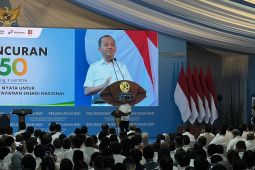
President Prabowo Subianto officially launched the Mandatory B50 Biodiesel Programme at the KM 57 Rest Area in Karawang District, West Java, on Thursday.
The legal basis for implementing the Mandatory B50 Biodiesel Programme is Ministerial Regulation Number 4 of 2025 on the Business Activities and Utilisation of Biofuels, as well as Ministerial Decree Number 257.K/EK.01/MEM.E/2026 on the Mandatory Blending of 50 Percent Biodiesel into Diesel Fuel.
The B50 programme requires diesel fuel to be blended with 50 percent biodiesel.
Under the policy, biofuel business entities, fuel business entities, and fuel distributors are required to comply with the prescribed standards and quality specifications.
The policy is part of the government's strategic agenda to reduce dependence on fuel imports, increase the added value of the country's natural resources, and strengthen Indonesia's economic and energy security.
Related news: Indonesia begins B50 biodiesel rollout at 29 fuel terminals
Translator: Putu, Kenzu
Editor: Fransiska Ninditya
Copyright © ANTARA 2026
View original source — Antara News ↗
Related stories

TASS
BusinessJul 9, 2026 · 1 min
Scientific center on Spitsbergen to accommodate up to 100 scientists at initial stage
TASS

TASS
BusinessJul 9, 2026 · 1 min
Scientists sample Barents Sea sediments for radioactivity tests
TASS

TASS
BusinessJul 9, 2026 · 1 min
Experts develop plan for adaptation to permafrost degradation in Russian Arctic
TASS
CNA
BusinessJul 9, 2026 · 1 min
SAP averts EU antitrust fine as regulators accept offer to address competition concerns
CNA