Indian Express
Heavy rain left a trail of fallen trees across Delhi. Here’s why
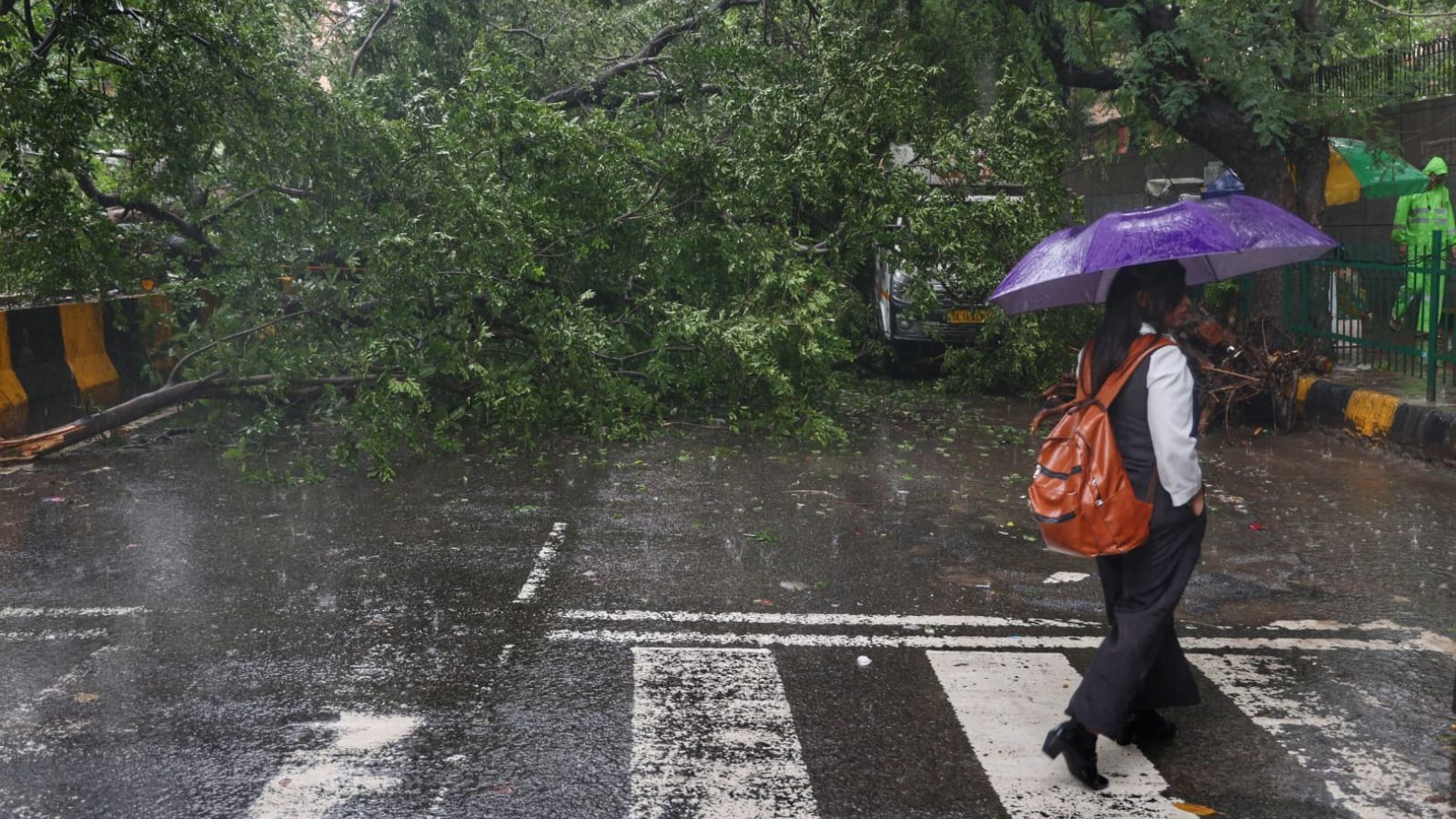
Another spell of heavy rain battered Delhi on Thursday, leaving roads waterlogged, traffic crawling — and a trail of fallen trees across the city.
From a banyan and a pilkhan tree that uprooted a concrete footpath in East of Kailash to an Arjun tree felled in Mount Kailash, a eucalyptus that crashed in Surajmal Vihar and a vilayati kikar blocking a road in Narela, the downpour left its mark across several neighbourhoods as residents lodged complaints with the Municipal Corporation of Delhi (MCD).
The extent of the damage is particularly significant given Delhi’s tree cover. Among India’s megacities, the Capital has the highest overall forest cover. It maintains a tree cover of 147 sq beyond the designated forests, accounting for nearly 9.8% of its total landscape, according to the 2023 India State of Forest Report.
Why the tree cover in capital is vulnerable
Trees in Delhi topple easily because a mix of ecological stress and regulatory hurdles leaves them structurally weak.
-Concretisation around trunks chokes roots and cuts off aeration
-Trenchless cabling and shallow watering damage or stunt root systems.
-Termite infestations hollow out trunks
-Irregular or delayed pruning allows canopies to grow heavy and unbalanced.
These vulnerabilities are compounded by staff shortage, fragmented responsibility across civic agencies, and the absence of an updated city‑wide tree census, NDMC’s Horticulture officials told The Indian Express.
Story continues below this ad
When high‑speed winds and heavy rainfall strike, the weakened trees are unable to withstand the pressure, leading to frequent collapses.
What does the law say
As reported by The Indian Express on June 16, remedial action can be taken against dead trees and trees leaning precariously or vulnerable to falling during a storm.
On June 6, 2025, the Delhi government had issued a notification for tree removal after releasing a Standard Operating Procedure (SOP).
There were some exemptions including a go-ahead for government and developmental agencies to fell, cut, or transplant trees for infrastructure projects without waiting for explicit prior permissions. Similarly, civic bodies and private individuals did not need permission for “general tending and light pruning” if the tree branch’s girth was less than 15.7 cm.
Story continues below this ad
Last month, the Delhi High Court stayed this notification, saying agencies can no longer rely on blanket exemptions to prune or cut trees during development works.
Instead, only emergency provisions of the Delhi Preservation of Trees Act (DPTA), 1994, remain operative, allowing immediate removal when a tree poses grave danger to life, property or traffic, with mandatory reporting to the Tree Officer within 24 hours.
For all other cases, the law requires a formal application, inspection and written approval, a process that often stretches weeks.
What do experts say
Several experts The Indian Express spoke to pointed to a range of factors behind the damage, from unscientific pruning and concretisation of pavements to gaps in enforcement.
Story continues below this ad
Naved Ahmed, a scientific team member at DU’s Centre for Environmental Management of Degraded Ecosystems (CEMDE), said, “Trees are suffocating in Delhi. The main reason is construction… and other reasons like tree ageing, fungal infections and poor species site selection.”
“I have seen pilkhan, ficus (gular) and peepal fall near New Friends Colony because of these reasons,” he added.
Dr Surya Prakash, retired zoologist at the School of Life Sciences at JNU, said, “I just returned from Delhi, having covered 100 km of roads that are waterlogged with huge potholes and RCC-stiffened pavement. Just imagine how suffocated our roadside trees are…”
He pointed to issues with tree pruning. “In the name of pruning, the ‘shoot apex’ is cut so trees expand horizontally… it can’t grow from the chopped area because the terminal tips are cut.”
Story continues below this ad
“The stumps,” he explained, “already surrounded by RCC, can’t sustain that horizontal load of branches because they are weak and ultimately fall.”
Chellaiah Sellamuthu, former NDMC Director (Horticulture) earlier told The Indian Express that pruning practices are often discouraged due to strict regulations under the DPTA. “There is no distinction between forest and non-forest trees in urban areas. The DPTA needs to treat them differently and allow horticultural practices that suit city conditions.”
View original source — Indian Express ↗
Related stories

The Punch
WorldJul 9, 2026 · 1 min
Nothing must happen to Peter Obi, Atiku warns Presidency
The Punch
The Punch
WorldJul 9, 2026 · 1 min
Canada extends proof of citizenship processing time to 19 months
The Punch
The Punch
WorldJul 9, 2026 · 1 min
Ebola death toll in DRC hits 600, WHO reports
The Punch
The Punch
WorldJul 9, 2026 · 1 min
Police kill two kidnappers, recover firearm after rescuing Ogun prince
The Punch