Times of Israel
New exhibit showcases ancient Jewish village on Sea of Galilee
Pieces of the past
Huqoq exhibition in Kibbutz Ginosar features finds from 1,600-year-old northern community that flourished under Byzantine rule
By Zev Stub
You will receive email alerts from this author.
Manage alert preferences on your profile page
You will no longer receive email alerts from this author.
Manage alert preferences on your profile page
Today, 1:33 pm
Edit
Zev Stub is the Times of Israel's Diaspora Affairs correspondent.
A new exhibition in northern Israel provides the first public glimpse of an ancient Jewish village with synagogue floor mosaics said to be among the most beautiful ever discovered in the country.
The “Secrets of Huqoq” exhibition at the Yigal Allon Center Museum in Kibbutz Ginosar, on the shores of the Sea of Galilee, explores the ruins of Huqoq, a flourishing ancient Jewish village that thrived during the Roman-Byzantine period. The location overlooks the Huqoq excavation site in the Amiad Forest on the shores of the lake.
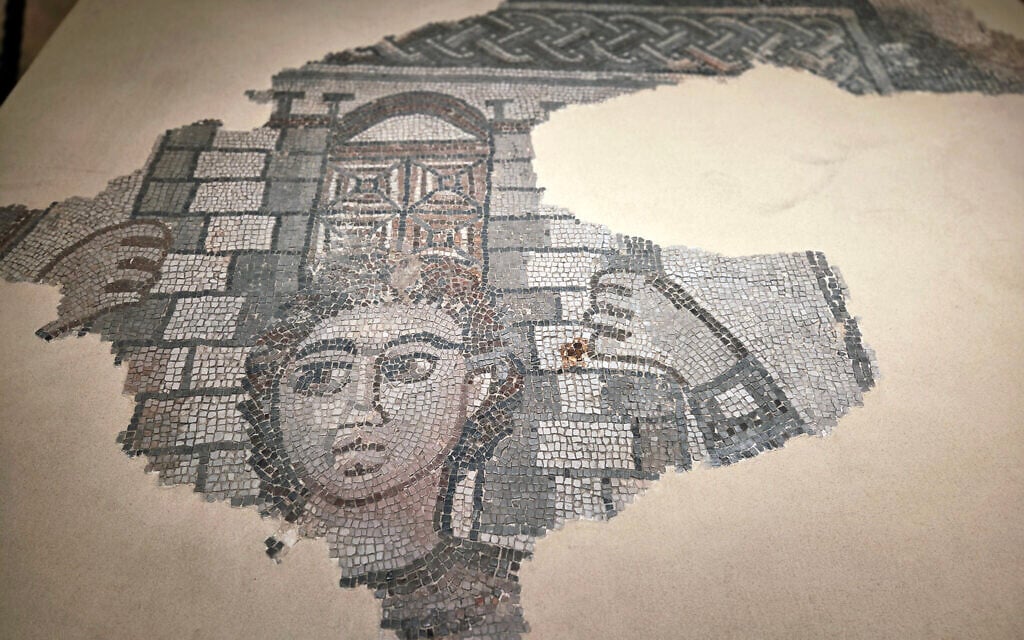
The 1,600-year-old site is exceptional for its ancient synagogue with well-preserved and colorful mosaics, including scenes from the biblical story of Samson.
“Extraordinary in their beauty and narrative richness, including rare biblical and extra-biblical scenes… the Huqoq mosaics are unequalled by any other synagogue in Israel,” the Israel Antiquities Authority (IAA) said in a statement announcing the new display.
Huqoq remained a prosperous Jewish village during the Byzantine period even as Christianity became the empire’s dominant religion.
Get The Times of Israel's Daily Edition
by email and never miss our top stories
By signing up, you agree to the terms
At the center of the exhibition is the original mosaic of Samson, carrying the gates of the city of Gaza on his shoulders as described in the Book of Judges. Other mosaics are not yet publicly displayed, but can be seen in photographs at the excavation provided by the site’s lead excavator, Prof. Jodi Magness of the University of North Carolina at Chapel Hill.
Mosaics discovered on the synagogue floor include the earliest known depictions of biblical Deborah and Yael, the first known depiction of the story of the oasis of Elim during the Exodus, as well as illustrations of Noah’s Ark, Jonah and the whale, and the splitting of the Red Sea.
The exhibit also features a hoard of bronze coins discovered within a hidden escape system found in the village, as well as other findings. A ring and dagger uncovered shed light on the dangers the Jewish community faced for being faithful to its identity while living under Christian rule, IAA said.
The exhibition presents Huqoq as an encompassing living environment, with a spring, agriculture, mikvehs (ritual baths), and a hidden underground escape network that allowed residents to flee from Christian persecution.
“Through archaeological finds, photographs, a small-scale model of the settlement, and an experiential space simulating part of its underground world, visitors enter the story of a town whose discoveries are still coming to light,” IAA said.
The exhibition is a joint initiative of JNF-KKL and the WF Albright Institute of Archaeological Research, supported by the US government and the IAA.
If you’d like to comment, join
The Times of Israel Community.
View original source — Times of Israel ↗
Related stories

The Next Web
TechnologyJul 9, 2026 · 1 min
Suspected Chinese spies are raiding university mailboxes via a Roundcube flaw
The Next Web

TASS
TechnologyJul 9, 2026 · 1 min
Mali finds evidence of Ukraine-trained terrorists operating in country
TASS

The Verge
TechnologyJul 9, 2026 · 1 min
ICE agents are making house calls for online critics
The Verge

CBC
TechnologyJul 9, 2026 · 1 min
Fitness influencer Connor Murphy reported dead in Thailand
CBC