Philippine Daily Inquirer
Shell Soldier blends FEAR, DOOM into one ambitious game
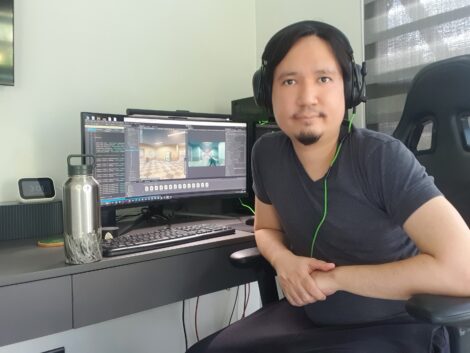
The FPS genre has changed dramatically over the past decade. Multiplayer shooters, live service games, extraction shooters, and battle royales have dominated the conversation, while single-player campaigns have slowly taken a back seat. Robert Sadang II, founder of CatHuntTree and the solo developer behind Shell Soldier, isn’t interested in chasing those trends. He grew up with campaign-driven shooters and simply wanted to make the kind of game he still enjoys playing today. The result is Shell Soldier, a dystopian sci-fi shooter that combines fast movement, aggressive combat, and enemy AI designed to keep players thinking instead of hiding behind cover.
Before becoming an independent developer, Robert worked as a mobile game artist. Like many developers, his first serious project wasn’t the one that eventually defined his studio. After graduating from game development school, he began building a commercial horror game before realizing halfway through development that the project simply wasn’t exciting him anymore. Rather than forcing himself to finish something he no longer believed in, he looked back at the games that had inspired him growing up.
“I started looking at my favorite games, which have always been campaign-driven first-person shooters, and quickly decided to pivot to that genre instead,” Robert told INQUIRER.net. “I knew it was the game I wanted to build because it was fun to play, not just for me, but for everyone I shared the early versions of the game with.”
Article continues after this advertisement
While F.E.A.R. is an obvious point of comparison, Robert says the game’s influences come from a much wider range of shooters. MachineGames’ Wolfenstein series inspired the gritty presentation and satisfying gunplay, while DOOM (2016), DOOM Eternal, and DOOM: The Dark Ages demonstrated how every encounter could become a puzzle built around movement, positioning, and weapon choice. Even games outside the traditional FPS space found their way into Shell Soldier. He points to Rollerdrome for showing how movement can become just as important as shooting, while Overwatch demonstrated how enemy variety can fundamentally change the way players approach combat. The first three Silent Hill games also left a lasting impression through their atmosphere and psychological horror, elements that eventually found their way into the world of Shell Soldier.
FEATURED STORIES
TECHNOLOGY
TECHNOLOGY
TECHNOLOGY
“When I designed the combat for Shell Soldier, I wanted players to use multiple methods of attack and engage enemies at different ranges rather than relying on a single gun and camping in one corner of the map.”
The enemy AI became the biggest expression of that design philosophy. Robert said he spent years refining how enemies behave because he wanted firefights to feel dynamic instead of predictable. Rather than charging directly toward the player, enemies spread across the battlefield, look for flanking routes, and attack from multiple angles to prevent players from comfortably defending a single position. Every encounter is designed to pressure movement because standing still gives enemies exactly the advantage they are looking for.
Enemy variety plays an equally important role. Different enemy types force players to constantly adjust their tactics instead of relying on a single strategy for the entire campaign. One of Robert’s favorite examples is the Sapper, an enemy that rarely engages the player directly. Instead, it deploys seeker mines that relentlessly chase the player around the battlefield while the Sapper retreats and continues deploying more explosives from a safe distance. The encounter isn’t difficult because the enemy has more health or deals more damage. It becomes difficult because players suddenly have multiple threats demanding their attention at once.
Article continues after this advertisement
Robert believes balancing a shooter comes down to one simple question: how effectively can the player hold a position, and how effectively can enemies force that player to abandon it? Giving either side stronger tools immediately changes that balance. Instead of relying on larger enemy health pools or higher damage values to increase difficulty, Shell Soldier tries to make players rethink their decisions during every encounter.
Although combat sits at the center of the experience, Robert never wanted the game to become a purely old-school shooter. The current build includes a perk system that allows players to strengthen different abilities while assigning separate perks to each weapon slot. The system adds another layer of customization without shifting the game’s focus away from fast, moment-to-moment combat.
“I’m a big fan of moment-to-moment decision making in games because it makes the experience more engaging and satisfying,” he said. “That said, I’m also a fan of progression mechanics.”
Article continues after this advertisement
The world surrounding those firefights also evolved considerably during development. Shell Soldier takes place in a dystopian future where the Armatac Corporation has effectively taken control of society, but Robert said that premise became more complicated as development continued. What began as a story about an oppressive corporation slowly introduced supernatural elements, mythology, and questions about who was truly manipulating events behind the scenes.
“When I first started developing Shell Soldier, I knew the game’s main villain would be an evil corporation,” he said. “As development progressed, however, I began incorporating supernatural elements and mythology into the story. I also started exploring ideas like ‘Who is really the bad guy?’ and ‘Who is manipulating whom?’ to make the narrative more unpredictable.”
Those ideas were shaped as much by film as they were by games. Robert credits Blade Runner, Ghost in the Shell, The Matrix, and Equilibrium for influencing the game’s atmosphere, while action films like Hard Boiled, Heat, and the John Wick series helped shape its firefights. Together, they created the tone he wanted for Shell Soldier, one where the mystery surrounding Subject 89 is just as important as the action itself.
Building that experience as a solo developer meant wearing almost every hat imaginable. Robert handled years of programming, level design, iteration, and optimization while gradually improving systems that had become more demanding as development continued. Surprisingly, one of the biggest technical challenges wasn’t enemy AI or combat at all. It was building a save system that could reliably store, load, and encrypt player data. He also found himself revisiting earlier code to improve performance after realizing the first versions of the project weren’t optimized well enough for the game he wanted to build.
Not every idea survived development. Robert originally planned to include destructible walls before eventually accepting that the feature was simply too complex for the scope of the project. He hasn’t completely abandoned the idea, joking that perhaps it can find a home in a future Shell Soldier 2.
Player feedback also became an important part of development once the demo reached Steam Next Fest. Robert said players immediately understood the shooting mechanics and slow-motion system, but he was surprised by how passionate FPS fans were about movement speed. Small adjustments to player movement generated far stronger reactions than he expected because those changes also affected how levels flowed and how combat encounters played out. Other mechanics required more substantial revisions, particularly the reinforcement beacon system after players repeatedly struggled to find and destroy the objectives during firefights.
“When multiple players bring up the same issue or suggestion, it’s often a strong indicator of where the game can be improved.”
Asked where Shell Soldier fits within today’s crowded FPS landscape, Robert doesn’t describe it as a retro shooter or a boomer shooter. Instead, he compares it to one of the games that first inspired the project.
“Shell Soldier is like F.E.A.R., but with more diverse enemies and combat that feels more like solving tactical puzzles,” he said. “It is my love letter to what I am passionate about when it comes to first-person shooters.”
Your subscription could not be saved. Please try again.
Your subscription has been successful.
After Shell Soldier, Robert hopes to continue expanding the universe he has spent years building, but he also wants to branch out into survival horror, third-person action games, and top-down titles. For aspiring developers hoping to follow the same path, he believes there is no shortcut that replaces experience. Building a game takes years, mistakes are inevitable, and every setback becomes another lesson that shapes the finished product. Watching players finally enjoy something that existed only as an idea years earlier, he said, makes all of that effort worthwhile.
View original source — Philippine Daily Inquirer ↗
Related stories

The Moscow Times
WorldJul 9, 2026 · 1 min
Moscow Judge Sentences Veteran Activist Lev Ponomaryov to 5.5 Years in Prison in Absentia
The Moscow Times

Indian Express
WorldJul 9, 2026 · 1 min
Serum Institute of India ties up with DNDi for Phase III trial of dengue therapy
Indian Express

Euronews
WorldJul 9, 2026 · 1 min
US approves sale of Tomahawk missiles to Germany, Chancellor Friedrich Merz says
Euronews

Euronews
WorldJul 9, 2026 · 1 min
Firefighters tackle large Edinburgh blaze as historic building left in ruins
Euronews