The Guardian
Experimental bathtub: the remote lake island trying wave power to boost energy security
Beaver Island sits in the middle of the northernmost end of Lake Michigan, about 70 miles from the maritime border with Canada. The forested island, just a little bigger than San Francisco in size, is a popular summer destination for tourists and home to about 600 permanent residents. Getting there requires a boat or plane ride.
Getting electricity to the island is not as easy. Power comes from mainland Michigan through cables that cross roughly 30 miles of lake bed. Outages are common during extreme weather, or when there are problems with the sensitive wires. The devastating ice storm that walloped the state last year knocked out power to the island for weeks.
That has got some residents hoping to see a more reliable source of power that is generated where they live. Turns out, there is an abundant source nearby: the waves that surround the island.
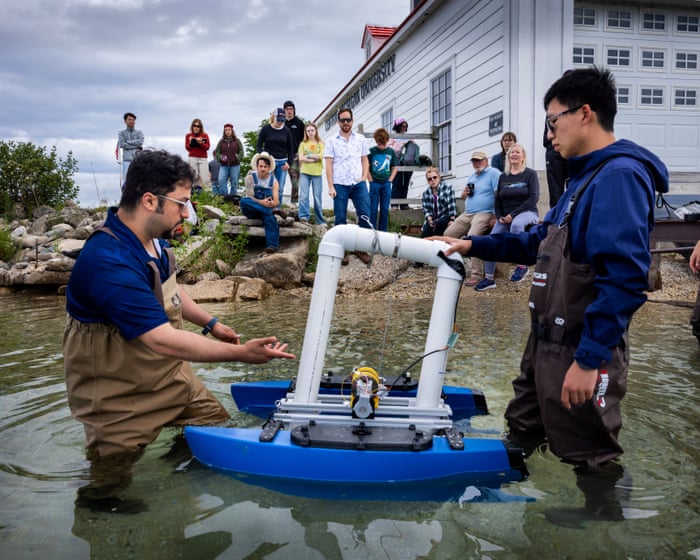
In June, researchers from the University of Michigan gathered on the shoreline to deploy two devices that convert the kinetic energy of waves into electricity. The gadgets – prototypes that look like small boats framed with PVC pipes and are about the size of a yoga ball – demonstrated their potential by powering a lightbulb and charging a mobile phone.
The project is one of many efforts across the country to use alternative sources of energy to improve reliability in remote places. In this case, the researchers spent two years gathering input from residents, who said providing a dependable source of power to the airport was a priority.
“We need to work with the community together to identify the need and design together with them,” said Lei Zuo, an engineering professor at the University of Michigan and the lead researcher on the project.
Several residents already power their homes and businesses with solar panels or geothermal energy, and the island has previously received federal funds to improve access to renewables. Similar programmes and grid modernisation plans face an uncertain future as the Trump administration cancels grants and programmes, raising questions about how such projects will be funded in the years ahead.
Efforts to improve reliability are under way in remote communities across the country. Galena, in Alaska, for example, is investing in solar and biomass to reduce reliance on diesel fuel and provide a stopgap against extreme weather. Beaver Island hopes to do the same.
“It’s a combination of looking at cost savings and also wanting to be independent and not dependent on the mainland for everything,” said Seamus Norgaard, who lives on the island during the summer. “And then also the environmental outlook.”
Beaver Island is not the only community looking for greater energy independence. Residents of Adjuntas, Puerto Rico, for instance, developed a community-owned solar microgrid after Hurricane Maria. The system, which can keep electricity running when the island’s rickety grid inevitably fails, has become a model for other places looking to improve reliability using locally generated power.
Even so, waves may not become anyone’s sole source of power, said Dan Hellin, the director of PacWave, an offshore testing facility in Oregon. But “finding something that works within the region is critical”, he said. “It’s developing a whole suite of renewables and applying them based on local conditions.”
Despite the technology’s potential, it is not widely used because of its expense and how hard it can be to deploy. It is also still new, and there is not a standardised design yet, Hellin said.
Funding is another challenge. Most wave energy projects in the US are funded by the federal government. The Michigan experiment is backed by National Science Foundation grants awarded two years ago. But marine energy, which falls under hydropower, has escaped some of the Trump administration’s animosity toward renewables, Hellin said. “It’s not on the radar in the same way.”
Early in his second term as president, Donald Trump included hydropower among the domestic energy sources his administration would prioritise for regulatory fast-tracking and support. The Department of Energy’s rebranded Hydropower and Hydrokinetic Office said it would use $220m appropriated by Congress to continue such research.
The University of Michigan wave project joins efforts in other parts of the country to push wave power technology toward commercialisation. The team behind it has a similar project under way in North Carolina’s Outer Banks. Beyond PacWave’s work in Oregon, a company called CalWave has tested devices off the California coast, and Hawaii has hosted a testing site for more than a decade.
Although waves on the Great Lakes are smaller and more seasonal than those on oceans, Saeid Bayat, of the University of Michigan, said research on these inland seas could help improve the technology as a whole. It is also an ideal experimental bathtub. “The Great Lakes provide real-world wave conditions while being much easier, safer and less expensive to access than most ocean sites,” Bayat said.
Back on Beaver Island, the team will continue improving the prototype. It plans to install a final version in the coming years, and Norgaard is among those eager to see that happen. “There is that excitement about these new futures and cleaner sources, and more locally produced, dependable sources of energy.”
A version of this article was originally published on Grist and has been republished by the Guardian as part of our ClimateDesk partnership. This coverage is made possible through a partnership between Grist and Interlochen Public Radio in northern Michigan.
View original source — The Guardian ↗
Related stories

TASS
BusinessJul 9, 2026 · 1 min
Qatar suspends ramp-up of LNG production following attack on tanker — Bloomberg
TASS

Bloomberg
BusinessJul 9, 2026 · 1 min
Airbus Employees in Spain Go on Strike Over Working Conditions
Bloomberg
Bloomberg
BusinessJul 9, 2026 · 1 min
Trump Stops in UK to Switch Air Force One Planes (Video)
Bloomberg

CNBC
BusinessJul 9, 2026 · 1 min
Cramer defends a struggling tech giant and says another stock could soon be a buy
CNBC