Indian Express
UPSC Key: Prambanan Temple, Kashmir’s militancy landscape and Astra missile
Nijjar killing: US charges Bishnoi, Brar; no India govt link: Canada
Syllabus:
Preliminary Examination: Current events of national and international importance.
Mains Examination: General Studies II: Bilateral, regional and global groupings and agreements involving India and/or affecting India’s interests.
What’s the ongoing story: Canada on Wednesday (July 8) ruled out Indian involvement in the 2023 killing of Canadian citizen and Sikh separatist Hardeep Singh Nijjar, an incident that strained diplomatic relations between the two countries.
Key Points to Ponder:
• Who was the Hardeep Singh Nijjar?
• What were the allegations against Nijjar?
• What was Canada’s stance earlier on India’s link with the death of Hardeep Singh Nijjar?
• What is Canada’s position now on the same?
• How India-Canada relations affected due to the 2023 killing of Canadian citizen and Sikh separatist Hardeep Singh Nijjar?
• What USA is saying on the 2023 killing of Hardeep Singh Nijjar?
• What is Five Eyes Alliance?
• Who are in Five Eyes Alliance?
• What you know about the Khalistan movement?
• What are the Historical events responsible for Khalistan?
• How Khalistan movement affected or can affect Indo-Canadian relationship?
• Khalistan and Canada-Connect the dots
• Canada has for long been considered a safe haven for Khalistan supporters and militant voices accused of terrorism in India-Why so?
• Why do Canadian politicians pander to Sikh extremists?
• What is the principle of reciprocity in diplomatic relations?
Key Takeaways:
• The development comes nearly three years after former Prime Minister Justin Trudeau alleged security agencies were probing credible allegations of a “potential link” between Indian agents and the murder.
• Separately, the US charged Lawrence Bishnoi and Goldy Brar with orchestrating Nijjar’s assassination, with the FBI announcing a reward of up to $50,000 for information leading to Brar’s arrest.
Do You Know:
• Nijjar was the chief of the separatist organisation Khalistan Tiger Force (KTF) and the head of the Guru Nanak Sikh Gurdwara Sahib in Surrey, Canada. A Canadian resident since 1997, he was married with two sons.
• According to the Indian government, Nijjar was involved in recruiting, financing and coordinating the activities of the KTF, which was designated a terrorist organisation under the Unlawful Activities Prevention Act (UAPA) in 2023.
• He was wanted in connection with an attack on a Hindu priest in Jalandhar in 2021, as well as in connection with the December 2020 protests against the farm laws.
• In September 2023, Trudeau alleged that the Indian government had been involved in Nijjar’s assassination, a charge that the Indian government dismissed as baseless.
• The allegations triggered one of the sharpest downturns in India-Canada ties, with both countries expelling diplomats and suspending several bilateral engagements. Relations began improving in June 2025 when the two nations agreed to normalise relations.
• Canada hosts one of the largest Indian diasporas in the world, numbering 16 lakh people of Indian origin, accounting for more than 3 percent of the total Canadian population and 700,000 NRIs. India became the top source of foreign students studying in Canada — 2.3 lakh, according to 2022 data. India’s total trade with Canada (goods and services) in 2021-22 was US $11.68 billion, much below potential, but when it comes to India’s import of pulses, almost 30% of the total import comes from Canada.
• Canadian pension funds have cumulatively invested around US $55 billion in India. Cumulative FDI from Canada since 2000 is about US$4.07 billion.
All these have continued despite speed bumps like the recent pause in trade talks — and despite challenges over the Khalistan issue.
Other Important Articles Covering the same topic:
📍Indian agencies shared, verified list of names and hideouts with US
Previous year UPSC Mains Question Covering similar theme:
📍‘Indian diaspora has a decisive role to play in the politics and economy of America and European Countries’. Comment with examples. (2020)
POLITICS
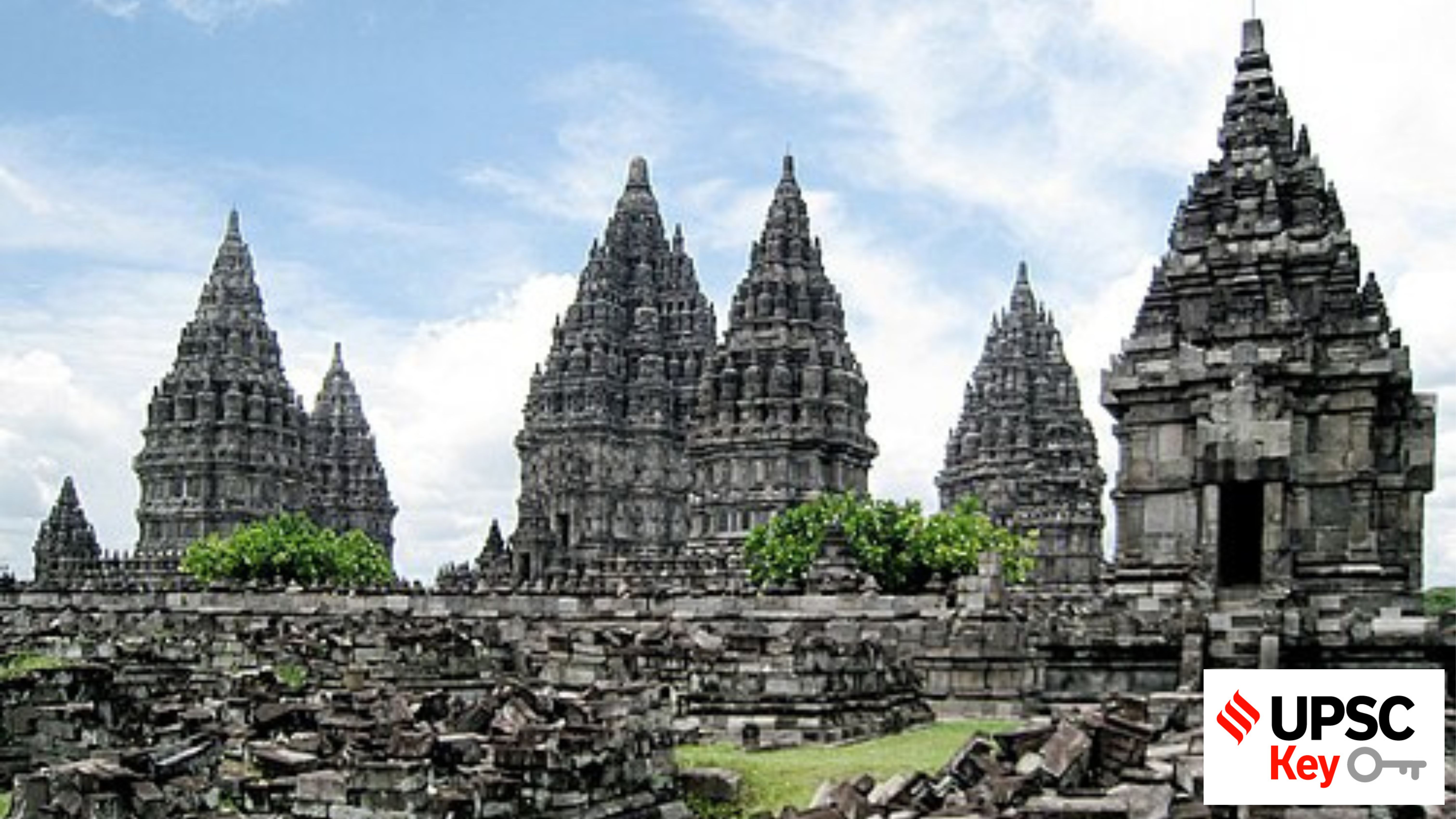
Modi, Prabowo launch project to conserve Indonesia temple
Syllabus:
Preliminary Examination: Current events of national and international importance.
Mains Examination: General Studies II: Bilateral, regional and global groupings and agreements involving India and/or affecting India’s interests.
What’s the ongoing story: Prime Minister Narendra Modi, before concluding his Indonesia visit on Wednesday, visited the 9th-century Prambanan Temple complex in Yogyakarta along with Indonesian President Prabowo Subianto to inaugurate a joint conservation project for the UNESCO World Heritage Site. The project will be led by the Archaeological Survey of India (ASI).
Key Points to Ponder:
• What you know about Prambanan Temple?
• What is special about Prambanan Temple?
• Map Work- Prambanan Temple complex in Yogyakarta
• What is the architectural style of the Prambanan Temple?
• What are the architectural features of a Prambanan Temple?
• South Asian and Indian temple architecture-compare and contrast
• What makes Prambanan Temple different from Indian temples?
• What you know about Sanjaya dynasty?
Key Takeaways:
• Calling the initiative a “shining example of the enduring civilisational bonds” between India and Indonesia, the two leaders also unveiled a plaque at the temple, marking the commencement of the ASI’s conservation and restoration project at the site.
• “President Prabowo Subianto and I inaugurated the UNESCO World Heritage Prambanan Temple Compound Restoration and Conservation Project,” Modi posted on X after his visit.
• “The magnificent Prambanan Temple stands as a timeless symbol of our cultural and spiritual links. Preserving such heritage is about safeguarding the traditions that continue to inspire generations,” he said, adding that India is privileged to partner with Indonesia in this important endeavour.
• The central focus of the project is the restoration of the Pervara temples — 224 subsidiary shrines arranged in four concentric rows within the middle zone of the compound, official sources told The Indian Express. Of these 224 temples, only six have been restored to date and the remaining 218 stand as extensive ruins.
• The project, spanning 10 years (2026–2036) with a total outlay of Rs 65 crore, will be executed by ASI in collaboration with the Indonesian Heritage Agency, sources added. The key activities of the project include LiDAR (Light Detection and Ranging) sensor, and photogrammetric documentation of scattered stone members, archival research, structural, hydrological, and geotechnical studies.
Do You Know:
• The Prambanan Temple Compound, inscribed a UNESCO World Heritage Site in 1991, is considered among the most magnificent ensembles of Hindu temple architecture in the world. Built in the 9th century under the Mataram Kingdom in Central Java, the compound contains over 500 temples, including the soaring 47-metre Shiva temple.
• India said its support for the restoration and conservation of the temple complex “reflects its enduring commitment to preserving shared civilisational heritage”. The conservation project follows the understanding reached between the two sides during President Prabowo’s state visit to India in 2025 to explore India’s assistance for the restoration of the temples at the Prambanan complex, the MEA said in a statement.
• From conserving key sections of the Angkor heritage complex in Cambodia to providing grant assistance for restoration of one of Sri Lanka’s five ancient temples dedicated to Lord Shiva, India has extended help to multiple partners in the past 12 years in reviving the “shared civilisational heritage”, according to officials.
Other Important Articles Covering the same topic:
📍Prambanan temple: Revisiting origins and history of Indonesia’s iconic heritage site
Previous year UPSC Prelims Question Covering similar theme:
1) Which of the following temples has/have a Nagara-style shikhara? (UPSC CSE, 2026)
1. Malegitti Shivalaya, Badami
2. Huchimalligudi Temple, Aihole
3. Dashavatara Temple, Deogarh
4. Virupaksha Temple, Pattadakal
Select the answer using the code given below:
(a) 1 and 2
(b) 2 and 3
(c) 3 only
(d) 3 and 4
Previous year UPSC Prelims Question Covering similar theme:
📍Chola architecture represents a high watermark in the evolution of temple architecture. Discuss. (2013)
📍Safeguarding the Indian Art Heritage is the need of the moment. Discuss. (2018)
NATION
10 yrs. after Burhan, how Kashmir’s militancy landscape has changed
Syllabus:
Preliminary Examination: Current events of national and international importance.
Mains Examination: General Studies III: Security challenges and their management in border areas – linkages of organized crime with terrorism
What’s the ongoing story: On July 1, 2015, a picture of 11 Kashmiri youth, dressed in camouflage, carrying Kalashnikov rifles and posing in a forest, appeared on Facebook. At the centre was Burhan-ud-din Wani, who, shedding anonymity, broke from others like him, choosing to broadcast himself and his group on social media and deciding to move through the Valley’s urban areas, particularly south Kashmir.
Key Points to Ponder:
• Who was Burhan Wani?
• What was the aftermath of Burhan Wani’s death?
• Who are called militants?
• What is terrorism?
• What are the reason for terrorism especially in the Jammu and Kashmir?
• What are the components of terrorism?
• Anti-militancy operations in India-Know in detail
• Analyse terrorism and militancy in Jammu and Kashmir-Before Article 370 and After Article 370
• ‘The militancy in Kashmir has entered a “secretive and dangerous” phase’-Elaborate
• “The command structure among militants is missing. There is no reigning force and that makes it dangerous. The separatist leadership is in jail and those who are out have lost their grip. We are fighting an invisible enemy now”-
What are the main concern for law enforcement agency?
• Know these terms-Terrorism, Insurgency, Belligerency and Civil war
Key Takeaways:
• The images would influence several educated, tech-savvy young men from well-to-do families, opening a new chapter in Kashmir’s fight against insurgency and leading to a crisis not seen since the 1990s.
• Exactly 10 years after Burhan Wani’s killing in a military operation in south Kashmir’s Kokernag, that landscape has shifted once more, with every key indicator – from the number of active terrorists to fresh local recruitments for attacks and killings – witnessing a sharp decline. Top-ranking security officials, however, caution that the forces need to stay alert as the situation on the ground remains complex.
• The numbers are indisputable: In 2016, the year after the photos first emerged, 157 terror operatives were killed in Kashmir. This number peaked at 266 in 2018 and saw another uptick to 230 in 2020. But since then, terrorist killings have steadily decreased, with just 10 recorded so far this year. The number of security forces killed has also declined – from a peak of 94 in 2018 to just one this year. The same goes for civilians – from 88 deaths in 2018 to just one this year.
• “As a civilian, you see peace, the dividends of peace – the attacks have declined, killings have fallen, and the number of arrests and FIRs have come down,” said a key anti-insurgency police officer. “But from the perspective of a security officer, the challenge remains.”
• On Wednesday, Zakir Ahmad Ganaie, a Lashkar-e-Taiba terrorist, was killed in a gunfight in south Kashmir’s Shopian. He was believed to be one of only two active local terrorists, apart from one Latief, operating in Kashmir. But the number of Pakistani operatives, security officials say, hovers around 30.
Do You Know:
• Officials say the insurgency landscape has shifted from towns and cities to the dense, mountainous forests of the Valley. On social media, the focus is back on anonymity, with communication sparse and an emphasis on leaving little or no footprint.
“Even though a large number of operations were always based on HUMINT (human intelligence), the TECHINT (technological intelligence) helped corroborate and pinpoint locations with more precision,” said a senior police officer. “It also helped us understand the evolving dynamics of insurgency and how they operate, communicate and what they were up to.”
Less online chatter has meant security forces have TECHINT to rely on, the officer said.
• Security officials said a key shift has been the takeover of “command and control” by Pakistani operatives. “After 2019, the Hizb (Hizbul Mujahideen) was almost wiped out, and Lashkar took the centrestage. They are highly trained, resilient and well-equipped. They operate from areas with a tactical advantage, such as high-altitude jungles. The command and control has increasingly shifted to these Pakistani operatives of Lashkar,” the police officer said.
Year
Militants killed
Security forces killed
Civilians killed
2016
157
88
56
2017
217
83
54
2018
266
94
88
2019
160
78
42
2020
230
57
37
2021
192
45
36
2022
186
30
30
2023
85
32
11
2024
68
26
32
2025
46
17
28
2026
10
1
1
Other Important Articles Covering the same topic:
📍Decoding Burhan Wani’s death: Behind hot pursuit, hunt for informer who turned cold
Previous year UPSC mains Question Covering similar theme:
📍To what extent is Article 370 of the Indian Constitution, bearing marginal note “Temporary provision with respect to the State of Jammu and Kashmir”, temporary? Discuss the future prospects of this provision in the context of Indian polity. (2016)
EXPLAINED
Why US & Iran may keep trading blows amid talks
Syllabus:
Preliminary Examination: Current events of national and international importance.
Mains Examination: General Studies II: Effect of policies and politics of developed and developing countries on India’s interests
What’s the ongoing story: US President Donald Trump said Wednesday that the interim ceasefire with Iran was “over” after a flare-up of hostilities between the two countries, although he added that he would allow negotiations to continue. Trump also threatened to hit Iran hard.
Key Points to Ponder:
• The June 18 Memorandum of Understanding (MoU) (MoU) between Iran and US-know in brief
• Why US President Donald Trump said that the interim ceasefire with Iran was “over”?
• Why there is attack and counter attack between US and Iran even after ceasefire?
• Know the implications of geopolitical conflicts in West Asia for global energy markets.
• Know the significance of US-Iran peace deal in reducing geopolitical risks in the global economy.
• What is the idea of a “new Middle East”?
• How India reacted?
Key Takeaways:
• Iran targeted US military sites in Bahrain and Kuwait after US forces struck Iranian targets in response to attacks on tankers in the Strait of Hormuz.
• The same pattern of attacks was also seen on June 26 and June 27 — Iran preventing transit through the Strait of Hormuz for commercial ships that did not coordinate with it, the US Central Command bombing Iranian targets and Iran hitting US bases in Bahrain and Kuwait.
• This familiar cycle of escalation has threatened the shaky ceasefire between the two countries and jeopardised negotiations to turn the June 18 Memorandum of Understanding (MoU) (MoU) into a permanent peace deal.
• While Trump’s comments on Wednesday have increased this uncertainty, he left a window open by saying that US representatives can continue negotiations. But he added: “They can talk, but I think they’re wasting their time.”
• Although Trump has at times stepped back from threats he has made against Iran, oil prices surged and stocks fell after his latest remarks, Reuters reported. The report, citing a source, said Trump did not repeat his comments about the interim deal being over when NATO leaders met later at the summit.
Do You Know:
• Under Article 5 of the MoU, the long-term administration of the Strait of Hormuz is to be determined jointly by Oman and Iran, “in line with applicable international law and the sovereign rights of coastal states of the Strait”.
• By June 23, Iran and Oman jointly declared the creation of a working group “to reach agreement on the future administration of navigation in the Strait”. While this meets Iran’s objective to prevent the strait’s return to its pre-war status, Oman’s cooperation remains crucial for Tehran.
• So far, Muscat’s rejection of flat tolls in the strait (prohibited by Article 26 of the UN Convention on the Law of the Sea) has resulted in an arrangement where ships pay coastal states for potential services rendered — which a liberal interpretation of UNCLOS Article 43 allows. While both states differ over whether such payments are to be voluntary or mandatory, it is evident that the structures for the strait’s long-term administration are already being built.
• Under the MoU, Iran is to allow unconditional passage to all commercial ships for 60 days. For Washington, this means a preclusion of any coordination with Iranian authorities. This interpretation was furthered through an International Maritime Organization-led (and US and Oman-backed) plan that sought to create a temporary southern route through Omani waters and another northern route close to Iran’s Larak island in the strait for commercial passage and rescue of stranded vessels.
The Strait of Hormuz
• The main traffic separation scheme in the central channel remains shut, pending mine clearance. But Iran’s June 25 strikes on vessels transiting through the southern route (and hence not coordinating with Iran) and subsequent exchanges with the US proved what Iranian Foreign Minister Abbas Araghchi ultimately asserted on June 28 — that Tehran would not accept any “new or separate arrangements from those currently being pursued” for the Strait of Hormuz.
• This, in turn, risks prolonging the 60-day window while shipping in Hormuz continues to remain disrupted. The IMF’s seven day moving average for May-June in the Strait varied between six and 12 ship crossings. The statistic for the same period in the previous year was 104-115.
• While the short-term nature of this Hormuz-focused difference can theoretically ensure that US-Iran military clashes do not become a permanent feature, it is categorically clear that a severe lack of trust with the US necessitates continual Iranian assertion to ensure that Washington does not deviate from MoU terms until negotiations for a final deal begin.
• Central to this is Washington’s need to shape regional developments enough in the short term to ensure that Iran’s long-term gains (beyond Hormuz) are curtailed. The volatility this creates is evident across regional states.
• In Iraq, for instance, both the US withdrawal and Iran’s entrenched presence through the Popular Mobilization Forces creates fresh ground for long-term Iranian influence.
• Oman, Qatar and Saudi Arabia — unlike Bahrain, Kuwait and UAE — are looking to contain the Iranian threat through engagement and reconciliation, a path reinforced by what is widely agreed to be a strategic defeat for the US and Israel in the war.
• Iran feels that the US will respond to its increased regional heft by repeatedly attempting to undermine its gains. This, in turn, would be something that Tehran would necessarily have to counter. This dynamic could trigger both intermittent military skirmishes before a final deal is reached, as well as a return to full-scale war.
Other Important Articles Covering the same topic:
📍Expert Explains | Despite talks, why US and Iran are still trading blows — and may keep doing so
Previous year UPSC Main Question Covering similar theme:
📍“India’s relations with Israel have, of late, acquired a depth and diversity, which cannot be rolled back.” Discuss. (2018)
The significance of astra missiles, which Indonesia will purchase
Syllabus:
Preliminary Examination: Current events of national and international importance.
Mains Examination: General Studies II: Bilateral, regional and global groupings and agreements involving India and/or affecting India’s interests.
What’s the ongoing story: India and Indonesia on Tuesday reached a significant milestone in their growing strategic cooperation by signing a deal for the supply of the Astra Mk 1 ‘beyond-visual-range air-to-air missiles’ (BVRAAM).
Key Points to Ponder:
• What is Astra missile?
• What are beyond-visual-range air-to-air missiles (BVRAAM)?
• Why is the Astra missile critical in the military’s inventory?
• Know Astra’s export potential.
• What are Cruise Missiles?
• What speed is a Mach?
• What is Ramjet?
• What is the difference between a ramjet and scramjet?
• Missile Technology Control Regime and India-Know in detail
• What is the history of missile technology in India?
• What kind of missiles does India have?
• Which of India’s missile systems are most important?
• What about hypersonic technology?
Key Takeaways:
• The development is significant as it marks India’s first export of Astra missiles to another country. These missiles will arm Indonesia’s Su-30 fleet.
• The deal came alongside other key agreements — including the sale of BrahMos supersonic cruise missiles, major defence technology transfers, critical mineral extraction and maritime security. Developed by the Defence Research and Development Organisation (DRDO), Astra is a family of indigenous BVRAAMs that will be integrated with the Air Force and the Navy.
• Beyond-visual-range (BVR) missiles are those capable of engaging beyond the range of 20 nautical miles, or 37 km. Air-to-air missiles are primarily fired from an airborne asset to destroy an airborne target.
Do You Know:
• Indigenously developed Beyond Visual Range (BVR) air-to-air missile, Astra is designed to be mounted on a fighter aircraft and is also designed to engage and destroy highly manoeuvring supersonic aircraft. With a 15-kilogram high-explosive pre-fragmented warhead, Astra has a range of over 70 km and can fly towards its target at a speed of over 5,555 km per hour. The missile has all-weather day and night capability.
• The missile has been developed by the Defence Research and Development Organisation (DRDO), along with almost 50 other public and private organisations, which were involved in multiple variants to meet specific requirements.
• India’s deal with Indonesia, signed on Tuesday to supply Astra Mk 1 missiles, marking the first export of the missiles to another country, shows that they have good potential for export to other countries as well. India is also set to supply the BrahMos supersonic cruise missiles to Indonesia, as well as to Vietnam and the Philippines. In future, India is likely to explore other friendly countries for the sale of the Astra missiles.
Other Important Articles Covering the same topic:
📍What is Astra missile?
Previous year UPSC Prelims Question Covering similar theme:
2) Consider the following statements: (UPSC CSE, 2023)
1. Ballistic missiles are jet-propelled at subsonic speeds throughout their flights, while cruise missiles are rocket powered only in the initial phase of flight.
2. Agni-V is a medium-range supersonic cruise missile, while BrahMos is a solid-fuelled intercontinental ballistic missile.
Which of the statements given above is/are correct?
(a) 1 only
(b) 2 only
(c) Both 1 and 2
(d) Neither 1 nor 2
Indira Point: inside the plan to protect lighthouse, develop tourism hub
Syllabus:
Preliminary Examination: Current events of national and international importance
Main Examination: General Studies III: Conservation, environmental pollution and degradation, environmental impact assessment and Infrastructure: Energy, Ports, Roads, Airports, Railways etc.
What’s the ongoing story: The Union Ministry of Ports, Shipping and Waterways has proposed protection and development works at Indira Point and the famous lighthouse at the site in the Andaman and Nicobar Islands. Through the Directorate of Lighthouses and Lightships, Sri Vijaya Puram (formerly Port Blair), an agency under the ministry, the Centre has sought coastal regulation zone clearance to carry out the proposed work.
Key Points to Ponder:
• What is Indira Point?
• What are CRZ (ICRZ)-1A and ICRZ-IVA categories?
• Why the lighthouse structure is needed?
• What exactly environment impact assessment (EIA) report says on concerned project?
• What environment impact assessment (EIA) report says about coral reefs?
• The Great Nicobar Island mega infrastructure project-what you know about the same?
• What is Andaman and Nicobar Islands Integrated Development Corporation Limited (ANIIDCO)?
• Map Work-Indira Point, Galathea Bay and Great Nicobar Island
Key Takeaways:
• Indira Point is India’s southernmost tip, located on the Great Nicobar Island (GNI) in the Union Territory (UT) of the Andaman and Nicobar Islands. It is an important maritime landmark, and lies to the south of the Galathea Bay, where a transshipment port has been proposed under the GNI mega infrastructure project.
• The lighthouse located at Indira Point is an important landmark on the Singapore-Colombo international maritime route and is used as a navigational aid by mariners. It also holds importance for safe navigation towards the Galathea Bay in the coming times, where a transshipment port has been proposed.
• The Ministry of Ports, Shipping and Waterways, through the Directorate General of Lighthouses and Lightships, wants to structurally repair and eventually develop tourism infrastructure and facilities around the lighthouse.
The Centre wants to strengthen the structure, the immediate site around it and along with it, it has proposed a string of development activities. In late November 2023, Sarbananda Sonowal, Union Minister of Ports, Shipping and Waterways made an official tour to the GNI and visited the proposed site of the International Container Transshipment Port at Galathea Bay. Sonowal also visited Indira Point and directed Union Territory and the Centre’s officials to explore the site’s development as a tourism destination including tourism amenities and facilities.
• The works proposed fall in sensitive coastal habitats, which are protected under the Island Coastal Regulation Zone (ICRZ) Notification, 2019. So, it needs prior approval from the UT’s Coastal Zone Management Authority and the Environment Ministry.
Do You Know:
• The Indira Point lighthouse was established in 1972 on an area of 11.5 hectares, with a 35-metre-high cast iron tower. In the 2004 tsunami, the southern shores of Great Nicobar Island subsided by about 4.25 metres, leaving much of the area surrounding the lighthouse closer to the sea. While the lighthouse tower survived the tsunami, its peripheral structures were damaged or washed away.
• Great Nicobar is the southernmost and largest of the Nicobar Islands, a sparsely inhabited 910-sq-km patch of mainly tropical rainforest in southeastern Bay of Bengal. Indira Point on the island, India’s southernmost point, is only 90 nautical miles (less than 170 km) from Sabang at the northern tip of Sumatra, the largest island of the Indonesian archipelago.
• Great Nicobar has two national parks, a biosphere reserve, small populations of the Shompen and Nicobarese tribal peoples, and a few thousand non-tribal settlers.
• The Andaman and Nicobar Islands are a cluster of 836 islands, split into two groups — the Andaman Islands to the north and the Nicobar Islands to the south — by the 150-km wide Ten Degree Channel. President Droupadi Murmu visited the archipelago in February this year, and interacted with some of its indigenous inhabitants.
• The mega infrastructure project — which is being implemented by the Andaman and Nicobar Islands Integrated Development Corporation (ANIIDCO) — is proposed to include an International Container Transhipment Terminal (ICTT), a greenfield international airport with a peak hour capacity to handle 4,000 passengers, a township, and a gas and solar based power plant spread across 16,610 hectares.
Other Important Articles Covering the same topic:
📍Convention centre, museum: Nod sought for work at Indira Point
Previous year UPSC Prelims Question Covering similar theme:
3) Which one of the following pairs of islands is separated from each other by the ‘Ten Degree Channel’? (UPSC CSE 2014)
(a) Andaman and Nicobar
(b) Nicobar and Sumatra
(c) Maldives and Lakshadweep
(d) Sumatra and Java
India’s engineering colleges are losing sheen in AI era: What a reset can look like
Syllabus:
Preliminary Examination: Current events of national and international importance.
Mains Examination: General Studies II: Issues relating to development and management of Social Sector/Services relating to Health, Education, Human Resources.
What’s the ongoing story: India’s ambition to become a global-tech powerhouse hinges on its ability to produce world-class engineers. From artificial intelligence (AI), semiconductors, and quantum technologies to advanced manufacturing, clean energy, and the digital economy, engineering talent will be the cornerstone of the country’s next phase of growth and global competitiveness.
Key Points to Ponder:
• Why does engineering education need a reset in the AI era?
• Know the significance of multidisciplinary learning in engineering education?
• Know the role of AI in transforming engineering professions.
• Discuss the importance of Industry-Academia collaboration in improving engineering education.
• Why are ethics increasingly important in AI-driven engineering?
• What are the challenges facing engineering education in India in the context of rapid technological change?
• Know the reforms required to make India’s engineering graduates globally competitive in the AI era.
• Know the importance of research, innovation and entrepreneurship in engineering education.
• How AI is changing the future of work for engineers?
Key Takeaways:
• The contrast is striking. While the Indian Institutes of Technology (IITs) and a handful of premier public and private institutions continue to attract the country’s brightest students, achieve excellent placements, and expand their research and innovation ecosystems, a large segment of engineering colleges is witnessing declining admissions, weak faculty, outdated curricula, and poor employability. The trend is reflected in the All India Council for Technical Education’s (AICTE) decision during 2025-26 to place 58 engineering colleges under progressive closure and discontinue more than 950 engineering and technical courses.
• The challenge, therefore, is not that engineering has become less relevant; rather, the real crisis lies in the widening gap between the capabilities expected by a technology-driven economy and those delivered by a large section of India’s engineering education ecosystem. Unless this gap is bridged, India’s aspirations for global leadership in deep technologies could be constrained not by a shortage of opportunities but by a shortage of employable, high-quality engineering talent.
Do You Know:
• The AICTE, India’s apex statutory regulator for technical education under the AICTE Act, 1987, traces its origins to an advisory body established in 1945. It is mandated to plan, coordinate, regulate, and promote the development of technical education by prescribing norms and standards, approving and inspecting institutions and programmes, framing regulations, and fostering quality, innovation, faculty development, and student welfare across the country.
• Every engineering institution in India must obtain AICTE approval before admitting students. Approval is contingent upon compliance with the prescribed norms for infrastructure, faculty, governance, financial viability, laboratories, libraries, classrooms, and other academic and operational requirements. It is not a one-time licence but a continuous regulatory process that requires institutions to maintain these standards year after year. Based on periodic assessments of compliance and performance, AICTE may permit expansion, reduce student intake, impose restrictions, or even withdraw approval.
• One of AICTE’s key regulatory mechanisms is “progressive closure”, introduced to safeguard students while ensuring the orderly exit of non-viable institutions. Under this framework, institutions are barred from admitting fresh students but allowed to continue until existing batches graduate.
• Until the late 1990s, engineering education in India was largely confined to publicly funded institutions such as the IITs, regional engineering colleges (now National Institutes of Technology, or NITs), a few state engineering colleges, and private institutions concentrated mainly in Maharashtra, Karnataka, and Tamil Nadu. Limited capacity made admissions highly competitive, leaving the country with a persistent shortage of engineering graduates.
• The global IT boom around the Y2K revolution transformed this landscape. Surging worldwide demand for software professionals triggered an unprecedented expansion of engineering education. Thousands of new colleges emerged across metropolitan, urban, and rural India.
• At the same time, the Union government expanded the network of Institutes of National Importance (INIs) by establishing new IITs and Indian Institutes of Information Technology (IIITs) and upgrading the regional engineering colleges into NITs. Today, India has 79 INIs: 23 IITs, 31 NITs, and 25 IIITs. The remainder comprises state
universities, affiliated colleges, and private engineering institutions regulated by AICTE.
• The AI revolution, which gathered momentum in the mid-2010s, has fundamentally reshaped engineering education. As industry demand shifted rapidly towards computer science, AI, data science, and allied disciplines, student preferences followed suit, while traditional branches such as mechanical, electrical, and related engineering experienced sustained declines in demand. Reflecting this changing landscape and the resulting decline in engineering enrolments, AICTE imposed a moratorium on new engineering institutions in 2020, before lifting it in 2023.
Other Important Articles Covering the same topic:
📍What makes a ‘good’ engineering college: Ranking, fees, placement – what matters most?
Previous year UPSC Prelims Question Covering similar theme:
4) Which of the following provisions of the Constitution of India have a bearing on Education? (UPSC, CSE, 2012)
1. Directive Principles of State Policy
2. Rural and Urban Local Bodies
3. Fifth Schedule
4. Sixth Schedule
5. Seventh Schedule
Select the correct answer using the codes given below:
(a) 1 and 2 only
(b) 3, 4 and 5 only
(c) 1, 2 and 5 only
(d) 1, 2, 3, 4 and 5
PRELIMS ANSWER KEY
1.(b) 2.(d) 3.(a) 4.(d)
For any queries and feedback, contact [email protected]
Subscribe to our UPSC newsletter. Stay updated with the latest UPSC articles by joining our Telegram channel – IndianExpress UPSC Hub, and follow us on Instagram and X.
View original source — Indian Express ↗
Related stories

ZDNet
TechnologyJul 9, 2026 · 1 min
Your Tenda router could have a hidden firmware backdoor - disable this setting ASAP
ZDNet
TechRadar
TechnologyJul 9, 2026 · 1 min
Accenture confirms breach after hacker steals 35GB of source code and other data
TechRadar

TechRadar
TechnologyJul 9, 2026 · 1 min
Asus unveils the 'elite' ROG Raikiri II Pro PC Controller featuring 'competition-grade responsiveness and ultra-low…
TechRadar
The Guardian
TechnologyJul 9, 2026 · 1 min
Telstra’s triple zero failure is a result of prioritising neoliberal ‘competition’ and reaping none of its benefits
The Guardian