Indian Express
New airport, upcoming Metro: Navi Mumbai emerges as key housing choice in MMR
3 min readJul 9, 2026 07:43 PM IST
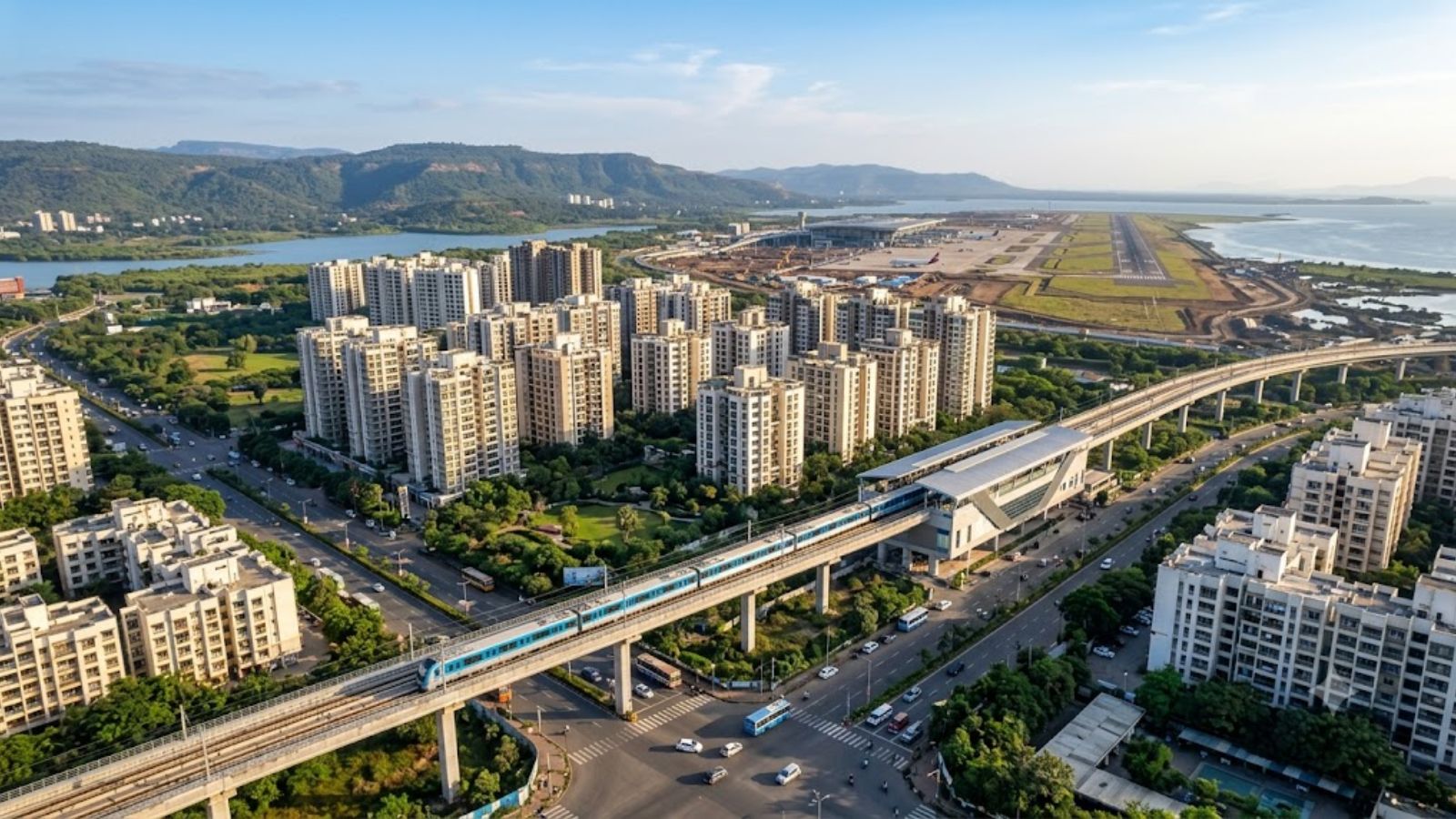
The consultancy expects the residential market to remain resilient, supported by end-user demand, infrastructure projects and a steady pipeline of new supply. (Image generated using AI)
Navi Mumbai is emerging as one of the strongest growth centres in Mumbai Metropolitan Region (MMR). Panvel recorded the sharpest rise in housing prices across the MMR, with average rates climbing up by 9 per cent over the past year, as per the half-yearly real estate report of Knight Frank India released on Thursday. Nearby Kharghar registered a 6 per cent increase.
The satellite city is no longer being driven by affordability alone, the report said. “Originally conceived as a planned satellite city, the region is increasingly evolving into Mumbai’s third growth corridor, not simply because it is affordable, but because it is becoming increasingly accessible,” it said.
The opening of the Navi Mumbai International Airport, the Mumbai Trans Harbour Link (MTHL), which has cut travel time to South Mumbai to around 30 minutes, upcoming Metro corridors, the Virar-Alibaug Multimodal Corridor and the Panvel-Karjat railway doubling project have all strengthened the region’s appeal.
Homebuyers continue to favour the city’s peripheral markets over Greater Mumbai.
Areas such as Vasai and Virar in the western suburbs, Kalyan, Dombivli, Bhiwandi and Karjat in the central belt, along with Navi Mumbai, accounted for the bulk of residential launches and sales.
Meanwhile, the broader housing market remained steady despite economic uncertainty.
As per the report, developers launched 49,161 homes in the first six months of the year, an 8 per cent increase over the same period last year, while sales inched up 1 per cent to 47,355 units. Unsold inventory fell 4% to 1.57 lakh homes.
Story continues below this ad
The numbers also underline how the centre of gravity in the MMR housing market has shifted. Navi Mumbai accounted for the largest share of new launches at 21 per cent, ahead of the peripheral western suburbs (19%) and peripheral central suburbs (18%). Greater Mumbai’s western suburbs contributed 17%.
Sales followed a similar trend, with the peripheral central suburbs recording the largest share, reflecting sustained demand in markets where homes remain relatively affordable.
Knight Frank said Navi Mumbai’s importance has steadily grown over the past decade. Its share of residential launches has risen from 18% in 2014 to 21% in the first half of 2026, while its share of sales has increased from 16% to 22% over the same period.
“Residential sales have consistently exceeded Navi Mumbai’s share of launches in recent years, suggesting that demand is strengthening faster than new supply is entering the market,” the report noted.
Story continues below this ad
The consultancy expects the residential market to remain resilient, supported by end-user demand, infrastructure projects and a steady pipeline of new supply. It also expects large developers to play a bigger role in redevelopment projects, helping renew ageing housing stock while adding fresh inventory.
The commercial property market also had a strong start to the year. Office leasing touched 7.3 million sq ft in the first half of 2026, up 33% year-on-year, driven in large part by JPMorgan’s lease of 2.2 million sq ft of office space in Powai.
View original source — Indian Express ↗
Related stories

TechRadar
TechnologyJul 9, 2026 · 1 min
How to watch the FIFA World Cup 2026 quarter-finals: Free Streams, TV Channels & Kick-Off times
TechRadar

TechCrunch
TechnologyJul 9, 2026 · 1 min
Block reaches $45M settlement with 46 states over Cash App fraud probe
TechCrunch

The New York Times
TechnologyJul 9, 2026 · 1 min
A Chinese Spacecraft Captures First Image of Quasi-Moon
The New York Times

TASS
TechnologyJul 9, 2026 · 1 min
Czech president says West has two-month 'window' to restart Russia talks — The Telegraph
TASS