Times of Israel
At Haifa gathering, scholars launch association for ‘contemporary antisemitism’
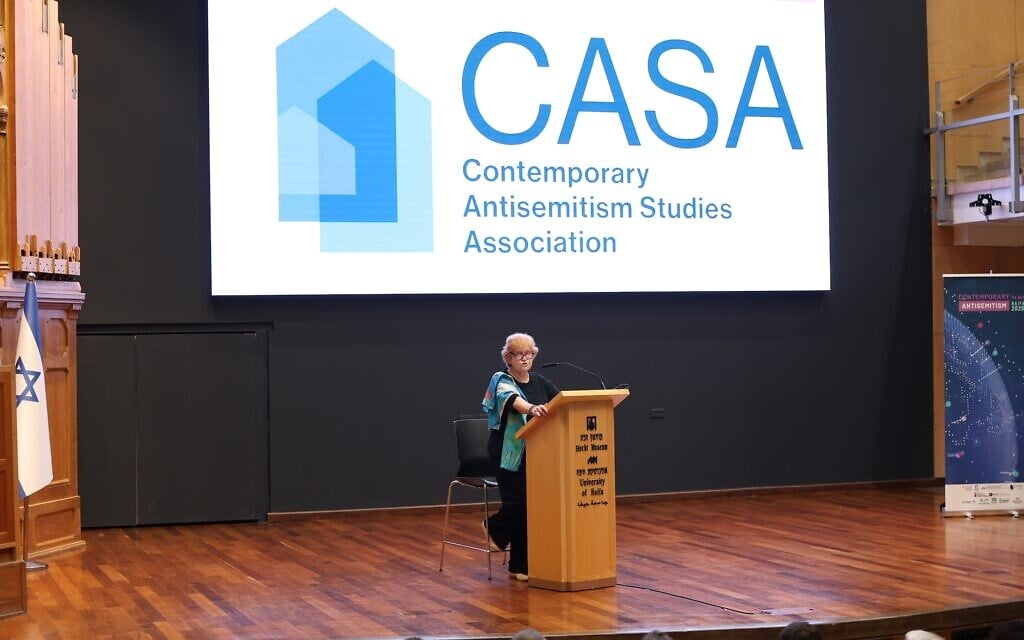
Scholars from around the world gathered in Haifa on Thursday to launch a new academic organization for studying antisemitism at what organizers say is the largest annual academic conference on contemporary antisemitism in the world.
The three-day Contemporary Antisemitism at the University of Haifa, running July 7-9, attracted more than 500 participants, including over 300 international speakers speakers, to explore how antisemitism is evolving in the post-October 7 era and its impact on higher education, law, media, technology, public policy, and democratic institutions.
Since the Hamas massacre of October 7, 2023, in southern Israel, global antisemitism has metastasized, leading to countless cases of harassment, hostilities, and violence against Jews. But many in the academic world dismiss its study as a “soft” field or recoil because of the political sensitivities, said the conference’s organizer, Jacob Dallal, who serves as the managing director of the Comper Center for the Study of Antisemitism and Racism at the University of Haifa.
“By putting the word contemporary in the title, we are putting issues around anti-Zionism on the table,” Dallal said. “If you look at most academic programs studying antisemitism, they talk about the Holocaust, but they don’t want to deal with Zionism or Israel. We see the importance of speaking about these topics with no prior judgments.”
During the event, organizers also formally launched the Contemporary Antisemitism Studies Association (CASA), a new international academic initiative dedicated to advancing the scholarly study of contemporary antisemitism as an academic field and creating a professional base for scholars studying the subject.
Get The Times of Israel's Daily Edition
by email and never miss our top stories
By signing up, you agree to the terms
Founded as a tri-national partnership between the London Centre for the Study of Contemporary Antisemitism, Gratz College, and the Comper Center, CASA aims to strengthen international research collaboration, launch a new academic journal and scholarly book series, and further develop contemporary antisemitism studies as a growing academic field, organizers said. The association already includes more than 150 founding scholars from around the world.
Given Israel’s current political and security situation, the conference may have been the largest international academic conference held in Israel over the past academic year, Dallal noted. It had been previously scheduled for March, but was postponed due to the war with Iran.
At the conference’s opening event, former US special envoy to monitor and combat Antisemitism Deborah Lipstadt warned that the political far right, the progressive left, and Islamist extremists are increasingly united by antisemitism, arguing that hostility toward Jews has become “the glue that holds these ideological opposites together.”
But the implications extend far beyond the Jewish community, she warned.
“This is not only about Jews. It never has been,” Lipstadt said. “It is about Western civilization writ large. It is about the future society we wish to build and leave to future generations. No one who values democracy, the rule of law, international stability and security can afford to look away. Far too much is at stake.”
Other speakers included former Soviet dissident and Israeli statesman Natan Sharansky, French philosopher Bernard-Henri Lévy, former Canadian minister of justice Irwin Cotler, and Holocaust historian Prof. Dina Porat.
For many of the conference’s attendees, the event provided a rare opportunity for scholars working in a field that is often ostracized academically to come together to share ideas. Participants discussed research on topics that ranged from university encampments to the funding of anti-Israel movements to the role of feminism in antisemitism.
“This is a dangerous conference in many ways, and I think people are here to talk about ideas that are sometimes taboo in academic settings,” said Sara Hirschhorn, a senior researcher at the Comper Center who helped organize the event. “There are plenty of academic conferences on medieval antisemitism or the Holocaust, but when it comes to contemporary antisemitism, there is a lot that you usually aren’t allowed to say out loud.”
View original source — Times of Israel ↗
Related stories

TechRadar
TechnologyJul 9, 2026 · 1 min
Two reasons why you might want to buy the Galaxy Z Fold 7 right now — yes, before the Galaxy Z Fold 8 lands
TechRadar

The Verge
TechnologyJul 9, 2026 · 1 min
Schlage’s Sense Pro unlocks the door so I don’t have to
The Verge

ZDNet
TechnologyJul 9, 2026 · 1 min
The best digital notebooks of 2026: Expert tested and reviewed
ZDNet

TechRadar
TechnologyJul 9, 2026 · 1 min
Here are 7 of my favorite laptop deals from the latest Best Buy sale — get up to $700 off HP, Acer, Samsung, and more
TechRadar