Indian Express
In Your Neighbourhood: As Chor Bazaar continues to change, this clock shop stands the test of time
The ticking begins long before one reaches the counter at Abdul Gani Ebrahim, a second-hand gramophone and wall clock dealer on Mutton Street in Chor Bazaar.
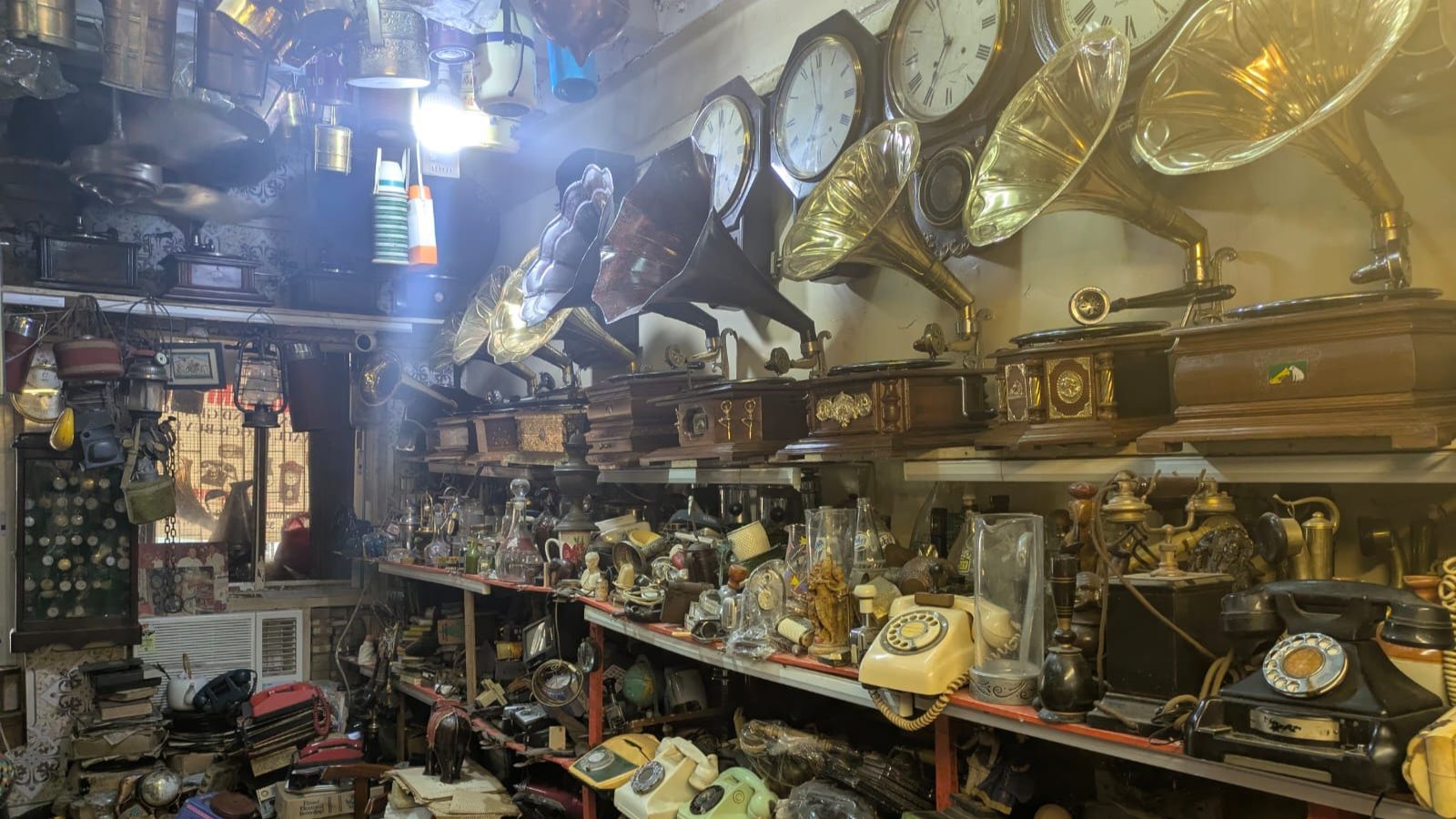
Grandfather clocks stand beside cuckoo clocks. Pendulum clocks line the walls while gramophones, old radios, vintage telephones, table fans and stacks of vinyl records fill every available corner. Behind the display sit hundreds of clocks waiting to be repaired, restored or sold, their winding keys carefully arranged beside them.
For nearly 70 years, the family has bought, repaired and sold antique clocks and gramophones from the same shop.
“We started with old watches, gramophones, radios, harmoniums and musical instruments,” said Mohammed Hanif, whose family founded the business nearly 70 years ago. “People brought us old things. We repaired them and sold them again. That’s how this business began.”
Customers browse through antique clocks on Mutton Street in Chor Bazaar, where the family says foreign buyers have sharply declined since the Covid-19 pandemic. (Express Photo)
In its heyday, the shop’s biggest customers were not from Mumbai but from overseas. Antique dealers and tourists from Britain, Germany, France, the United States and the Gulf flocked to Chor Bazaar in search of colonial-era clocks, gramophones and curiosities that had become difficult to find elsewhere.
“Our main customers were foreigners,” Hanif said. “People came here from all over the world.”
Today, they rarely do.
The family says business first began slowing after the 2008 Mumbai terror attacks before the Covid-19 pandemic transformed the market.
Story continues below this ad
“After the lockdown everything changed,” said Mohamed Shafi, Hanif’s nephew and a third-generation member of the family business. “Foreign customers have reduced by almost 70 per cent. Earlier they came to buy. Now many of them just take photographs of the shop.”
The fall in overseas buyers has also coincided with rising freight costs, making exports increasingly unviable.
“Earlier we used to send two or three containers every year,” Shafi said. “Now we don’t even send one. Shipping has become too expensive and there are hardly any foreign dealers left.”
Once one of Mumbai’s best-known antique markets, Chor Bazaar has seen many long-standing traders shut down, relocate or become scattered as redevelopment reshapes parts of the neighbourhood.
Story continues below this ad
“Earlier everything was in one line,” Shafi said. “Now shops have shifted to different buildings and upper floors. The market has become scattered and customers don’t know where to find everyone.”
Inside Abdul Gani Ebrahim, however, much remains unchanged.
The family estimates it has around 500 to 600 clocks, including German, Swiss, American and vintage timepieces. Alongside them are gramophones dating back as far as 70 to 90 years, including models from His Master’s Voice (HMV), Swiss and German manufacturers. The shelves also hold antique records, radios, ceiling fans, table fans and pocket watches collected from across the country.
Among the shop’s regular customers is antique clock and watch collector Himanshu Goyal, who says the family’s reputation has kept him returning.
“I’ve found some rare clocks and watches at this shop,” Goyal said. “I’m lucky to have found this shop because they’re reliable when it comes to authenticity, and they still manage to surprise me every time.”
Story continues below this ad
Nearly all of the antiques are sourced from within India. Dealers from Rajasthan, Delhi, Karnataka, Kerala, Tamil Nadu and other states bring old pieces to Mumbai, where they are repaired or restored before being sold.
Long before Covid changed the market, the family had already begun adapting to changing tastes.
About two decades ago, they started manufacturing antique-style replicas of clocks, gramophones, telephones and bioscopes. While they resemble century-old originals, the replicas use modern battery-operated mechanisms instead of traditional winding keys.
“Customers liked the antique look but they didn’t know how to operate the key mechanism,” Hanif said. “If someone winds it incorrectly, the spring can break and repairing it is difficult. That’s why we started making battery-operated versions that look old but are easier to maintain.”
Story continues below this ad
Those replicas have become increasingly important as the customer base has shifted.
Instead of overseas collectors, the shop today caters largely to Indian buyers, architects, interior designers, hotels, cafés and homeowners looking for vintage décor. It also rents original gramophones, clocks, radios and other period pieces to film and television productions, where authenticity often matters more than age.
“There are fewer collectors now,” Hanif said. “Most business comes from rentals, display pieces and people decorating homes or commercial spaces.”
As Chor Bazaar continues to change around them, the family still spends its days searching for old clocks and gramophones from across India, restoring what can be preserved and recreating what no longer survives. For a shop that has witnessed seven decades of change in Chor Bazaar, adapting has become just as important as preserving the past.
View original source — Indian Express ↗
Related stories

TechRadar
TechnologyJul 9, 2026 · 1 min
Two reasons why you might want to buy the Galaxy Z Fold 7 right now — yes, before the Galaxy Z Fold 8 lands
TechRadar

The Verge
TechnologyJul 9, 2026 · 1 min
Schlage’s Sense Pro unlocks the door so I don’t have to
The Verge

ZDNet
TechnologyJul 9, 2026 · 1 min
The best digital notebooks of 2026: Expert tested and reviewed
ZDNet
TechRadar
TechnologyJul 9, 2026 · 1 min
Here are 7 of my favorite laptop deals from the latest Best Buy sale — get up to $700 off HP, Acer, Samsung, and more
TechRadar