Indian Express
Delhi records first ‘Good’ AQI day in over 2 years – thanks to heavy rains
3 min readNew DelhiJul 9, 2026 10:54 PM IST
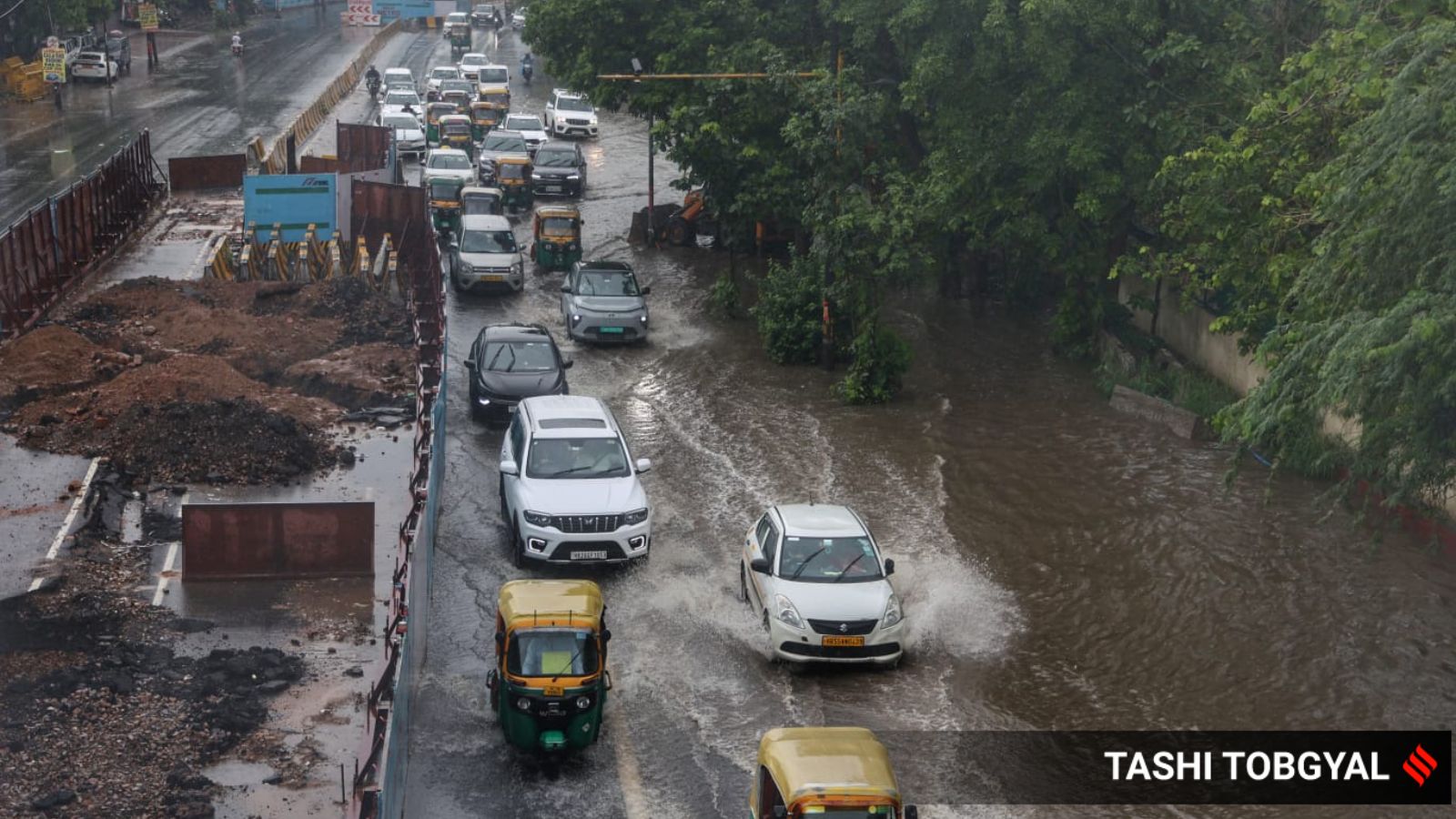
Commuters tread through water-logged MB Road in New Delhi during monsoon showers on Thursday. (Express Photo by Tashi Tobgyal)
Heavy rain lashed parts of Delhi on Thursday, bringing relief from the heat but triggering waterlogging, traffic snarls and tree falls across the city.
The city also recorded its first ‘Good’ AQI day in nearly two years and 10 months on Thursday, with the daily average AQI dropping to 48 at 4 pm – the lowest recorded so far this year. The Capital had last witnessed a ‘Good’ AQI day on September 10, 2023, when the daily average AQI stood at 45, as per data from the Central Pollution Control Board.
While rainfall remained uneven across the Capital, Northeast Delhi emerged as the wettest pocket, with Tukmirpur recording around 160 mm of rain during the day, which is comparable to some of the highest single-day July rainfall events recorded at Safdarjung base station.
Waterlogging and rain in Noida, on Thursday. (Express photo by Abhinav Saha)
Although Safdarjung did not witness an extreme rainfall event, the around 160 mm recorded at Tukmirpur is of the same order as the Capital’s most intense July downpours. The India Meteorological Department (IMD) records show the highest 24-hour July rainfall at Safdarjung remains 266.2 mm (July 21, 1958), followed by 169.9 mm (July 25, 1982) and 153 mm (July 9, 2023).
Rain also disrupted normal life in neighbouring Noida while in Ghaziabad, the collapse of a residential road sent a parked car and a scooter plunging into a pit. Authorities declared a holiday in government schools in Ghaziabad.
IMD radar imagery showed highest rainfall activity over North Ghaziabad and Northeast Delhi. The second-highest rainfall belt extended across Central and East Delhi, while only moderate rain was recorded over Gurgaon and parts of Southwest Delhi.
At Delhi’s base station, Safdarjung recorded 72.6 mm rainfall in the 24 hours ending 8.30 am on Thursday, followed by another 32.4 mm between 8.30 am and 5.30 pm, taking the day’s cumulative rainfall to 105 mm.
Story continues below this ad
Rainfall remained distributed. For instance, Mayur Vihar in Delhi recorded 43 mm till 4 pm, followed by Ghaziabad’s Nehru Nagar station (31.5 mm) and Hindon (28.5 mm).
The widespread cloud cover and rain caused daytime temperatures to plunge well below normal. Safdarjung recorded a maximum temperature of 29.2 degrees Celsius, 7.4 degrees below normal, while the minimum settled at 24.3 degrees Celsius, 3.6 degrees below normal. Lodi Road recorded an even lower maximum of 28 degrees Celsius.
The weather office has forecast generally cloudy skies on Friday, with very light to light rain at many places and moderate rain at isolated locations accompanied by thunderstorms, mainly during the morning and forenoon. The maximum temperature is expected to remain between 32 and 34 degrees Celsius, with the minimum between 22 and 24 degrees Celsius.
In one of the most serious rain-related incidents, a section of a road in Vasundhara Sector 13 in Ghaziabad caved in beside an under-construction basement after incessant rain, sending a parked car and a scooter into the pit. No one was injured.
Story continues below this ad
In Noida, several areas, including Sectors 16, 33 and 12, witnessed severe waterlogging, with knee-deep water reported at places, making movement difficult for pedestrians and two-wheeler riders.
Several motorcycles and scooters stalled after water entered their exhausts, forcing riders to push their vehicles through flooded stretches. Some commuters crossed inundated roads by walking along roadside dividers.
View original source — Indian Express ↗
Related stories

Indian Express
WorldJul 9, 2026 · 1 min
‘That’s what I’m doing with India’: Netanyahu eyes India as key ally beyond US
Indian Express

TASS
WorldJul 9, 2026 · 1 min
Some Iranian missiles fired at US bases in Middle East reached targets — WSJ
TASS

RNZ
WorldJul 9, 2026 · 1 min
King Charles on Matariki: 'Share and clebrate together'
RNZ

TASS
WorldJul 9, 2026 · 1 min
At least million people arrive in Mashhad to attend Khamenei’s funeral
TASS