The Guardian
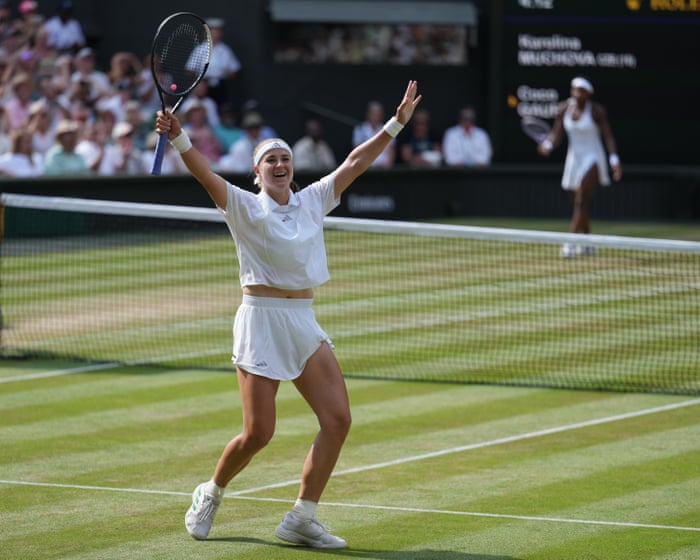
Muchova into Wimbledon final after nailbiting tie-break defeat of Coco Gauff
She finds a first serve on match point and the contact is perfect: 117mph, punched hard down the centre line, and from the moment her hand receives the message from her strings, she must know this is it. Of course the ball may come back, and indeed the ball does come back, but only barely. And in those few seconds as it arcs over the net, springs back up off the grass and hangs there like a beautiful sweet fruit, Coco Gauff has a Wimbledon final in her grasp.
The afternoon has been hot: viciously hot, sadistically hot, the sort of heat that seems to take years from you. In the crowd, paper fans wave and flutter like butterflies, and this has been a match full of natural beauty, of clean swings and satisfying timing and brilliant shapes set against pale green. And still the return from Karolina Muchova hangs there, high and slow, a sentence demanding a punctuation mark, a piece of Centre Court cinema about to roll the credits.
For Gauff, this simple put-away will affirm everything we wanted to know about her. That one of the most gifted players of her generation can become the all-surface genius she always threatened to be. That there is nobody on the planet better at closing out the clutch moments in clutch matches, at drawing strength from their moment of greatest weakness. Nobody on tour has won more deciding sets all year. In majors, it’s 13 of her last 15.
And after finding herself blown off the court in set one, the match has followed a familiar pattern. At some point early in the second set she begins to lock in. These moments are never not worth watching. People call it “moving through the gears”, but really it’s a kind of divine alignment, all the pictures in her head sharpening into a devastating focus. She runs the corners and hits the corners. The court begins to shrink before her opponent’s eyes. Gauff at her best makes you feel like you’re being chased.
While all this is going on, Muchova hitches her sodden polo shirt back on to her shoulders and plots her retribution. If you love tennis, you simply have to love Muchova. Perhaps it’s the baggy, retro 1990s look, perhaps the magic in her hands, the way she finds impossible angles, the sliced backhand that would bounce on a pond. Perhaps it’s the way she has fought back from a catastrophic wrist injury to reach the pinnacle of her game at the age of 29.
Three years ago I watched Muchova play her first grand slam final, at Roland Garros against Iga Swiatek. She fought hard, chased everything down, and for a brief moment, Swiatek almost managed to spook herself into an almighty upset. But deep down, she wasn’t really ready yet, and maybe she knew it.
Now under the tutelage of Sven Groeneveld, her game is more rounded, more resilient, more varied. She won her first grass-court title last month.
Now, and with a certain nonchalance, she pushes back the Gauff surge, shuts out the noise of the partisan crowd, forces the third set into a tie-break, which, as the ball loops over the net, stands at 9-8 to Gauff.
Gauff goes for the drop shot. The idea has a certain logic. She’s had plenty of joy with it already, and Muchova has shown signs of stiffness during the third set. Also, to this point her conventional forehand – targeted remorselessly by her opponent – has had the accuracy of a sawn-off shotgun: 20 unforced errors and six winners, of which four come in the tie-break.
But it’s the wrong choice, and as the ball clacks off her strings and flubs into the net, she knows it. “I just panicked a little bit,” she will later say.
It’s not the end. Muchova finds a perfect lob to bring up her first match point. Gauff saves it with a stunning crosscourt pass. But two points later, the American puts another desperate forehand into the net and it’s over: 6-2, 1-6, 7-6 (10). Muchova presses a towel to her face and weeps a little. “I don’t even know what I’m saying,” she will say on court a few moments later. “I’m kind of shaking.” It’s the first match she’s ever played on Centre Court.
The second will come on Saturday against her friend and practice partner Linda Noskova. Already she has moved mountains to be here: conquered injury, beaten grand slam champions in Barbora Krejcikova and Naomi Osaka, and now forced the sport’s greatest pressure player to crumble under pressure.
She has already risen from No 10 to a career-high No 6 in the world. This feels like her moment. But as she and Gauff now know better than anyone, moments still need to be seized.
View original source — The Guardian ↗
Related stories

ESPN
SportsJul 9, 2026 · 1 min
Clips-Raptors trade for Kawhi on hold amid probe
ESPN
ESPN
SportsJul 9, 2026 · 1 min
What went wrong for Coco Gauff at Wimbledon
ESPN

ESPN
SportsJul 9, 2026 · 1 min
Top '27 recruit Spears Jr. reclassifies, picks Tex...
ESPN
ESPN
SportsJul 9, 2026 · 1 min
Judge to have rib imaged as Yanks stay cautious
ESPN