BBC
Accused Charlie Kirk shooter confessed, roommate says in video played in court
Portions of both the video and text exchanges were redacted, while others were played only for those in the courtroom - not for public consumption.
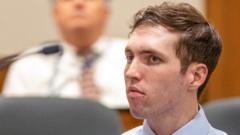
Twiggs, appearing in the video from April with long hair parted in the middle, a navy blue blazer and blue patterned tie, paused at times to sip from a bottle of water as Prosecutor Ryan McBride posed questions.
According to Twiggs, Robinson, 23, asked for an engraving tool in the months before the shooting, saying he wanted to inscribe bullets for an upcoming camping and hunting trip with his family.
Robinson sometimes discussed politics, said Twiggs, but he didn't share the same interest and didn't "really contribute much" to such conversations.
Twiggs said he believed Robinson listened to politics on the radio while traveling to and from his jobs as an electrician. Most of his comments centered on President Donald Trump, or new legislation, Twiggs said.
Twiggs said he never heard Robinson discuss Kirk, and the pair did not speak about LGBTQ issues, according to the recorded statement.
On the day of the shooting, Robinson left earlier than usual, around 4am, but Twiggs said he thought he was just going to a job that was further away.
The alleged shooter texted his roommate after Kirk was killed, telling Twiggs to "drop what you're doing" and "look under your keyboard."
As Robinson texted further, Twiggs asked: "You weren't the one who did it, right?"
"I am," Robinson wrote in text messages presented in court. "I'm sorry."
When Twiggs asked why, Robinson responded that he'd "had enough of his hatred. Some hate can't be negotiated out."
He continued texting Twiggs on the night of the shooting, still near the campus where Kirk was shot, telling his roommate that he'd left his rifle in bushes where he'd changed his clothes and was waiting to retrieve it.
"If I'm able to grab my rifle unseen, I will have left no evidence," Robinson said in the text messages.
He complained about crickets being too loud and lamented that a sniffer dog may have located the firearm.
There was a heavy police presence and a squad car remained near the spot he wanted to get to - so "I'm just sitting in my car watching reels for another hour," Robinson texted Twiggs.
He also texted that he was leaving Orem, more than a three-hour drive from their apartment in St George, in southern Utah, telling his roommate he was on his way home.
The next day, Twiggs said, Robinson was in their apartment when he woke up, he said on video.
Robinson "didn't go into detail" about the previous day, Twiggs said.
"I just asked him in person if what he said was true the night before and he said it was. He started crying a little bit and said he wishes he hadn't done it and then kept going around and just doing stuff, I think to keep himself busy or distracted or something."
Robinson told his roommate that he intended to turn himself in.
Utah State Bureau of Investigation agent Brian Davis previously testified on Wednesday that Robinson, accompanied by his parents and a family friend, arrived around 9pm that day to turn himself in at Washington County Sheriff's Office.
Hours of court proceedings on Wednesday afternoon and Thursday morning centred on discussion between the prosecution and defence, as well as lawyers for the media and Erika Kirk, about whether Twiggs' video statement could be published.
Judge Tony Graf eventually ruled that both the footage and text messages exchanges could be published, with some redactions, and with some portions visible only in the courtroom and not made publicly available.
Robinson's defence team has raised repeated objections to exhibits and testimony throughout the proceeding. Earlier in the week, the prosecution presented an FBI report, which described DNA belonging to Robinson and Twiggs found on a rifle, screwdriver and towel recovered at the scene.
The defence then spent hours questioning the analyst who signed the report, asking about protocol, testing, interpretation and margins of error.
Related stories
Philippine Daily Inquirer
WorldJul 9, 2026 · 1 min
July’s hottest (and coolest) food and drink partnerships
Philippine Daily Inquirer

Al Jazeera
WorldJul 9, 2026 · 1 min
Trump airport name change sparks backlash in Florida
Al Jazeera
CNA
WorldJul 9, 2026 · 1 min
Stocks shrug off tensions to rise on renewed tech interest
CNA

CBC
WorldJul 9, 2026 · 1 min
Jail guard targeted in Project South alleged murder plot accused of overseeing abusive practices
CBC