SBS News
Body of slain Iranian supreme leader arrives at Shi'ite shrine as crowds chant 'Kill Trump'
In brief
The funeral procession of Iran's slain Supreme Leader Ayatollah Ali Khamenei has reached the country's holiest shrine for his burial.
The US and Iran have traded fresh attacks after US President Donald Trump said the interim ceasefire with Iran is "over".
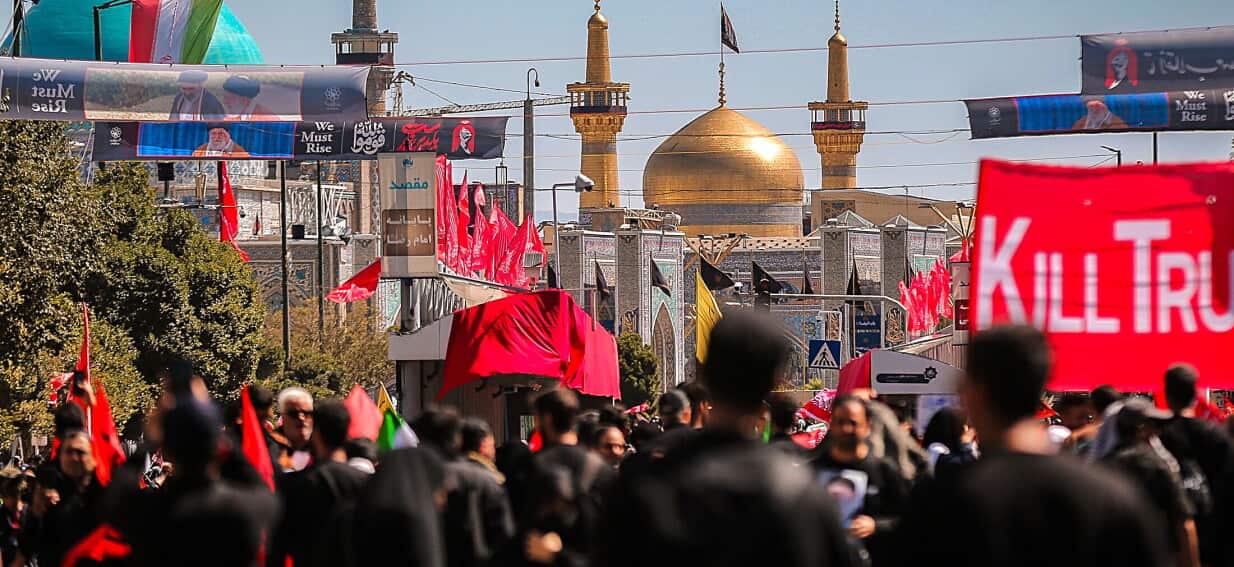
The funeral procession of Iran's slain Supreme Leader Ayatollah Ali Khamenei has reached the country's holiest shrine for his burial as the crowd bore banners reading "We Will Kill Trump".
As a week of funeral events reached its culmination, Khamenei's son and successor Mojtaba Khamenei is still hidden from public view after being disfigured in the 28 Februarystrike that killed his father, a sign of the unease still gripping Iran.
Khamenei's body was carried by truck slowly through the crammed streets of Mashhad in northeastern Iran towards the gilt dome and minarets of the Shrine of Imam Reza, flanked by white-turbaned clerics. Black-clad mourners pressed in close behind, waving Iranian flags, photographs of the late Khamenei and red placards with revolutionary slogans.
A helicopter lifted his coffin the final short stretch with the truck unable to pass through the thick crowds. It then lay on a carpet as clerics stood praying behind.
News that makes sense
Your trusted source for staying up-to-date with the world around you. Get free daily news updates and analysis, straight to your inbox.
Meanwhile hostilities with the United States have erupted again this week despite a truce, with Iran still controlling the vital Strait of Hormuz waterway and proclaiming its victory in having survived a months-long assault by its most powerful enemies, Israel and the US.
Iranian authorities are presenting Khamenei's burial and the huge crowds attending his funeral as evidence of the popularity of their theocratic state and its lasting ideological fire, nearly half a century after the 1979 Islamic revolution.
But beneath the surface, Iran faces huge internal challenges and the legacy of Khamenei's 37-year rule is bitterly disputed in a country where large numbers have repeatedly risen up to protest poverty and repression in recent years.
'Kill Trump'
The whereabouts of Mojtaba Khamenei, proclaimed supreme leader by a clerical assembly in early March, a week after his father's death, has remained a mystery to Iranians.
He has not appeared in public since the war began with the strike that killed Ali Khamenei. While he has issued written statements, no image, video or voice recording of him has been issued.
He suffered debilitating injuries in that same strike, his face disfigured and limbs badly wounded.
Senior sources in Tehran have said he is recovering but that he has not yet been well enough to manage public appearances. State security services are also trying to limit his exposure in case of more attacks from the United States.
As crowds jostled in Mashhad awaiting Khamenei's funeral cortege, the crowd chanted slogans demanding revenge on US President Donald Trump for his killing.
“I swear by the blood of the supreme leader, Trump, we will kill you!” they shouted, with women holding up placards reading "Kill Trump".
The shrine's courtyard was a sea of mourners as dusk fell, their defiant chants of "Death to America" ringing out above the lyrical funeral laments and sorrowful string music broadcast by loudspeakers.
Senior ayatollahs sat waiting on a raised dais, under the intricate blue tiling of an arched recess.
Imam Reza was one of Shi'ite Islam's holiest figures and the shrine complex in Mashhad, Khamenei's hometown, is a centre for pilgrimage with its golden dome and another azure domed mosque among Iran's most recognisable buildings.
As the crowds awaited the coffins of Khamenei and his family in the sweltering July heat, hoses pumped water high into the air to spray across the mourners and keep them cool.
Khamenei's remains, along with those of four family members killed alongside him, have already been paraded through Tehran, the Shi'ite Muslim clerical centre of Qom and the Iraqi shrine cities of Najaf and Karbala.
At each event, huge crowds have thronged the streets to the mournful accompaniment of sung Shi'ite laments and chanted revolutionary slogans.
Martyrdom holds a central place in Shi'ite theology, and Khamenei's death at the hands of foreign enemies has played into a religious and political tradition that runs deep through the Islamic Republic.
Renewed attacks
Meanwhile, Iranian armed forces have launched attacks on US military infrastructure in Gulf states following US strikes on Iran's southern coastal and eastern provinces, putting further strain on a three-week-old ceasefire agreement.
Iran's Revolutionary Guards Navy said the US attacks and intervention in redirecting shipping through the Strait of Hormuz were disrupting the waterway's gradual reopening.
The Guards said the number of vessels transiting the strait under Iranian supervision had recovered to about 50 per cent of pre-war levels over the past two weeks, adding that permission was being granted only to ships using routes designated by Iran.
Any further US intervention will draw a "crushing response", the Guards said.
The US military said on Wednesday that its latest strikes were aimed at keeping the Strait open after it said Iranian forces had struck three tankers in the area.
The assault came hours after US President Donald Trump said he believed the interim ceasefire with Iran to be "over".
While Iran has not claimed responsibility for the ship attacks, analysts say Iran uses such actions to gain leverage in negotiations.
Oil prices, which had spiked amid concerns over the effect of the renewed attacks on shipping and global supplies, fell back on Thursday as investors weighed whether the flare-up was tactical and temporary or might augur a complete collapse in the ceasefire.
Iranian officials said the US attacks had killed 14 people and injured 78 across five provinces on July 8 and 9, state media reported.
The Fars news agency said one US strike had hit a rail bridge used for trade with Russia and China.
Several explosions were heard on Thursday morning in Iran's Bushehr province and in Bandar Abbas, a port city on Iran's south coast, the Mehr news agency reported.
Bushehr is home to a Russian-built nuclear power plant and a local official later told state media that a US projectile had hit the perimeter area of the facility.
The perimeter had already been hit several times before an April 8 ceasefire.
Iran's army said in a statement released by state media that it had launched attacks at US Patriot systems in Kuwait, an early-warning site in Qatar and a US army fuel depot in Bahrain.
Kuwait said its armed forces had engaged with a cruise missile, three ballistic missiles and 10 drones in its airspace, and that one person had been injured from falling shrapnel.
Sirens also sounded in Jordan after missiles launched from Iran were detected, the state news agency reported.
Eight were intercepted, with no injuries or damage reported.
The Revolutionary Guards later said Iran had fired 10 ballistic missiles at Jordan's Azraq military base, which is used by US forces, and also a US military control centre in the Middle East, without elaborating.
Qatar, which hosts the largest US base in the region and has often mediated between the US and its adversaries including Iran, condemned attacks on commercial shipping but also called for a return to diplomacy.
The foreign ministers of Turkey and Oman also stressed the need to avoid further military escalation in separate calls with their Iranian counterpart, Abbas Araqchi.
In a call with the army chief of Pakistan, which has also mediated in the conflict, Araqchi condemned what he called US "warmongering policies".
For the latest from SBS News, download our app and subscribe to our newsletter.
View original source — SBS News ↗
Related stories
MarketWatch
BusinessJul 9, 2026 · 1 min
Taco Bell is reportedly pulling produce from some stores. Here’s what to know.
MarketWatch
MarketWatch
BusinessJul 9, 2026 · 1 min
Why a hidden divergence between the VIX and Nasdaq volatility has the smart money on edge
MarketWatch

Bloomberg
BusinessJul 9, 2026 · 1 min
Asian Stocks Set to Gain After US Chipmakers Rally: Markets Wrap
Bloomberg
MarketWatch
BusinessJul 9, 2026 · 1 min
SK Hynix is about to hit the U.S. market. Here’s what to know about the deal.
MarketWatch