CNA
Johor state polls: Can smaller reformist parties like Bersama and MUDA break into PH’s urban seats?
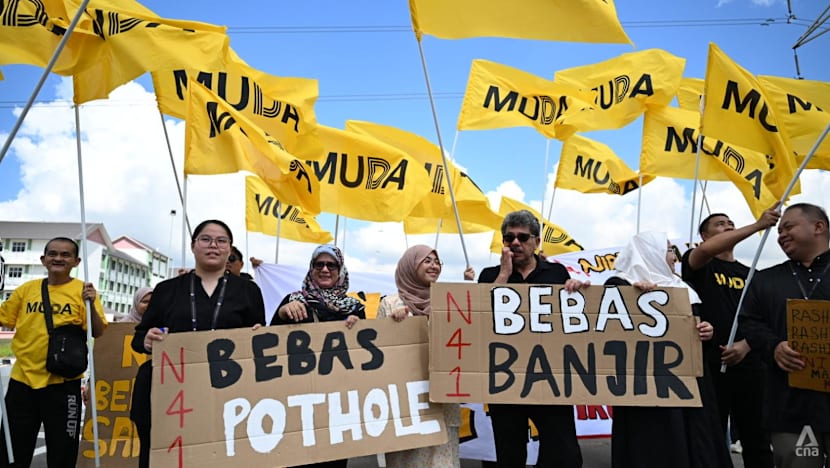
JOHOR BAHRU: For the past four years, 26-year-old Rashifa Aljunied has been walking the grounds in Puteri Wangsa, a densely populated urban mixed constituency in Johor Bahru.
She was first a volunteer after the Malaysian United Democratic Alliance's (MUDA) breakthrough in the 2022 Johor state election saw the youth-focused party secure its first state assembly seat there.
Fast forward to 2026, and Rashifa is now MUDA’s candidate to defend the party’s incumbency in Puteri Wangsa in the upcoming Johor state polls to be held on Jul 11.
The rising costs of living, increasingly frequent floods and housing affordability are among the concerns she hears most from voters.
“They want to see more alternative political establishments that can represent their voices,” she told CNA.
“I want to be the best representative for them.”
The first-time candidate is taking on former education minister Maszlee Malik of the Pakatan Harapan (PH) coalition in a five-cornered contest that is closely watched.
Rashifa’s candidacy comes at a crucial moment for two of Malaysia’s smaller reformist parties - MUDA and also the newly relaunched Parti Bersama Malaysia (Bersama) that is led by two former cabinet ministers Rafizi Ramli and Nik Nazmi Nik Ahmad.
Political observers say Johor marks Bersama’s first electoral test since its relaunch in May while MUDA has scaled down.
The latter is contesting in only four seats - as compared to the seven it did in the 2022 state polls - as well as campaigning without its most recognisable figure, Syed Saddiq Abdul Rahman.
Syed Saddiq - MUDA’s founder and a former minister of youth and sports - has opted to skip campaigning for the Johor state polls in order to focus on his court case.
The Muar Member of Parliament is awaiting a Federal Court decision on a prosecution’s appeal against an acquittal in his graft case involving Armada funds. Armada is the youth wing of Syed Saddiq’s former party, the Parti Pribumi Bersatu Malaysia (Bersatu).
Neither MUDA nor Bersama is likely to emerge as a credible alternative to the larger coalitions in the state polls, say analysts.
But they add that the results could provide an early indication of whether these smaller reformist parties can begin making inroads into PH’s traditional urban support base in Johor where Malaysia’s two other key coalitions - Barisan Nasional (BN) and Perikatan Nasional (PN) - do not hold much sway.
For Bersama especially, retaining election deposits or even winning a single urban seat would indicate a “major achievement” for a party making its debut in Johor’s state election.
“While neither party may yet be strong enough to defeat PH on a broad scale, they are capable of reducing PH's majorities or even causing PH to lose certain seats to BN,” said socio-political analyst Awang Azman Awang Pawi of Universiti Malaya.
He added that losing their deposits in most seats would instead reveal a “significant gap between their visibility on social media and their actual support on the ground”.
RETAINING DEPOSITS A “BREAKTHROUGH”
Bersama’s co-leader Nik Nazmi acknowledged that contesting the state election was a “long shot” for the party, saying that retaining its election deposits would already be a “breakthrough”.
“If we can show that we can do better than PH in a few seats, I think that would be something that offers success,” the former natural resources and environmental sustainability minister told CNA.
In Malaysia, candidates lose their RM5,000 (US$1,200) election deposit for state seats if they fail to capture at least 12.5 per cent of the votes cast.
Bersama was relaunched by Rafizi and Nik Nazmi - who were formerly from Prime Minister Anwar Ibrahim’s Parti Keadilan Rakyat (PKR) - after resigning from their Cabinet positions last year.
The party is contesting 15 seats in Johor, while Anwar’s PH coalition is contesting all 56 seats.
Awang Azman of UM said that for Bersama and MUDA, securing between 10 and 15 per cent of the vote share in several constituencies would indicate the “existence of a support base that can be expanded”.
On Bersama, he noted that the "minimum benchmark for success" is whether Rafizi and Nik Nazmi's influence can attract a segment of PH supporters, young voters, the middle-class and voters "dissatisfied with the mainstream political parties".
But James Chin, professor of Asian Studies at the University of Tasmania, cautioned that expectations for Bersama remained low.
“If they are lucky, they get three or more (seats). If they are unlucky, they may end up with zero but as long as they get back their deposit, that would be (considered) a major win (for them),” he told CNA.
Meanwhile, Syaza Shukri - a political scientist at the International Islamic University of Malaysia (IIUM) - stressed that Bersama’s performance should be judged by how much of PH’s traditional support base it could pull.
She identified urban and mixed constituencies such as Johor Jaya, Permas, Larkin, Stulang, Perling, Skudai, Kota Iskandar, Senai and Puteri Wangsa as key seats to watch.
“These are areas where disillusioned PH voters, younger voters and reform-minded voters may be more open to an alternative,” Syaza told CNA.
PH held 12 seats in the recently dissolved Johor state assembly, mostly in urban and suburban constituencies, making it the state’s opposition bloc. BN had 40 seats, while PN had three.
Unlike at the federal level, where PH and BN are partners in Anwar’s unity government, the two are rivals in Johor.
The Johor state polls are likely to see PH and BN go head-to-head in tightly fought contests. PN, the main opposition bloc nationally, is seen as a secondary political player in Johor and is beset with its own internal strife.
For MUDA, analysts said that Puteri Wangsa remains the “most symbolic seat” and its success should be measured by its ability to retain the seat, or at least remain one of the top two contenders in the constituency.
“MUDA's biggest challenge is to demonstrate that its 2022 victory in Puteri Wangsa reflected genuine support for the party and its constituency service, rather than simply benefiting from cooperation with PH or Amira Aisya's personal popularity,” said Awang Azman of UM.
Amira, MUDA’s acting president, had won the seat in a six-cornered fight in 2022.
This time, political newcomer Rashifa is contesting against PH’s Maszlee, BN’s Teow Chia Ling, Nicholas Paul Vincent of Bersama and independent hopeful Wang Wee Siong.
CAN REFORMIST PARTIES ERODE PH’S URBAN BASE?
Observers noted that Bersama and MUDA are unlikely to replace PH as the dominant force in urban Johor, but they could reshape the contest by “disrupting the balance of votes” among PH’s traditional urban voters, potentially benefitting BN in closely fought constituencies.
“In multi-cornered contests, Bersama or MUDA do not need to win a large share of the vote to damage PH's prospects. A swing of only a few thousand votes or a lower turnout among PH's traditional supporters could prove decisive in marginal seats,” said Awang Azman of UM.
“In closely contested constituencies, votes cast for either party could determine whether PH retains the seat or whether BN wins due to a divided opposition vote.”
Syaza of IIUM said Bukit Batu is one urban seat to watch, with MUDA appearing to establish it as a foothold after PH won the constituency by just 137 votes in the 2022 state election.
She added that Bersama and MUDA are likely to appeal to younger voters who have yet to develop strong party loyalties.
“The older PH voters, even if they’re not happy with PH, I think (they) would vote strategically because they would not want to see their votes fragmented and (hand) a win to BN,” she told CNA.
“Younger voters may not mind that much … If the so-called ‘liberal’ vote is split, then of course BN would be the beneficiary.”
For 26-year-old physiotherapist Fangqi Goo, a resident of Puteri Wangsa, her priority is voting for a representative who is “visible on the ground” and is able to offer better policies.
“I think MUDA brings fresh ideas and creativity while older parties have more traditional support and greater experience. But what’s more important for me is supporting whoever benefits the people,” she told CNA.
Another voter, Muhammad Rafi Shukri from the Taman Puteri constituency, said that the contest remains “largely between BN and PH”.
“Other parties like Bersama and MUDA are still new to me,” the 39-year-old told CNA.
Some analysts also predicted that Bersama could siphon Chinese voters away from PH. Chinese voters comprise between 24.5 per cent and 61.1 per cent of the electorate in the 15 constituencies that Bersama is contesting in, local news outlet Free Malaysia Today (FMT) reported.
Bersama’s presence, it appears, seems to rattle some quarters.
Over the weekend, Jalex Lee - the PH candidate for Pemanis - called on the Chinese community to refrain from backing Bersama’s candidates as it would risk splitting his coalition’s votes, FMT reported.
Chin of the University of Tasmania said that one of the biggest questions in this state election is whether Chinese voters will continue to back the Democratic Action Party (DAP) - a PH component party - or show signs of shifting and opt for other parties as seen in Sabah.
At the November 2025 Sabah state election, the DAP experienced a total wipeout and lost all the constituencies it had previously held.
Both Bersama and MUDA have rejected claims that they are splitting the opposition vote.
“Every party should be just working hard and trying to win on their own merit and not spook people into voting for them,” Bersama co-leader Nik Nazmi told CNA.
“We want to stand alone so we do not have to compromise. I think people are tired of that. They want coherence and that’s what we are offering.”
MUDA candidate Rashifa echoed that sentiment.
“The seat does not belong to any political party. It belongs to the people,” she told CNA, referring to the Puteri Wangsa state constituency seat.
MUDA had won Puteri Wangsa in the 2022 state election after contesting the seat under an electoral pact with PH before leaving the coalition in 2023.
“Elections are a celebration of democracy … Whether the votes are divided or not, what matters most is that every Malaysian has the opportunity to vote based on their own values, hopes and confidence in a candidate,” said Rashifa.
Even so, analysts said that PH’s performance is likely to depend more on broader electoral factors than on the number of votes diverted to Bersama or MUDA.
“These include voter turnout, public sentiment towards the federal government, candidate quality, the strength of DAP and PKR's campaign machinery, cost-of-living concerns, and BN's ability to mobilise its core supporters,” said Awang Azman of UM.
He noted that the popularity of Bersama’s national leaders such as Rafizi and Nik Nazmi would not automatically translate into votes for the party’s state assembly candidates.
Many of the candidates from the small parties are “fresh names” lacking strong public recognition and grassroots machinery compared with DAP, PKR and BN component party - the United Malays National Organisation (UMNO) - analysts said.
Still, Bersatu secretary-general Azmin Ali on Wednesday claimed that the PN coalition - which his party is a part of - can form the next Johor state assembly with MUDA as its partner if they win a total of at least 29 seats.
PN is contesting 33 seats, with Bersatu staking a claim on 16 of them.
Azmin’s claims, however, contradicts Bersatu president Muhyiddin Yassin’s comments on Tuesday, when the latter conceded that PN may not be able to form the next Johor state government.
WHAT COULD OUTCOMES IN JOHOR MEAN FOR GE16?
Moving forward, Syaza of IIUM said that a strong showing especially by Bersama in Johor could threaten PH and Anwar, influencing his calculations on the timing of the next general election. Malaysia’s 16th General Election (GE16) must be called by February 2028.
“Not only does it mean that Bersama’s reach translates offline but it could also show that urban voters are really unhappy with PH and it could spill into other states,” she told CNA.
“So what this means is that Anwar might postpone GE as far as possible (in order to stay in power).”
Chin of the University of Tasmania said that a good result would give Bersama momentum heading into the upcoming Negeri Sembilan state polls that will be held on Aug 1.
Beyond electoral performance, Awang Azman said both parties must prove that they have distinct political identities.
“If voters perceive Bersama merely as a PKR splinter party, or MUDA simply as a youth party without a clear state-level agenda, both will struggle to grow,” he said.
“They must prove that they have compelling political reasons for existing, rather than merely serving as protest vehicles against PH.”
Additional reporting by Rashvinjeet S Bedi
Source: CNA/ia(as)
Related stories

The Hill
PoliticsJul 9, 2026 · 1 min
House Republican introduces Birthright Citizenship Clarification Act to codify Trump executive order
The Hill

Straits Times
PoliticsJul 9, 2026 · 1 min
Trump updated Netanyahu on the US’ ‘moves in Gulf’: Israeli PM’s office
Straits Times

Straits Times
PoliticsJul 9, 2026 · 1 min
Iran buries former supreme leader Khamenei after new US fighting erupts
Straits Times

The Hill
PoliticsJul 9, 2026 · 1 min
Trump’s Air Force One switcheroo highlights security concerns around Qatari model
The Hill