Buenos Aires Times
Milei urges governors to renew commitment to 'May Pact' in speech
President Javier Milei marked Argentina's Independence Day celebrations in San Miguel de Tucumán with a call on provincial governors to renew their commitment to his government and economic plan.
Milei called on Argentina’s leaders to reassert their commitment to his so-called ‘Pacto de Mayo’ agreement, while unveiling the next stage of his government's reform agenda.
The La Libertad Avanza leader even went on to liken his economic programme to General José de San Martín's crossing of the Andes in 1817.
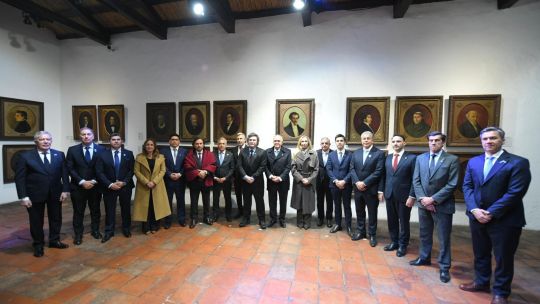
Speaking shortly after midnight during the traditional Independence Day vigil at the Historic House of Independence in San Miguel de Tucumán, Milei addressed a ceremony attended by members of his Cabinet, ruling party lawmakers and 13 provincial governors to mark the 210th anniversary of Argentina's declaration of independence.
Buenos Aires City Mayor Jorge Macri was also present.
The President said his administration’s ‘May Pact,’ signed in Tucumán two years ago by the national government and some provincial governors, had been designed to "remove the boot from the provinces' necks" by restoring their autonomy and unleashing their productive potential.
"Our government undertook a historic commitment: to free the Argentine people from the tyranny of the all-pervasive state," Milei said. "The Argentine people decided to put the state back in its proper place. They chose that path in 2023 and reaffirmed it in 2025."
Reviewing his administration's record, Milei claimed that many of the May Pact's objectives had already been achieved.
He stated his government had averted hyperinflation, reduced poverty, eliminated the quasi-fiscal deficit, lifted currency controls, approved the RIGI investment incentive scheme and claimed to have enacted more than 16,000 legal reforms.
Milei also highlighted the return of mortgage lending, the elimination of road blockades and the dismantling of what he described as the "business model" of social welfare intermediaries.
He pointed to legislation approved by Congress, including the first budget in a century with a balanced fiscal position and no risk of sovereign default, the Fiscal Innocence Law, labour modernisation reforms and amendments to the Glacier Protection Law that, he said, restored greater control over natural resources to the provinces.
According to Milei, those measures have helped reduce Argentina's country-risk rating from around 3,000 basis points to approximately 400. He added that the Economy Ministry had already secured financing for the country's debt repayments due in 2026 and 2027.
In one of the most striking passages of his speech, the President compared his economic reforms with General San Martín's military campaign.
"Having achieved this economic transformation without a default, without confiscations and by relying on market-based solutions amounts to an economic crossing of the Andes," he said.
The President described the current political moment as "a Second Independence," arguing that Argentina was once again breaking free from a system that had constrained the the nation’s provinces.
"For too long the national state failed the provinces and prevented their development," he said, citing export taxes, multiple exchange rates, exchange controls and the former application of the Glacier Protection Law as examples.
He argued that the new agreement with provincial governments would lay the foundations for "a future of genuine freedom."
– TIMES/PERFIL
related news
View original source — Buenos Aires Times ↗
Related stories

The Hill
PoliticsJul 9, 2026 · 1 min
House Republican introduces Birthright Citizenship Clarification Act to codify Trump executive order
The Hill

Straits Times
PoliticsJul 9, 2026 · 1 min
Trump updated Netanyahu on the US’ ‘moves in Gulf’: Israeli PM’s office
Straits Times

Straits Times
PoliticsJul 9, 2026 · 1 min
Iran buries former supreme leader Khamenei after new US fighting erupts
Straits Times

The Hill
PoliticsJul 9, 2026 · 1 min
Trump’s Air Force One switcheroo highlights security concerns around Qatari model
The Hill