Times of Israel
Maccabiah baseball field is a symbol of Israeli resilience – and a home – for players and fans
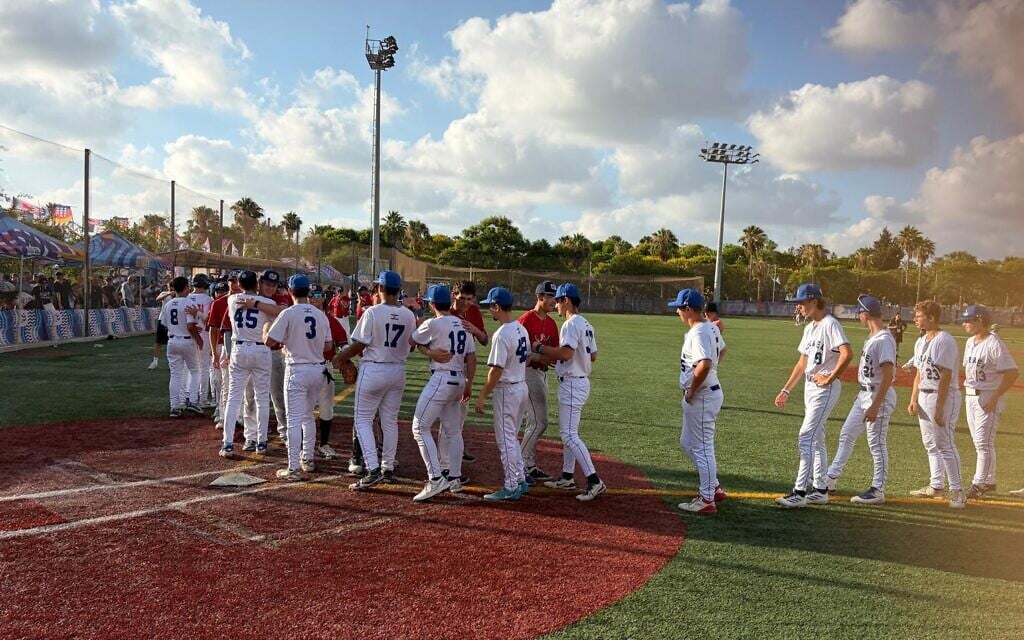
The sea of smooth green Astroturf at the Ezra Schwartz Memorial Field, a regulation-sized baseball field in the central Israeli city of Ra’anana, was ringed by Israeli, American and multicolored Maccabiah flags this week as fans filled the bleachers to watch two teams go head-to-head, one suited up in red and white, the other in white and blue.
Team USA and Team Israel had battled it out in a six-game series, which was tied at 3-3 on Wednesday, when Team USA went on to take game seven with a 5-1 win.
After the final out, there was a short roar from the victorious American team, a momentary quiet from the Israelis, and then a peaceful shaking of hands as the two teams filed past one another.
The tournament itself was an achievement for both teams, as Team USA was whittled down to just 17 players after the 22nd Maccabiah Games, scheduled for last year, were delayed by the 12-day war with Iran, prompting some athletes to drop out.
“We never even got to train together,” said USA coach Wayne Stotsky, who ended up merging two older and younger teams.
Get The Times of Israel's Daily Edition
by email and never miss our top stories
By signing up, you agree to the terms
The merger made things more challenging for his own players, who had little bench time during the tournament week, but also for the Israelis, who fielded a much younger team.
The Israeli team of 17- and 18-year-old high schoolers, said coach Freddy Bain, made history playing against college-age players: “We played neck and neck with them,” Bain said.
The Israeli team will head to Italy on Thursday to play in the U18 European Championship.
That’s a different kind of challenge, said Bain, playing in unknown territory, knowing the team may come up against anti-Israel sentiment, possibly requiring them to stay in their hotel rooms between games.
But they’re excited, said player Eitan Agus, 17, who has been playing baseball in Ra’anana since he was six years old.
“Playing on this field and with these players was amazing,” Agus said.
Israeli baseball offers the opportunity to think about something beyond war, loss and trauma, which have been front and center in this English-speaking enclave in the country’s center.
Grief, along with a sense of renewal, seems baked into the sunny field, built in 2017 and named for Ezra Schwartz, the 18-year-old Bostonian who was on his way to volunteer at a nature preserve when he was killed in a 2015 terrorist shooting in the West Bank.
His uncle, Yoav Schwartz, lives in Ra’anana and raised the NIS 2 million ($660,000) for the multipurpose field with help from the Jewish National Fund and the Israel Baseball Association.
The field has been home base for the Maccabiah baseball games, and it’s a second home for this community of Anglo Israelis, who know exactly where to set up their stadium chairs to chat comfortably, mostly in English, with one another.
The first pitch was thrown out on Wednesday by Nadav Kamer, a 17-year-old seriously injured by a Palestinian terrorist attack in January 2024, who has made a miraculous recovery. Kamer once played baseball two to three times a week and dreamed of playing professionally. These days, he’s focused on keeping score for the team.
Baseball and tragedy are somehow linked on this field.
It’s the finest regulation baseball field in Israel right now, said Ra’anana Baseball Association president Ruby Schechter, after years of playing on the baseball diamond in Kibbutz Gezer, Israel’s first regulation field.
There were also hundreds of games played at the Baptist Village in Petach Tikva, a Christian conference and sports center that has softball and baseball fields.
Schechter, a member of the Israel Association of Baseball and a coach in Ra’anana, works hard to grow baseball in Israel, but it’s an uphill battle.
“Baseball is a hard sport to promote,” said Schechter, who grew up in New Jersey as an avid baseball fan. “Soccer and basketball take up more room, and they’re more aggressive sports, with a lot of fighting and shouting and anger. We’re an anomaly they don’t understand.”
There’s a stronger sense of community in baseball, said Schechter, and it’s a more supportive sport in general, which may explain why it’s filled with expatriate American-Israelis, even now, 40 years after it was first brought to Israel by American immigrants.
Still, said Yonatan Ziering, 25, a former third baseman who is still involved with the Ra’anana team, the national Israeli baseball team is the best it’s ever been, with more players who are Israelis without a hint of North American parentage.
Ziering, the son of two American immigrants, fits the more typical Ra’anana baseball stereotype.
“It was pretty normal that for an Anglo kid, you played baseball on Fridays,” said Ziering. “Everyone starts playing baseball, the parents coach, it’s a very intimate feeling in the baseball community here.”
He got more serious about the sport in high school, when he joined the local baseball academy, but decided against entering the army as an elite athlete, which would have pushed him toward the United States and college baseball.
Instead, he chose to serve in the elite Egoz commando unit.
He was in the midst of his active army service on October 7, 2023, when his older brother, Aryeh Ziering, an officer in the Oketz canine unit, was called early that morning to head south with his dog to help fend off the Hamas invasion.
Yonatan Ziering headed north to join his unit and only heard much later that evening that Aryeh had been shot and then killed in battle.
Now, nearly three years later, Ziering speaks about his brother in the present tense and has given a lot of thought to his brother and the sports they played together.
Aryeh would often join the weekly Saturday night pickup baseball game. When Ziering and his wife, Ellian Koschitzky, married in May 2025, they held one of the sheva brachot, traditional post-wedding celebratory dinners, at the field during that week’s Saturday night game.
Ziering said that his brother loved how sports could push an athlete to the edge, making them the best version of themselves.
“In baseball, the process is very important,” said Ziering. “It’s such a valuable lesson for life, to look at good processes in the long run. You don’t win games on spectacular plays — it’s on the routine plays, not the diving catch. You have to appreciate the work.”
“You need patience and resilience to play the game, and that’s not always an Israeli characteristic,” added Ziering, “but that’s changing.”
View original source — Times of Israel ↗
Related stories
ESPNcricinfo
SportsJul 10, 2026 · 1 min
Chennai locked in to host Renegades vs Scorchers BBL opener
ESPNcricinfo

ESPN
SportsJul 10, 2026 · 1 min
Player rating: Mbappé and Dembelé strike to seal W...
ESPN

BBC
SportsJul 10, 2026 · 1 min
Loyal and royal: How the future King became a football superfan
BBC
Indian Express
SportsJul 10, 2026 · 1 min
FIFA World Cup: How teams have attempted to beat France and failed
Indian Express