Times of Israel
‘Modern palace’ seeks billionaire: Inside Israel’s highest-priced, $210m mansion
To real estate broker Amir Davidson, the Caesarea mansion his company is marketing is much more than Israel’s most expensive home.
“This is a modern palace, a piece of art, built in the style of Versailles in France but with modern technology,” said Davidson, CEO of Davidson Real Estate.
He walked past one of the gold-leafed fountains surrounding the property known as Bat Sheba’s Palace during an exclusive tour given to The Times of Israel, adding, “It’s larger than the floor area of the White House. There is nothing like this in Israel.”
The massive estate includes nearly 7,000 square meters (73,700 square feet) of built interior area across 11,000 square meters (2.7 acres) of landscaped grounds. Designed with gold and marble in Baroque and rococo styles, the home was completed in 2015 by Italian craftsmen, with custom-made furnishings crafted from marble, onyx, lapis lazuli, tiger’s eye, and malachite stone.
And with multiple swimming pools, spa and entertainment facilities, and countless spaces for hosting guests, it ostensibly lacks nothing — except a buyer.
With an asking price of $210 million, the property is accessible only to a tiny circle of the ultra‑wealthy around the world, even as interest in Israel’s ultra-luxury real estate market has exploded over the last decade, Davidson said.
“I’d say there are about 300 people in the world who could potentially be buyers,” he estimated, saying his target market is affluent Jews. “Since our office took over the listing about a month ago, we have been working to reach out to them. There are offers on the table that are currently under consideration.”
A stunningly ambitious project
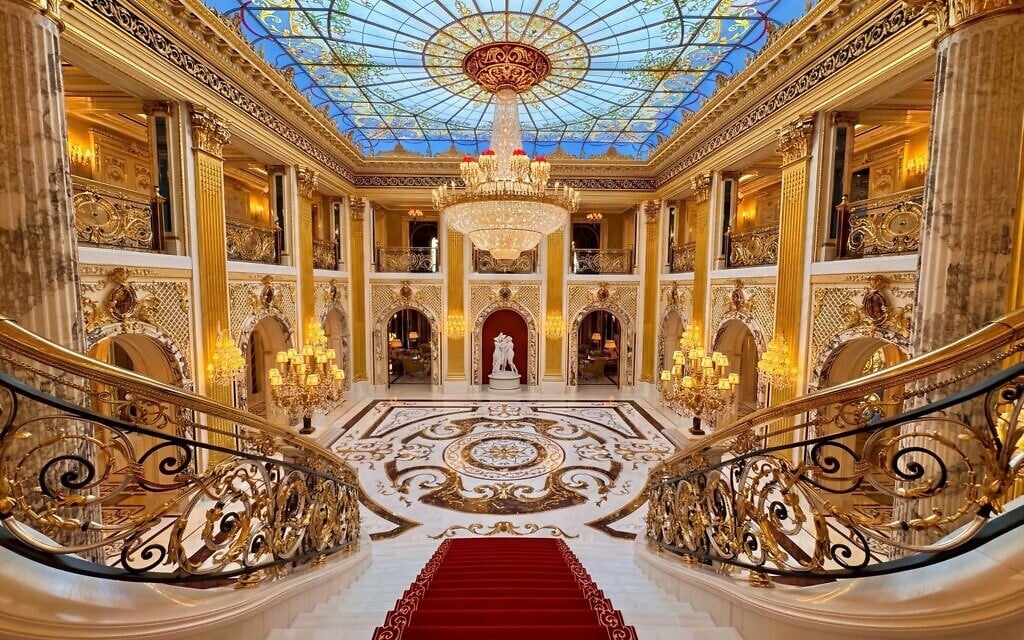
The central hall of Bat Sheba’s Palace, a chandeliered room of marble, gold and statues, calls to mind the world’s greatest palaces and fairytales.
While modern trends in home design tend to favor minimalist aesthetics, with a focus on clean lines, open spaces and neutral colors, the home’s owner, Valery Kogan, the co-owner of Moscow’s Domodedovo Airport, clearly had a very different vision.
Beginning in 2008, Kogan acquired six neighboring homes in Caesarea’s exclusive Cluster 5 enclave and demolished them, creating a combined lot so large that it spans two streets and is considered both first- and second-line to the sea.
By 2010, local workers began work on the mansion’s structural foundations, while Italian architects, led by Citterio F.lli and Cristiano Mattia Ferme, brought in teams of stonemasons and artisans from abroad to create the regal, neo-Baroque finishes he demanded.
Floors, walls, and ceilings were clad with 24‑karat gold leaf and rare marble, and inlaid with laser‑cut gemstones privately sourced and imported to Israel by the boxful. Crystal chandeliers and golden candelabras were coordinated with silk-trimmed couches and tapestries. Double-height pillars that sat unsold in a warehouse in Italy for a century were shipped to Israel in one piece in a painstaking delivery process.
“The level of planning and detail that went into this home is hard to comprehend,” Davidson said. “The vision is simply extraordinary.”
Construction on the home was completed in 2015, inaugurating a two-story main residence with 5 bedrooms and 15 bathrooms.
Visitors entering the heavily secured compound are greeted by a pair of monumental fountains with scenes rivaling the dramatics of Rome’s Trevi Fountain. Around the corner, in the backyard, an ornate swimming pool sits at the center of a sprawling private courtyard.
The ground floor contains dozens of reception and entertainment spaces furnished with precious stones, silk fabrics and custom-made decor. Multiple kitchens and catering facilities are hidden out of sight to avoid inconveniencing visitors.
Upstairs, elaborate bedrooms and bathrooms continue the same lavish aesthetic. Views of the sea are disappointing, however, with the Mediterranean coast distant and obscured by sand dunes.
Below ground, a maze of entertainment areas includes a private cinema, wine room and underground parking. A tunnel connects the main residence to a 900-square-meter (9,700-square-foot) spa and wellness pavilion featuring pools, saunas, treatment rooms and a gym — all rendered in the same Baroque style. (There are said to be several rather plain mamad safety shelters scattered underground, although access was not granted during our tour.)
A staff of caretakers provides 24/7 security and maintenance for all aspects of the property, whether the owner is present or not.
The thrill of the chase
It is not known how much time the owner spent there, but in 2020, the home was put up for sale at an asking price of $258 million.
“It’s not clear why the owner decided to sell, especially after the enormous effort that went into planning and developing this property,” Davidson said. He hypothesized that the work of planning and developing a project of this scale excited him more than actually living in it.
In 2025, the building underwent a modernization project to upgrade climate and lighting technologies and refurbish the interior and landscape. In recent months, Davidson Real Estate, founded by Amir’s mother Liora, has taken over marketing efforts for the home at a revised price of $210 million.
Since then, the company has rolled out a multi‑stage global campaign that includes contacting family offices, coordinating with top brokers abroad and leveraging social media, Davidson said.
The younger Davidson, 24, has become the public face of his parents’ company, developing a social media presence that has drawn millions of views showcasing multimillion-dollar homes through glossy video tours.
“It’s a very serious price,” Davidson said. “Actually, if you calculate what it would cost to acquire this land and build such a house today, it might come out more than the asking price.”
But for the right owner, there is no “fair” market value for a home like this, he added.
“It’s like a piece of artwork,” Davidson said. “At the end of the day, it’s an emotional purchase. If we find the right person, they’ll be willing to pay that price.”
The high-end of the market
Regardless of whether the asking price is “fair” or not, the sale of any property in Israel at that level would be unprecedented.
While the market for ultra-luxury properties around the world has grown in recent years, only about a dozen homes on Earth have ever sold for more than $200 million, according to confirmed public records.
The shortlist includes mansions in “old money” locales like Hong Kong, Monaco, London, New York City, Malibu and the French Riviera. In the Middle East, the most expensive deal ever recorded is a $150 million penthouse sold in Dubai’s Business Bay district last December.
Dozens of homes around the world have asking prices above $200 million, but in most cases, they end up facing major price cuts or trading privately off-market for significantly less, industry sources say. The second-most expensive home on the market in the Middle East, a Renaissance-style masterpiece in Dubai known as The Marble Palace, currently lists at $204 million.
Meanwhile, in Israel, Bat Sheba’s Palace stands head and shoulders over the local luxury real estate market, where the most valuable homes are valued at NIS 100-200 million ($34-68 million), Davidson said.
The most expensive home sale in Israel was recorded in September 2020, when casino magnate and philanthropist Sheldon Adelson paid $87 million (roughly NIS 300 million at the time) to purchase the US ambassador’s residence on Galei T’chelet Street in Herzliya Pituah.
That street, widely considered the most expensive in Israel, includes several mansions built on plots of 2-3 dunam (0.5-0.75 acres) overlooking the Mediterranean, Davidson noted. Tech billionaire Teddy Sagi and shipping magnate Eyal Ofer are among those with properties there.
In total, Israel has about 100 properties valued above NIS 100 million, Davidson estimated. About 20 are located in Jerusalem, and the rest are scattered across Tel Aviv, Herzliya Pituah, Caesarea and affluent enclaves such as Savyon and Kfar Shmaryahu, he said.
Currently, there are 25-30 such luxury homes available for sale, Davidson calculated, mentally scrolling through listings in his head. The majority are marketed off-market to selected clients only.
“These are properties you can’t find listed anywhere online,” Davidson explained. “For these, an agent like myself would first vet the client and then approach the owner and suggest a deal.”
In 2025, just two deals in Israel were closed above the $21 million mark, Davidson noted — a home in Jerusalem’s Talbieh neighborhood previously owned by philanthropist Michael Steinhardt, and a home in Caesarea sold in a deal brokered by Davidson.
Even as Israel’s housing market started to heat up in the second half of the 2010s, with prices more than doubling over the course of a decade, homes of this grandiose caliber were virtually unthinkable.
“Luxury real estate really started to surge in the last 10 years,” Davidson said. “We’ve seen a significant spike in which many high-net-worth internationals want to have a home here, especially since the October 7, 2023, Hamas attack. These are Jews who have properties all over the world and often donate a lot to Israeli causes, and they want to have a foothold in Israel that can be a home for their families in case it is needed.”
Unlike in previous years, when many wealthy Jews from abroad displayed interest primarily in vacation homes to visit during the holiday, many are thinking now about how to import their overseas lifestyles here, Davidson said.
While the broader housing market faces economic headwinds, the luxury segment appears to be following its own trajectory. Demand for homes in the general Israeli market has cooled slightly over the past year, with prices declining by about 1%, according to data from the Central Bureau of Statistics.
In recent months, the sharp decline in the value of the US dollar has chilled demand from American buyers, while purchases by French and British nationals have surged, a recent Finance Ministry report showed.
But the market for high-end properties remains strong around the country. Among recent notable sales is a villa in Jerusalem’s Talbieh neighborhood that sold for $14.7 million.
“It’s not just about buying an apartment in Tel Aviv or Jerusalem as an investment, it’s about finding a community where they can live comfortably with the same standards as they have abroad,” Davidson said.
Davidson recalled a 700-square-meter (7,500-square-foot) Netanya penthouse with an indoor pool he recently sold to an American investor for NIS 55 million ($18.8 million).
“If I had told you a decade ago that a place in Netanya would sell for that price, you would have laughed,” Davidson said. “Then, homes were just a fraction of that.”
Closing a colossal deal of this sort would be a far cry from what Israel’s early pioneers could have ever pictured. The very existence of a $210 million mansion in Caesarea reflects how dramatically Israel’s economy — and its relationship with wealth — has changed over the past generation.
But despite the challenges of finding a buyer, Davidson believes the market is on his side.
“At the end of the day, if someone wants a property like this in Israel, only one exists,” he said. “If you want to live this kind of lifestyle, there is no second to it.”
View original source — Times of Israel ↗
Related stories

CNA
BusinessJul 10, 2026 · 1 min
SK Hynix advisors win big fee windfall after modest SpaceX payday
CNA

TASS
BusinessJul 10, 2026 · 1 min
Turkey's first nuke plant to be commissioned later this year — Rosatom CEO
TASS

Bloomberg
BusinessJul 10, 2026 · 1 min
Adani Flagship Is the Next Big India Pick for Singapore’s Helios
Bloomberg
CNA
BusinessJul 10, 2026 · 1 min
Oil heads for weekly gain as Middle East supply risks persist
CNA