VnExpress
Southeast Asia's most populous country among top 5 Asians with worst traffic
Indonesia has been ranked the fifth most traffic-congested country in Asia, highlighting the region's continuing struggle with worsening road gridlocks.
According to Numbeo's Traffic Index by Country 2026 Mid-Year, Indonesia recorded a traffic index score of 191.1, placing the Southeast Asian nation behind only Sri Lanka (254.5), Bangladesh (246.2), Iran (215.3), and India (205.1) in Asia, according to the ranking by Serbian crowd-sourced online database of perceived consumer prices, real property prices, and quality of life metrics.
Jordan, Turkey, Lebanon, the Philippines, and Pakistan rounded out the top 10 most congested countries in the region.
Among other Southeast Asian nations, Malaysia, Thailand, Singapore, and Vietnam ranked lower, reflecting lighter national traffic conditions.
Indonesia is both the largest country by area and the most populous nation in Southeast Asia. According to the United Nations Population Division, its population is estimated at about 287.9 million in 2025, making it the fourth-most populous country in the world.
On a global scale, Indonesia ranked 11th.
Nigeria recorded the world's highest traffic index at 320.3, followed by Costa Rica, Sri Lanka, Bangladesh, and Kenya.
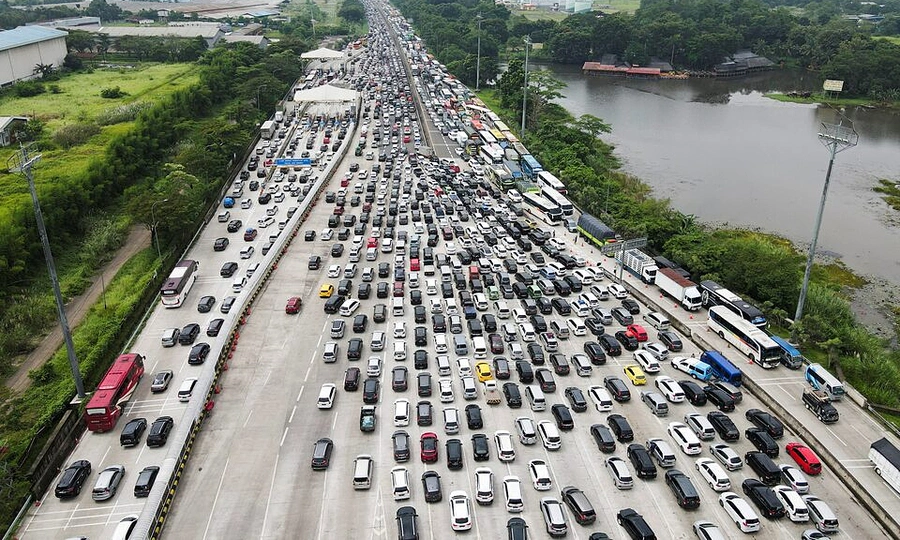
A general view of a traffic jam at a toll booth of a highway as Indonesian Muslims go back to their hometown for celebrating Eid al-Fitr known locally as ‘Mudik’ in Karawang Regency, on the outskirts of Jakarta, Indonesia in 2022. Photo by Reuters
Numbeo compiles its Traffic Index using data submitted by users to compare congestion levels across countries and cities. The index measures the overall level of traffic congestion experienced by commuters by evaluating average travel time, traffic inefficiencies, estimated fuel consumption, and carbon dioxide emissions. Higher overall scores indicate more severe congestion.
The scoring system relies on several specific sub-indices to break down the commuter experience. The Time Index reflects the average one-way daily commute in minutes, providing a baseline for how long it typically takes to travel within a given city.
Building on this, the Time Expenditure Index estimates commuter dissatisfaction. This metric is based on the assumption that frustration increases exponentially once a one-way commute exceeds 25 minutes.
Additionally, the Inefficiency Index assesses how effectively a city's transport system functions. Higher scores in this category generally point to a greater reliance on private vehicles, limited use of public transportation, or excessively long commutes.
Finally, the CO2 Emission Index estimates the amount of carbon dioxide produced by a passenger's daily round-trip commute, measured in grams. The estimated emissions for a single one-way trip can be calculated by dividing this round-trip figure in half.
View original source — VnExpress ↗
Related stories

Antara News
WorldJul 10, 2026 · 1 min
Govt targets 37,000 leprosy case detections to speed up elimination
Antara News

RNZ
WorldJul 10, 2026 · 1 min
Family time keeps All Blacks captain Ardie Savea fresh
RNZ

Euronews
WorldJul 10, 2026 · 1 min
The Rolling Stones - 'Foreign Tongues': Euronews Culture's review and verdict
Euronews

TASS
WorldJul 10, 2026 · 1 min
Over 40 million people attend farewell ceremonies for Khamenei in Iran — TV
TASS