Indian Express
Switzerland’s invisible empire in India: The story behind Voltas
Every summer, millions of Indians switch on an air conditioner to escape the heat. Among the brands most closely associated with that ritual is Voltas. Yet the story behind one of India’s best-known air-conditioning companies is not merely one of engineering or consumer comfort. It begins with a colonial belief that tropical climates shaped the character of those who lived in them — that heat made South Asians lazy, uncivilised and unfit for self-government. Ironically, the company’s history is closely intertwined with a European country more often associated with neutrality than with empire: Switzerland.
Decades before Volkart Brothers joined hands with Tata Sons to create Voltas in 1954, the Swiss merchant house had established itself as one of South Asia’s most influential trading firms. Founded in 1851 with offices in Winterthur near Zurich and in Bombay, Volkart would become one of the largest exporters of Indian raw cotton by the early twentieth century, surprising many contemporaries.
A member of the firm’s senior staff in 1919 is known to have remarked, “and many an observer looks with amazement at the structure which took root in a landlocked provincial town in Switzerland 68 years ago and which could grow into a mighty tree despite…the attacks of better suited competitors” (as cited by historian Christof Dejung in ‘Cosmopolitan capitalists and colonial rule: The business structure and corporate culture of the Swiss merchant house Volkart Bros., 1850s–1960s’ published in 2020).
Senior executives of Swiss cotton importer Volkart enjoyed a colonial lifestyle in Bombay. (Winterthur City Archives)
It was not, however, exceptional for a non-British, or rather a non-colonial, enterprise to compete successfully in British India. Much like the Swedish Match company, the Swiss Volkart Bros. entered the colonial economy as a private enterprise, benefiting from the structures and protections established by the major imperial powers. Recent research has put the spotlight on the ways in which Switzerland was involved in colonial practices without having any colonies, while successfully maintaining an image of neutrality.
As early as 1932, economist Richard Behrendt argued that Switzerland profited more from colonialism than the great European powers themselves, who were burdened with the cost of maintaining the empire.
Colonial Switzerland and the making of neutrality
At the height of European colonial expansion in the late nineteenth century, the Swiss parliament debated whether the country should acquire colonies of its own. The proposal was defeated because Switzerland’s landlocked geography made the logistical demands of the empire difficult to sustain. Instead, the Swiss Republic left the search for profit in the colonies entirely to private initiative.
Thereafter, Swiss involvement in colonial enterprises came through piggybacking on the European powers — the British, the French, or the Dutch.
In an interview with indianexpress.com, Harald Fischer-Tiné, Professor of Modern Global History, noted that Swiss involvement in colonialism extended across several fields. The most important among them was economic exploitation. “Swiss firms would use the protection of other European colonial powers in South and Southeast Asia. There were many Swiss companies that earned an awful lot of money in the Philippines, Indonesia as well, using the imperial dividend of being white Europeans,” he says.
There was also massive participation by Swiss mercenaries in colonial enterprises. “At the infamous Battle of Plassey, there were several mercenaries involved from the German and French-speaking part of Switzerland,” says Fischer-Tiné.
Swiss military participation extended far beyond South Asia. Recent research has identified a much higher number (more than 8,000) of Swiss mercenaries who served in the Dutch colonial army in the East Indies between 1848 and 1914, contributing directly to the violent expansion and maintenance of Dutch rule.
The third pillar of Swiss involvement in colonial enterprises was scientific collaboration. As Fischer-Tiné explains, “Many Swiss natural scientists, botanists, race scientists, and physical anthropologists would use imperial expeditions in Africa, the Pacific, and Southeast Asia to build a name and to develop their technologies. They were providing the tools of the trade for British, German, and French colonisers who were anthropologically measuring their population and so on.”
In many plantation colonies, the expertise of Swiss entomologists and botanists helped Dutch, British, and French plantations flourish.
The Swiss also benefited from their multilingualism, allowing them to conduct business across British, Dutch, and French colonial spheres without being closely identified with any single colonial power.
Despite these engagements, Switzerland cultivated the image of a country without a colonial past — an interpretation that Swiss historians have challenged in recent years.
The image of “neutrality,” says Fischer-Tiné, was a major piece of cultural capital that Switzerland has been selling since the late 19th century. Consequently, when supranational institutions such as the Red Cross and the League of Nations emerged, Switzerland successfully positioned itself as the ideal neutral venue for international conferences, negotiations and diplomatic gatherings. That image has endured into the present day, most recently with Switzerland hosting the US-Iran peace talks at Lake Lucerne in June 2026.
Colonial cotton trade in South Asia
It is in this context of colonialism without colonies that the Volkart Bros emerged.
Jonathan George Volkart, the younger of the two brothers, first travelled to India to work as a cotton purchasing agent at Wattenbach and Co. in Calcutta. His elder brother Solomon visited India in 1844 to assess trading opportunities. A few years later, the two established Volkart Brothers.
From their first trading house in Bombay, they rapidly expanded into offices in Colombo, Cochin, and Karachi. Many other branches followed with the expansion of the rail network and the opening of the Suez Canal in 1869.
While the Volkart business relied on colonial rule to a large extent, the British, too, gained handsome advantages from the arrangement, especially after the American Civil War in the 1860s. The “cotton famine” that followed the war halted the export of vast amounts of raw cotton from the Southern United States to the textile-producing regions of Europe, such as Lancashire.
In an effort to replace those cotton exports, the British turned to the cotton-producing regions of South Asia.
In an effort to replace those cotton exports, the British turned to the cotton-producing regions of South Asia. But the areas of cotton cultivation in India were removed by hundreds of miles from the sea ports, most importantly, Bombay. “And that’s where the Volkarts came in with Swiss experience of logistics, making sure that the cotton bales would reach the harbour in the shortest amount of time,” says Fischer-Tiné.
Historian Christof Dejung, in his 2020 research paper Cosmopolitan capitalists and colonial rule: The business structure and corporate culture of the Swiss merchant house Volkart Bros., 1850s–1960s, explains that contrary to what British bureaucrats had hoped, the quality of Indian cotton was not acceptable in British markets. Consequently, only about three percent of Indian cotton was exported to Great Britain. “Instead, the majority of Indian raw cotton found ready markets in East Asia and Europe, the latter giving a Swiss firm like Volkart a competitive edge,” writes Dejung.
The Volkarts soon diversified into spices, coffee and coir yarn before expanding into engineering goods in the 1880s.
In 1923, Volkart established its first engineering division in Bombay, with departments for mechanical, electrical, milling, textile, agricultural, and refrigeration work. Soon, it forayed into the incipient market for “comfort air conditioning.”
With stricter norms for foreign firms taking shape in the post-independence period, Volkart entered a partnership with Tata Sons in 1954 to create Voltas, today India’s largest air-conditioning company by market share.
Carrying the colonial mindset, leading a colonial life
Volkart’s expansion led to a steady increase in staff both in India and Europe. In 1860, the company employed only nine European staff in India; by 1951, that number had risen to 136.
Dejung writes that for the Swiss merchants, working in India “offered an opportunity to enjoy a certain colonial romanticism and to enjoy exotic adventures.” Solomon’s son-in-law, August F. Amman, who later became a partner in the firm and was stationed in India, wrote a memoir about his time in the subcontinent, recounting hunts for tigers, crocodiles, and elephants, alongside unpleasant encounters with snakes and scorpions.
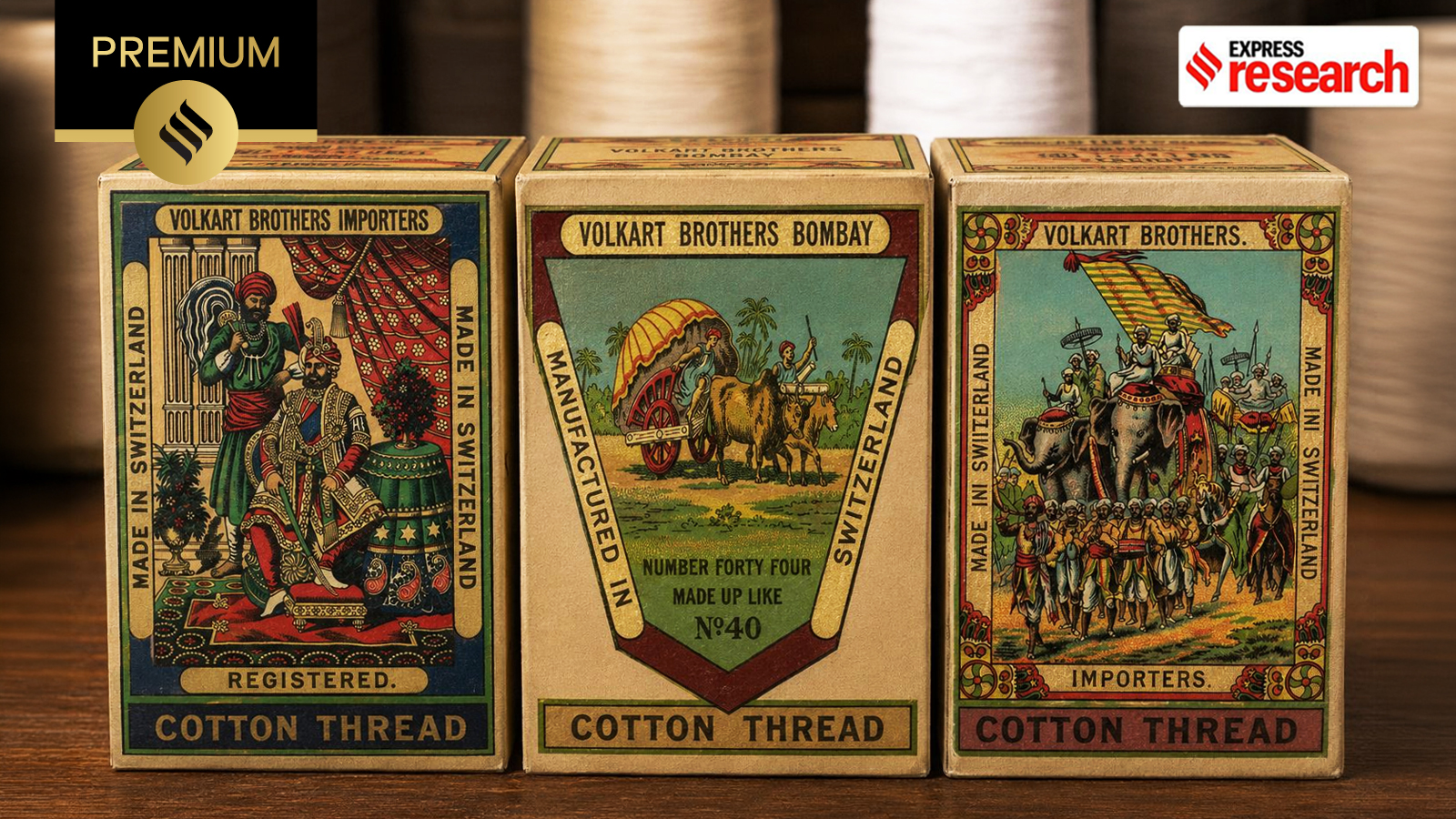
Label used by the Volkart Brothers on their products to be sold in India (Stadtarchiv Winterthur)
At the same time, many complained about the rigours of the tropical climate, which they found physically taxing. This attitude towards the climate fed directly into the way Volkart marketed its air-conditioning business. Architectural historian Priya Jain, in her 2021 paper Selling comfort: Volkart Brothers and the origins of air conditioning in India (1923–1954), notes that the Volkart archives reveal “that the promotion of air-conditioning in India by VB engineers and merchants extended discriminatory colonial views about race, climate, and civilisation.”
Volkart’s employees had a complicated relationship with the colonisation of the subcontinent. While they depended on infrastructure built by the imperial regime, they were also critical of colonial racism, which they considered detrimental to their business interests. At the same time, they maintained the fashion choices and lifestyle of their imperial counterparts, living in colonial bungalows and employing a large entourage of Indian servants and staff.
“This was largely motivated by colonial pretension — the desire to stand out from the local population and never renounce the cultural symbolism of European clothing as an icon of civilisation, no matter how extreme the conditions,” writes Dejung.
To the nationalist awakening in the subcontinent during this period, too, Volkart’s employees reacted in contradictory ways. “They had their ears to the ground and were aware of what people were keen on,” says Fischer-Tiné. Much like the Swedish matchbox makers, the Volkart Bros. capitalised on the nationalist mood of the time, using patriotic or religious motifs on their packages of cotton thread to target local customers.
Indian motifs used by Volkart Brothers on their packages of cotton thread (Stadtarchiv Winterthur)
They were, at the same time, extremely uneasy about political developments in India. Fischer-Tiné says the Swiss had some sympathy with ideas of political emancipation, stemming from a historical consciousness of fighting against Habsburg domination in the 14th century. On the other hand, correspondence between Volkart employees in Bombay and Winterthur shows that this sympathy did not extend to what they regarded as an “uncivilised and potentially anarchist Indian variety of national self-determination,” says Fischer-Tiné.
When the political tides shifted, the Volkarts once again turned to the identity of “neutrality” to maintain their commercial presence. Dejung illustrates this point in his paper, noting that despite maintaining a Swiss identity, the Volkarts employed many Germans. During the World Wars, when German employees were interned, the survival of the firm depended on convincing the British that it belonged to “neutral” Switzerland.
It was a convenient reflex, and not a new one. Volkart’s neutrality did not place it outside the colonial world; rather, it often enabled Swiss businesses to move comfortably within it.
The air conditioner switched on in an Indian home today carries no simple or direct imprint of colonial rule. Yet the business genealogy behind it leads back to a Swiss merchant house that moved Indian cotton through imperial markets, lived within colonial hierarchies, sold mechanical comfort through racialised ideas of climate, and finally reconstituted itself through partnership with Indian capital after independence.
*This article is part of ‘The Lesser Colonisers of India’, a series that uncovers how commercial enterprises from countries other than Britain played a significant role in shaping colonial India. The first story was about a Swedish matchbox company that shaped colonial India. Next up are stories on a Czech shoe giant and German dye companies.
Further reading:
Christof Dejung, Cosmopolitan capitalists and colonial rule: The business structure and corporate culture of the Swiss merchant house Volkart Bros., 1850s–1960s, 2020
Harald Fischer-Tiné, Colonial Switzerland: Rethinking colonialism from the margins, 2015
Priya Jain, Selling comfort: Volkart Brothers and the origins of air conditioning in India (1923–1954), 2021
View original source — Indian Express ↗
Related stories

Lovin Malta
WorldJul 10, 2026 · 1 min
Courtroom Falls Silent As Daphne’s Damaged Phone And Photos Of Her Wrecked Car Shown To Jury
Lovin Malta

Indian Express
WorldJul 10, 2026 · 1 min
Maharashtra ATS launches statewide crackdown on ISI-linked radicalisation network
Indian Express

Philippine Daily Inquirer
WorldJul 10, 2026 · 1 min
College behind bars: Mandaue launches education program for PDLs
Philippine Daily Inquirer
ABC News
WorldJul 10, 2026 · 1 min
China achieves first-ever controlled rocket recovery
ABC News