The Guardian
France’s attacking evolution under Didier Deschamps passes latest Morocco test | Raphaël Jucobin
The scorelines may have been exactly the same, but the stylistic gulf in France’s two World Cup knockout performances against Morocco could not have been greater.
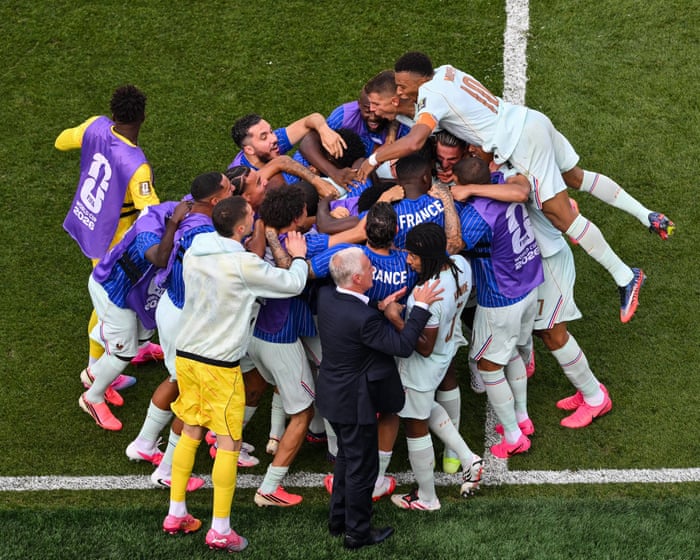
In the space of just a single tournament cycle, Didier Deschamps has embraced a vastly different style, one based on a freeform attacking line. As a one-two punch from Kylian Mbappé and Ousmane Dembélé sent the team into this year’s semi-finals, the 57-year-old’s tactical reinvention was once again vindicated.
In 2022, the France head coach had set up in characteristically pragmatic fashion, with his team managing to blunt Morocco’s attacks in a tightly contested semi-final in Qatar. Les Bleus won by converting two of their three shots on target across the match, all the while keeping that year’s breakout team at bay.
By half-time in Boston three and a half years later, France had managed four times as many efforts on Yassine Bounou’s goal as they did across the entire match in 2022. It was France’s turn to be frustrated.
A high pressing line, one of the major stylistic innovations compared with recent France teams, nevertheless kept Morocco on the back foot for most of the first half. Left without an attacking focal point in Ismael Saibari’s absence, the Atlas Lions had little reprieve from the onslaught and offered little going forward themselves.
There will have been fears that the bruising win over Paraguay five days earlier had stunted the momentum of the France attack, which had been operating at a rate of over three goals a game until then. Having been left without ideas by a combative defence, there was a sense that the provocative South American side, while aided by neglectful refereeing, had laid the blueprint to frustrating Les Bleus.
The bitter aftertaste of that match lingered for several days, not least given the racist abuse and repeated verbal attacks the Paraguayan senator Celeste Amarilla has aimed at Mbappé.
“Morocco will be our opponent, not the referee,” Deschamps insisted on the eve of the match. And while Les Bleus did enjoy a more even-handed officiating performance and a less provocative opponent on Thursday compared with their battle in Philadelphia, Morocco’s defence posed a similarly stern test.
A familiar sense of exasperation appeared to set in as the first half went on, with Bounou denying Désiré Doué and the rest of the forwards struggling to connect with each other. The three-minute delay before Mbappé could take his ill-fated penalty midway through the half would evidently add to the feeling of irritation for France.
While the Paraguay defence had conceded precious little space to their opponents, Morocco were less conservative in their approach. Mbappé found an opening behind his former club-mate Achraf Hakimi, which led to the penalty, while the captain created space for himself on the edge of the box before breaking the deadlock on the hour mark.
As was the case against Sweden, the captain’s bolt from the blue opened the scoring after a relatively wasteful display in front of goal. Dembélé’s strike minutes later appeared to hint at an opening of the floodgates, only for an ankle problem to bring a premature end to Mbappé’s evening and in turn break up France’s attack.
Les Bleus ended the match having had less time on the ball than their opponents, as was the case in their previous match-up, but the momentum of the match never looked like swinging against them this time round. In midfield, Manu Koné’s all-action performance will have secured him one of the few spots in the starting XI that were still open to debate, and laid to rest any worries concerning that arose from Aurélien Tchouaméni’s fitness problems.
The defence has scarcely been tested over the last three hours of play. . It’s a situation that suits Les Bleus, given William Saliba’s lingering back problems, but it does mean they enter uncharted territory in the final four. Either the Spain or Belgium attack will be sharper and less forgiving than those of any of their opponents so far.
Morocco were invariably pinned back as France suffocated the best team they have faced so far in the tournament. For all of their struggles in front of goal, Les Bleus rarely felt threatened by their opponents. “We felt that they weren’t dangerous in the moments when we left them the ball,” Adrien Rabiot told the French broadcaster M6. “We felt as though we didn’t have to fear them.”
Not for the first time at this World Cup, France’s attack took at least a dozen chances before finally breaking through. For all the telepathic interplay between Mbappé, Dembélé, and Michael Olise, there is a sense that the sheer quantity of chances they have created has masked their wayward finishing.
In his pre-match press conference, Deschamps conceded that his team could still improve in front of goal. “The better the quality of the opponent, the more clinical you have to be,” he underlined. As Les Bleus prepare to leave the east coast for the first time since their arrival in the US for their semi-final in Dallas, there is a sense that they will be leaving the comfort zone they have established both on and off the pitch.
At the moment, though, they appear ready to face any challenge.
View original source — The Guardian ↗
Related stories
Sky Sports
SportsJul 10, 2026 · 1 min
Scorecard: England vs India, Women's Test, Lord's
Sky Sports

Philippine Daily Inquirer
SportsJul 10, 2026 · 1 min
Cebu City to host 2027 Fiba Women’s Asia Cup
Philippine Daily Inquirer
Sky Sports
SportsJul 10, 2026 · 1 min
'It's the purest form of cricket!' | Beaumont on her Test cricket love before England retirement
Sky Sports

Philippine Daily Inquirer
SportsJul 10, 2026 · 1 min
Linda Noskova says run to Wimbledon final came 'out of nowhere'
Philippine Daily Inquirer