CNA
Johor state polls: Parties roll out heavy hitters in bid to sway young fence-sitters, but is it ‘counterproductive’?
JOHOR BAHRU: Malaysia's top political leaders have descended on Johor in the final days of campaigning ahead of the state election, in what analysts say signal concerted efforts by the parties to win over undecided voters and boost turnout among key demographics.
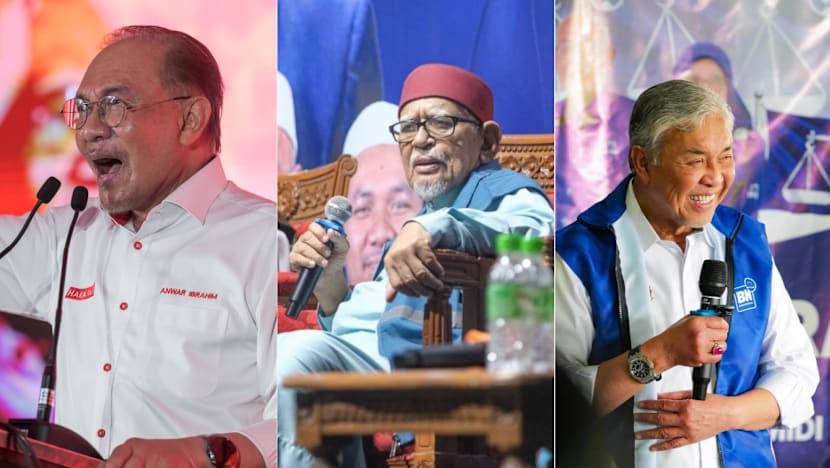
Ahead of polling day on Saturday (Jul 11), senior figures from Pakatan Harapan (PH), Barisan Nasional (BN) and Perikatan Nasional (PN) have joined walkabouts and delivered fiery rally speeches as they sought to energise party supporters and persuade fence-sitters hours before polling opens.
Among those on the campaign trail are Prime Minister Anwar Ibrahim who is campaigning for PH candidates, BN chairman and Deputy Prime Minister Ahmad Zahid Hamidi who is rallying support for BN and as well as Parti Islam Se-Malaysia (PAS) president Abdul Hadi Awang, who is making the push for PN.
These leaders have been making multiple trips to the southern state amid their busy schedules.
In a political landscape where personality-driven campaigning remains influential, analysts said the visibility and appeal of senior leaders could play a role in convincing undecided voters and even encouraging those who might otherwise stay home to cast their ballots, though the effect cannot be overstated.
"The primary objective of these heavy hitters campaigning in Johor is to galvanise the party machinery and get their core supporters excited, which in turn encourages others to come out and vote," Adib Zalkapli of geostrategic consultancy Viewfinder Global Affairs told CNA.
"This includes fence-sitters, who are not loyal party members or supporters.”
Political analysts said fence-sitters account for roughly 40 per cent of Johor's electorate, with younger voters making up a particularly influential segment that helped shape the outcome of the last state election and the 2022 general election.
In the March 2022 state election, many ascribed BN’s landslide victory of securing 40 out of 56 state seats to a lower turnout amid the COVID-19 pandemic. At the time, many fence-sitters chose not to vote, and turnout was around 50 per cent, one of the lowest recorded for Johor.
Meanwhile in the November 2022 general election, turnout was significantly higher, with an average of more than 70 per cent, and this led to PH winning 14 out of 26 federal parliamentary seats contested in Johor.
Independent pollster Merdeka Center said Johor's most decisive voting bloc comprises about 1.13 million of the state's 2.7 million voters - people aged between 21 and 39.
First-time voters who make up 6.1 per cent of the electorate were also described as potential “kingmakers”.
Francis Hutchinson, Principal Fellow and Coordinator of the Malaysia Studies Programme at Singapore's ISEAS-Yusof Ishak Institute, said these younger voters "don't have particular loyalty to any party" and are especially concerned about issues such as underemployment and the rising cost of living.
He added that two other groups of fence-sitters include supporters from the United Malaysia National Organisation (UMNO) who drifted from the party ahead of the 2018 general election following the 1Malaysia Development Berhad (1MDB) corruption scandal, as well as traditional PH supporters who have become increasingly disillusioned with the Madani government over its current term.
"They may use the state election to send a message of discontent to PH leaders at the national level and warn them not to take their support for granted," he said.
The battle over who will govern Johor is mainly between the BN and PH coalitions, which are both contesting all 56 seats. The two are allies in Anwar’s federal unity government but rivals at the state level in Johor.
Other coalitions and parties vying to make a dent in the polls include PN, the relaunched Parti Bersama Malaysia (Bersama) as well as the Malaysian United Democratic Alliance (MUDA).
CAN SWING VOTERS BE SWAYED BY POLITICAL BIGWIGS?
On Thursday, Anwar spent the day hosting Thailand Prime Minister Anutin Charnvirakul in Kuala Lumpur, holding bilateral talks and even sharing a light-hearted rendition of Elvis Presley's Can't Help Falling in Love, with the latter on the saxophone.
Hours later, the PH chairman switched into campaign mode in Johor, addressing three rallies stretching over 100km across the southern state. This marked the 78-year-old's third campaign stop in Johor over the past month.
At the coalition's rally in Puteri Wangsa, an urban seat PH hopes to flip in its favour, Anwar arrived at around 11.30pm, about an hour behind schedule.
Hundreds of supporters, many dressed in red, waited for his arrival, while thousands more followed the event via a livestream. Red is one of the primary colours of the PH coalition and is used in its flag.
"Never compromise your own honour and dignity. You have a right. Every vote counts. Take the extra mile, make the extra effort to return and vote," Anwar told the crowd, making an appeal to out-of-state voters.
Earlier that day, CNA joined Democratic Action Party (DAP) Johor chief Teo Nie Ching on a campaign walkabout in Skudai. DAP is a PH component party.
Responding to CNA’s question on what the PM’s involvement in the campaign signals, Teo said Anwar - who is also finance minister - was best placed to rebut BN's claims that the federal government had not allocated sufficient funding to Johor.
She added that his popularity could also help PH win over undecided voters.
"He is quite popular, especially among younger Malay voters, so we see that as an advantage. We need his presence so that he can explain PH's position to residents," she said.
BN has similarly relied on its top leadership to bolster its campaign.
Coalition chairman Zahid campaigned alongside BN candidates throughout the election period, including appearing with caretaker Chief Minister Onn Hafiz Ghazi on nomination day and joining events in Johor Bahru and Perling.
In a Facebook post following the event, Zahid called for voters to judge BN based on its record and performance in the state government.
"We have made every effort, presented all the facts and put forward all our offers. Now, it is time for the Bangsa Johor community to make its choice,” he wrote.
On Friday, the deputy prime minister and UMNO president is scheduled to lead prayers for the coalition's success ahead of polling day. UMNO is BN’s lynchpin party.
UMNO supreme council member Nur Jazlan Mohamed told CNA that Zahid's presence reinforced BN's message that the state government had delivered tangible results over the past four years.
"I think voters have realised that with all the initiatives that we have undertaken, whether with federal government support or not, the state is moving in the right direction, especially southern Johor," said Nur Jazlan, who is also deputy president of Malaysia's Senate.
Similarly, PN has deployed its senior leaders to the frontlines of the campaign trail.
Despite recent health concerns and criticism over his parliamentary attendance, PAS president Hadi campaigned in Johor ahead of nomination day and later addressed PN's final rally in Muar on Wednesday.
He urged Malay voters to turn out in greater numbers.
"If the non-Muslims come out and vote, they will dominate politics. If we (Muslims) don't, our political strength will diminish," the 78-year-old said.
Bersama co-founder Rafizi Ramli has also maintained a strong presence throughout the campaign, serving as the main speaker at the party's nightly ceramah - or talks - across Johor's urban constituencies where it is mainly contesting.
While analysts said appearances by senior leaders can energise party machinery, boost morale and increase turnout among loyal supporters, they cautioned that such visits alone may not be enough to sway large segments of undecided voters.
Speaking at an RSIS seminar on Monday, Merdeka Center co-founder Ibrahim Suffian noted that Anwar's approval rating stood at 55 per cent in December 2025, the highest among Malaysia's political leaders.
"But good approval ratings do not mean you win elections," he said, pointing to PH's disappointing performance in last year's Sabah state election.
Ibrahim said fence-sitters were generally less influenced by identity politics and more likely to be persuaded by credible candidates and realistic policy proposals.
Ahmad Mohsein Azman, a senior analyst at strategic advisory firm BowerGroupAsia, echoed that view.
He said deploying political heavyweights was intended to signal the importance of the election and inject urgency into campaigns, but younger undecided voters were often more interested in parties' overall performance than the personalities leading them.
"The presence of big names may even be counterproductive," he said, adding that younger fence-sitters are increasingly focused on the collective political effort rather than individual leaders.
WHO COULD SWEEP TO POWER?
According to official pollsters and key politicians CNA spoke to, projected results are likely set to mirror the status quo, with BN retaining control of the Johor state government and PH forming the largest opposition bloc.
Prior to the dissolution of the 56-seat state legislative assembly last month, BN held 40 seats, PH had 12 seats, PN with three and MUDA with one seat.
PN meanwhile is expected to suffer losses amid infighting and mixed messaging among their leadership.
PN main component parties PAS and the Parti Pribumi Bersatu Malaysia (Bersatu) are contesting under the same banner for the Johor polls, but there is no coherent campaign between them. This after PAS said that it no longer wants to work with Bersatu.
PN’s final campaign rally on Wednesday, for instance, did not feature any senior Bersatu leaders.
Medeka Center is projecting BN to win between 40 and 42 seats in the polls, with the DAP to remain the largest party in the opposition. DAP’s coalition partners in PH - the Parti Keadlian Rakyat (PKR) and Parti Amanah Negara (Amanah) - are projected to win one or two seats each.
Ibrahim said in the Monday webinar: “We are expecting BN to win, (but) the big question mark is on the margin - will they get fewer than 40 seats or more than 40 seats?”
Meanwhile, Hutchinson of ISEAS-Yusof Ishak Institute posited that BN “will equal, if not surpass, its 2022 performance”.
“It is also quite likely that PN’s support will ebb, but given the reduced number of seats this coalition holds, the impact will be muted,” he said.
UMNO’s Nur Jazlan told CNA that BN is eyeing 38 seats at the minimum so that the coalition is able to command a supermajority in the state assembly.
“As long as we maintain our two-thirds, it's okay. Elections are not like a football game. You know, there's no score here,” said Nur Jazlan.
“What we need is a strong majority to carry out what (we envision),” he added.
Meanwhile, PH’s Teo said that she is confident of a much higher voter turnout than in the 2022 state polls, and that this will boost PH’s chances of making more in-roads into the southern state.
“Previously it was during COVID-19 and many were quite reluctant to come back to vote. Now we have buses arranged from KL and from (JB Sentral for those working in Singapore) and they are fully subscribed,” she added.
Hutchinson told CNA that turnout is “absolutely crucial” in the results, citing how BN has impressive machinery which have managed to mobilise 600,000 voters to turn out in recent polls in Johor.
“Pakatan Harapan needs to excite its voters to turn out, as it cannot rival this machinery. This explains, to a large extent, the very different electoral performance in the state and general elections of 2022,” said Hutchinson.
“One key indicator of PH support is the congestion on the Causeway of outstation voters returning. For PH, turnout in the high 60s will begin to look good for them,” he added.
Additional reporting by Izzah Aqilah Norman
Source: CNA/am(as)
Related stories

France 24
PoliticsJul 10, 2026 · 1 min
What future for Gaza after Hamas dissolves governing body?
France 24

Straits Times
PoliticsJul 10, 2026 · 1 min
Senegal's top court calls parliament-backed reform 'unconstitutional'
Straits Times

OnlineKhabar
PoliticsJul 10, 2026 · 1 min
President certifies four bills
OnlineKhabar
OnlineKhabar
PoliticsJul 10, 2026 · 1 min
Kathmandu, July 10 The price of gold and silver has increased in the domestic market today, the last trading day of the…
OnlineKhabar