Indian Express
Rima Kallingal on her chenda arangetram: ‘Learning a new art changed my life’
Rima Kallingal has spent most of her life on a stage. She started dance when she was just three and acting when she was 25. Now, since the last decade, she runs her own dance company.
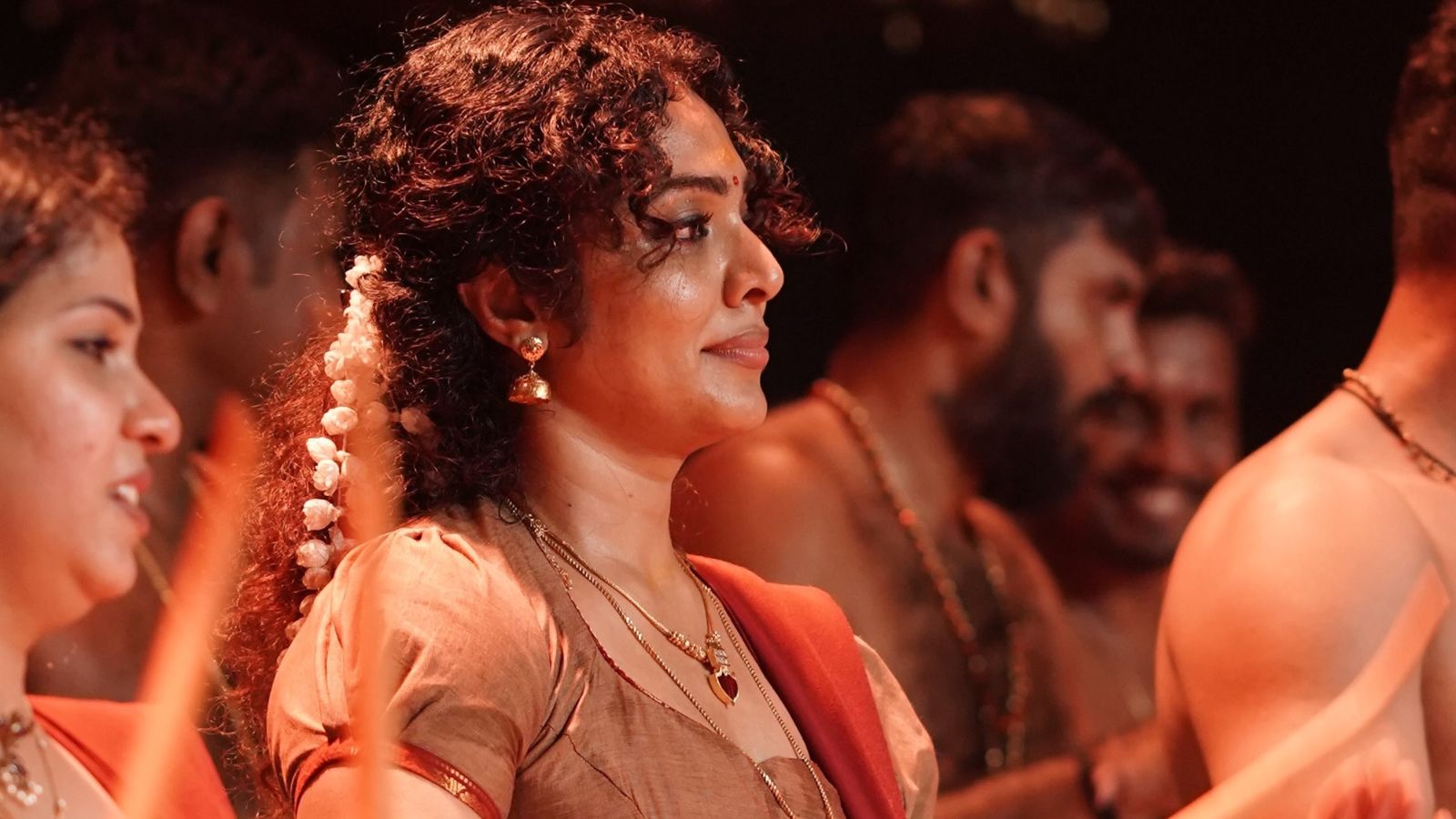
But last Sunday, she stood at the Black Box Theatre inside the Kerala Sangeetha Nataka Akademi in Thrissur, with the chendal kol (the sticks) in her right hand while her left hand played to the beats of the panchari melam (six-beat rhythm of the percussion ensemble). Kallingal laughed and interacted with her fellow performers as she completed her arangetram (formal debut) in the traditional art of chenda melam.
Kallingal, a dancer and actor in Malayalam films, performed with members of her dance school, the Mamangam Dance Academy, who made their debut with her. Videos of the group’s performance spread quickly online. They were trained by percussionist Vivek Kanimangalam.
Training to play the chenda has been integral to Mamangam Dance Company’s upcoming dance production titled “Vattam” which is set to premiere in Moscow on July 21.
The name ‘vattam’, is derived from the chenda’s vattam (the circular drumheads). The idea for this production came from percussionist and choreographer Santosh Madhav, who has been working with Mamangam since it started 12 years ago. “People, who have no prior acquaintance and have never worked together have come to one place to perform beautifully, with great discipline,” says Madhav, who is known to masterly blend the rhythmic melam with modern dance.
But there is also a deeper understanding to the term ‘melam’. “It connects to the circle of life. There are times when people with power draw the circle and some people get left out. But at the end of the day, everybody needs to be together to complete the circle,” says Kallingal.
To get it right, the team went looking for the sound source. They travelled to Vellarakkad in Thrissur where the chenda wood is sourced and to Peruvanam in Thrissur, the birthplace of pandi melam. There, they met percussion legend Peruvanam Kuttan Marar and asked him about the instrument’s history. Kallingal says, “Our research period at Mamangam was the most elaborate. We spent a lot of time on it. I ddid not want anything to be on the periphery.”
Story continues below this ad
The original plan was to learn just enough chenda to perform one choreography. But then, when they started training with their guru Kanimangalam, there was an unexpected shift. Mid-research and mid-choreography and with the premiere in Moscow just months away, the team decided that they should learn the chenda in-depth. “I asked my team and everybody was game. They all gave me two hours extra daily, after eight hours of dance rehearsals,” she says. The physical toll was real – calluses and sore shoulders from the weight of the drum. Kallingal compares it to the strain dance itself puts on the body.
She speaks about her guru with visible warmth. Kanimangalam, she says, treated the dancers as artistes, not students. He spent time on each student individually, correcting their technique, even holding online classes for members scattered across cities.
Kallingal also speaks highly of other artistes including Unni Manghat, a senior chenda artist who performed with the troupe despite his seniority; Madhav, who served as the show’s pramani (the chief master percussionist who leads the orchestra) and Jithin Kallat of the Thrissur Vadhyagurukulam, who brought in 30-40 top Thrissur pooram artists to play alongside the troupe.
“I have always believed local is international. I want to explore and go deep into my roots and present it in a contemporary space, where the kids of today look at our culture and say, ‘Wow, this is so cool’,” she says about her dreams with Mamangam.
Story continues below this ad
Kallingal’s own path to the stage was never a straight line. Before her film debut in Ritu (2009), she trained for four years with the contemporary dance company Nritarutya in Bangalore, where she also picked up Taekwondo and Chhau; she already knew Kalaripayattu.
On screen, she is known for playing strong, unconventional women, in films such as 22 Female Kottayam (2012), which won her the Kerala State Film Award and the Filmfare Award for Best Actress, Rani Padmini (2015) along with Manju Warrier. She is also a co-founder of the Women in Cinema Collective, formed in 2017 to push for safer, fairer working conditions in the Malayalam film industry.
Kallingal keeps coming back to how the whole experience of learning the chenda has changed her. “We are all in the middle of a lot of stuff in our life – work, family problems. But I really wish this for everybody – to open your heart and mind to a new art form, a new craft, a new sport. It will change your life.”
View original source — Indian Express ↗
Related stories

France 24
WorldJul 10, 2026 · 1 min
Spain faces deadly wildfires, at least 12 killed, 19 missing in Andalusia
France 24

The Hindu
WorldJul 10, 2026 · 1 min
China’s temporary export ban on helium| Explained
The Hindu

Indian Express
WorldJul 10, 2026 · 1 min
India’s first bullet train project: NHSRCL completes launch of 13 heavy portal beams in Ahmedabad
Indian Express

Indian Express
WorldJul 10, 2026 · 1 min
Kolkata Metro achieves Purple Line tunnel breakthrough at Victoria station
Indian Express