BBC Sport
'What old timers can do' - the evolution of Belgium's golden generation
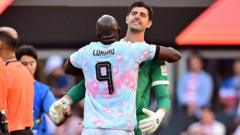
Of the four survivors from 2014 and 2018, 34-year-old Courtois has played every minute of this tournament, but De Bruyne, Lukaku and Witsel have featured far less regularly.
Central midfielder Witsel, 37, who left relegated Girona at the end of the La Liga season, was brought on for a single minute at the end of the win over the USA.
At 33, Lukaku has scored an impressive three goals but has done so by playing fewer than 50% of minutes, often coming on as a substitute and taking advantage of a tired defence reeling from the strong pressing of 25-year-old Atalanta forward Charles De Ketelaere.
And De Bruyne, now 35, was injured during the Senegal game - before his departure Belgium had won one out of three matches, but since then they have won twice and scored seven goals in roughly 130 minutes of play.
Full-back Thomas Meunier also played in the 2018 tournament, but not 2014, and his minutes played have decreased as the tournament has gone on.
None of that is to say the more senior players are not contributing - Courtois remains one of the world's best goalkeepers, Lukaku's goals have been crucial, and De Bruyne's performances were among the team's best before his unfortunate injury.
But their role in the squad is changing, with a greater reliance on them making the difference in key moments rather than taking responsibility for the overall quality of the team's performances.
So far at least, Garcia and Belgium appear to handling the transition better than many teams do when their stars begin to fade.
Belgium appeared galvanised by the controversy over Fifa's decision to suspend USA striker Folarin Balogun's one-match suspension in the last 16.
The players mocked President Trump by mimicking his campaign trail dance on the pitch, and afterwards Garcia praised the unity of his squad, saying: "The group is very mature. We have leaders to help us."
In the past, Lukaku has characterised himself as the more vocal of Belgium's leadership group, while De Bruyne sets professional standards in training on the pitch.
One of the quirks of being a leader in the Belgium dressing room is language diversity.
Belgium's colonial history and its modern position as the centre of the European Union make it highly diverse, and the World Cup squad features players with heritage from countries including DR Congo, Ghana, Guinea-Bissau, Senegal, France, Italy, Portugal, and Spain.
Lukaku alone speaks six languages fluently.
Some players are native Dutch speakers from the north of the country, while some come from the French-speaking Wallonia region. Many speak both languages, but not all, meaning players commonly communicate in English as a group.
"It's a very strategic thing to do", says Dr. Jim Ureel, senior lecturer in applied linguistics at the University of Antwerp.
"Language is a very sensitive topic in Belgium - it's heavily linked to identity and politics. Dutch-speaking people don't necessarily want to adapt for the French, and vice-versa. If the players were choosing one or the other, it could become a problem.
"English therefore becomes very useful - you can avoid those issues and it all becomes neutral, especially because young footballers almost always speak good English and lots play in English-speaking countries.
"When things become more personal, in smaller groups, they might switch into what they're most comfortable with.
"I think it's very clever how they do it."
If Belgium are to make it past Spain and beyond, Lukaku and his fellow leaders' motivational team talks are going to have to be especially inspirational, regardless of the language they're delivered in.
This is not quite the golden generation having one last crack at fulfilling their potential, but rather a core of seasoned professionals taking on a new paternal role, leading forward those who are now their team-mates and will soon become their successors.
View original source — BBC Sport ↗
Related stories

ESPN
SportsJul 10, 2026 · 1 min
'Kyrie is back': Inside Kyrie Irving's surprise vi...
ESPN
CNA
SportsJul 10, 2026 · 1 min
Al-Ittihad turn to Wissing after Gamba Osaka's Asian triumph
CNA
BBC Sport
SportsJul 10, 2026 · 1 min
Why question marks hang over McGregor's UFC return
BBC Sport
Sky Sports
SportsJul 10, 2026 · 1 min
Edwards leaves FSG and Liverpool ahead of new season
Sky Sports