CNA
Singapore's blue bins were made for frictionless recycling. Is it time to ditch them?
Four years after his debut as Singapore’s recycling mascot, Bloobin has yet to find a reason to wipe that permanent frown off his face.
Bloobin was introduced by the National Environment Agency (NEA) in 2022 as the grumpy face of its Recycle Right campaign, which marked a shift in Singapore’s recycling messaging.
Rather than encouraging residents to simply recycle more, the campaign sought to address a persistent problem: contamination caused by food waste, liquids and other non-recyclable items being thrown into blue recycling bins.
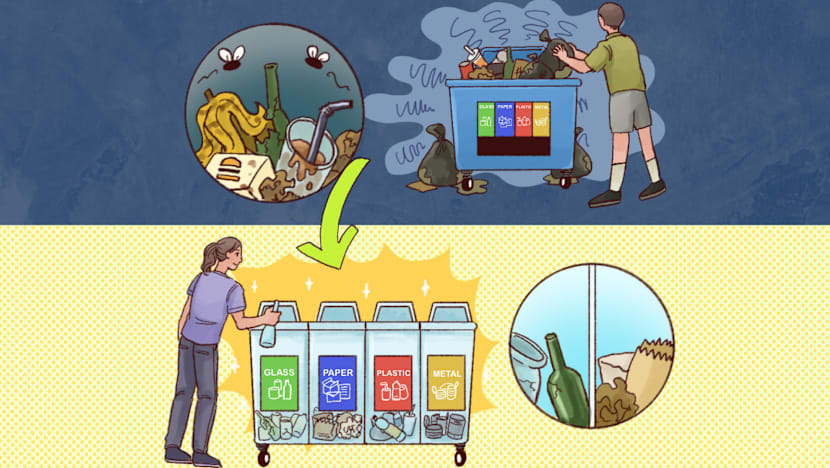
Bloobin – a play on blue bin – is exasperated by being stuffed with food waste, tissue paper, toys and other non-recyclables, hence his grouchy countenance.
And who could blame him? After all, the contamination rate of recycling bins and recycling chutes in Singapore has remained at 40 per cent since 2021, according to the Ministry of Sustainability and the Environment in a parliamentary reply earlier this year.
With contamination remaining stubbornly high and domestic recycling falling to a record low last year, experts say it may be time to retire the iconic blue bin and rethink Singapore's recycling system.
It's a pressing issue because contaminated recyclables are incinerated for energy before the ash is sent to Semakau Landfill, further clogging up Singapore’s only offshore waste disposal site.
Already, more than half of Semakau’s 28 million cubic metre capacity has been used up and the facility is expected to be full by 2035.
The ubiquitous blue bins had been designed for totally frictionless recycling – throw all your recyclables into the one bin, and someone else will sort them later. But that convenience has now proven to be both the bin's greatest strength and its biggest weakness.
In June, NEA reported that Singapore's overall recycling rate last year, combining waste from both domestic and non-domestic sources, was 52 per cent. This was slightly higher than 50 per cent in 2024, but below the 59 per cent recorded in 2019, when the Zero Waste Masterplan was launched with the goal of raising Singapore's overall recycling rate to 70 per cent by 2030.
NEA data also shows that the 2025 domestic recycling rate hit an all-time low of 11 per cent, unchanged from 2024 and down from 19 per cent a decade earlier in 2015.
Domestic waste refers to waste collected from households and trade premises such as shophouses, hawker centres and educational institutions.
NEA said that as part of its review of the Zero Waste Masterplan, set to begin in the coming months and expected to be completed in 2027, it will reexamine household recycling approaches, including the National Recycling Programme and the blue recycling bins.
But the blue bins should not be deemed failure, said professor of strategy and sustainability at James Cook University Adrian Kuah, who noted that they were introduced when the country's biggest challenge was simply getting residents to recycle.
"The philosophy was that convenience would drive participation," said Prof Kuah, noting that a single communal bin for people to deposit their different recyclables lowered the barrier to recycling and was well-suited to Singapore's high-density housing.
Since then, he said the blue bins have largely achieved their original objective, helping to make recycling more common over the last 19 years and raising public awareness.
"However, the challenge today is no longer participation but material quality," said Prof Kuah.
"As Singapore reviews its National Recycling Programme (NRP), the key question is whether a model that was successful in promoting participation remains the best way to deliver high-quality recycling in a circular economy."
‘A VICTIM OF ITS OWN SUCCESS’
The ubiquitous blue recycling bins seen across Singapore today were not part of the country’s original household recycling system. When the NRP was launched in 2001, recyclables were collected door-to-door in recycling bags.
That was found to be too manpower intensive, and so in 2007, public waste collectors – NEA-appointed companies to collect household waste and recyclables in designated areas – began providing one blue recycling bin for every five HDB blocks.
In 2011, the collectors provided a blue recycling bin for each HDB block. Paper, cardboard, plastic, glass and metal recyclables could all be deposited into the blue bins without the need for residents to sort their recyclables or wait for scheduled collections.
In response to CNA TODAY's queries, NEA said: "This approach lowers the barrier to participation as it makes recycling more convenient for households."
Today, more than 80,000 blue recycling bins have been deployed across HDB and landed estates in Singapore.
While experts agreed that the blue bins do make it easier for residents to deposit their recyclables, that effortlessness has become a double-edged sword, contributing to contamination as people increasingly treat the bins as general rubbish receptacles.
Assistant Professor Mark Teo, from the Singapore Institute of Technology (SIT) and the vice-chair of the sustainability education committee, said: "The design of the blue recycling bin has, in some ways, been a victim of its own success – it is highly convenient for both throwing and collection, to the extent that this convenience may have become counterproductive."
While the bins are designed to accept all recyclable items, many consumers still do not really know what is recyclable, despite efforts by the NEA in 2019 to standardise bin labels to make it easier for residents to identify what can and cannot be recycled.
When faced with that mental strain, human nature defaults to the path of least resistance, said Associate Professor of Urban Sustainability Terry van Gevelt from the Singapore Management University (SMU).
In this context, he explained, that may mean treating the recycling bin exactly like a regular rubbish bin.
Prof Kuah agreed, adding: "Many residents want to recycle but are unsure what belongs in the blue bin, do not rinse containers, or assume that anything carrying a recycling symbol is recyclable."
The situation has also led to “wishcycling", where people place items in recycling bins hoping they can be recycled, he said.
As time went on, this meant high contamination rates, with blue recycling bins in some estates becoming dumping grounds rather than collection points for recyclables, he added.
Furthermore, Asst Prof Teo noted that in many areas, recycling collection points are set up primarily for the ease of the workers collecting them, rather than for the experience of the people using them.
"As a result, these bins often resemble ordinary rubbish bins, and are treated accordingly by the public, who subconsciously associate them with general waste disposal rather than a distinct, valuable process."
Ms Jacqueline Thai, advocacy and communications executive at Zero Waste SG, added that the low-friction system offered by the blue bins undermines individual responsibility over waste or recyclables, as there is no reinforcement that waste reduction and recycling are necessary, and have to be done right.
She noted that the high contamination rate also undermines public confidence, especially when residents see contaminated bins overflowing, leading them to question whether their efforts matter.
Asst Prof Teo said: "Part of the challenge in Singapore, ironically, is that we are too successful in our waste collection and disposal.”
Rubbish chutes and daily collection are incredibly convenient, he noted. This ensures a very clean living environment, but it also means most people do not think twice before throwing things away.
Over the years, NEA has developed and introduced various initiatives under the NRP, including ongoing public education and outreach through the Recycle Right campaign
Launched in 2019, Recycle Right offers educational resources, community outreach and an AI chatbot to encourage proper recycling practices. NEA also engages community and corporate partners, schools and non-governmental organisations (NGOs) to ensure that residents across all age groups can learn to recycle right.
MOVE ASIDE BLOOBIN
There are already a few estates in Singapore experimenting with life without the blue bin.
Take a walk through Tiong Bahru’s historic walk-up flats, for example, and the familiar 660 litre recycling bins are nowhere to be found.
Instead, there is a new smart recycling machine called REhub at Tiong Bahru Community Centre that has four compartments – one each for paper, metal, glass, or plastic – into which residents can deposit their clean, dry recyclables.
To use REhub, residents first register using their phone number, date of birth and postal code. They then select the type of material they are recycling, after which the corresponding bin opens for 60 seconds to accept the items.
Each bin displays examples of recyclable and non-recyclable items, along with information on how each type of material is processed after it is deposited.
REhub is the result of a pilot called Bye Bye Blue Bin: From April 11, the blue bins in the heritage enclave of Tiong Bahru were removed and replaced with six fortnightly recycling collection drives run by resident volunteers in partnership with waste management company Cora Environment and Tiong Bahru Community Centre (People’s Association).
Mr Kelvin Wang, a key member of the volunteer group Love Tiong Bahru, which led the recycling pilot, said that residents from all 49 blocks in the heritage enclave participated, with more than 60 per cent of households returning three or more times.
The pilot collected almost 4,000kg of uncontaminated recyclables over six collection drives.
"The biggest challenge was balancing convenience with recycling quality," said Mr Wang. He noted that some residents found it inconvenient to store recyclables between collection drives, while others welcomed the opportunity to recycle in a way that they knew would reduce contamination.
Mr Wang said that residents became much more mindful of properly preparing recyclables, with strong repeat participation. They rinsed bottles and containers, flattened cardboard boxes and sorted materials before bringing them to the collection drives.
"Because the materials were cleaned and sorted beforehand, the recyclables formed a largely uncontaminated clean stream, allowing them to be effectively recycled," he said.
An uncontaminated clean stream refers to recyclables that are clean, properly sorted and free from contamination.
After the pilot’s success, Love Tiong Bahru introduced REhub on June 27, which combines greater convenience with proper source separation to reduce contamination.
"If residents make good use of the machine and the outcomes remain positive, we will explore introducing additional machines in other parts of the estate in future," said Mr Wang, adding that the machine has been popular with residents so far.
Resident Chua Qiu Mei said that over the five years she has lived in Tiong Bahru, she has never used the blue recycling bins because they were often dirty and contaminated with rubbish.
But when REhub started, she began bringing recyclables from both home and work, even encouraging colleagues not to throw away plastic bottles.
“I’ll bring them home from my office (to recycle),” said the 41-year-old dental assistant.
Madam Jia Luan, who has been living in the estate for more than 50 years, said that although she is not tech-savvy, she has been learning to use the smart bin herself and thinks it is a good alternative to the blue bins.
"The blue bin did not really work because people are not willing to follow instructions. They just throw everything inside," said the retiree who is in her 60s.
Mdm Luan said she frequently saw food waste thrown into the blue bins, contaminating the contents and rendering entire batches of recyclables unsuitable for recycling.
Noting that the REhub offers a neater way for residents to recycle, Mdm Luan said: "It’s a good idea, but everybody must play their part."
With the overall contamination rate at 40 per cent, this is a problem islandwide. Even among landed property residents, who have individual blue recycling bins outside their homes, convenience does not necessarily translate into greater use.
While Mr Alex Thian’s family recycles regularly, the biotechnology company chief executive feels that the blue recycling bin relies too heavily on residents already knowing what to do.
“People assume that just because the blue and green bins (for general household waste) are there, residents know the difference. But a lot of people don’t," he said.
"I see a lot of blue bins in my neighbourhood barely being used. Everyone just dumps all their trash and recyclables outside and lets the waste collector sort it," said the 66-year-old, who lives in a landed property estate in the east.
Mr Thian said the system needs to be backed by sustained public education and stronger incentives if recycling rates are to improve.
Over at Bedok, Mr Shane Lim, 31, said he observed the same patterns with residents in his landed estate.
While some residents use the blue bins for recyclables, he has also seen neighbours use them as makeshift parking markers or throw rubbish into them when their general waste bins are full.
"I wouldn't say (the blue bins are) very effective. You still need to have the awareness of the benefits of recycling," said the bike mechanic.
Aside from public awareness, experts say bin design makes a difference too.
Prof Kuah said for example, narrow slots for paper, circular openings for bottles and cans, transparent panels allowing residents to see correctly sorted recyclables inside, and clearer visual cues can all help reduce mistakes.
If residents see a transparent bin filled only with aluminium cans, they are naturally less likely to throw other materials into it, he added.
Agreeing, Associate Professor Huong Ha of the School of Business at Singapore University of Social Sciences (SUSS) said good bin design, such as clear labels, pictorial instructions, appropriate openings, covered bins and convenient locations, makes recycling easier and reduces confusion.
Early signs from the REhub initiative in Tiong Bahru indicate as such too. In response to queries from CNA TODAY, NEA said it is encouraged by the strong community support.
"The initiative has demonstrated the importance of collective resident participation in tackling contamination at source."
It is still in its early days, though, and the technology is not without teething problems.
When CNA TODAY visited the REhub in Tiong Bahru on June 30, three days after it had been installed, its touchscreen malfunctioned at one point, preventing some residents from registering and depositing their items.
Assoc Prof Ha said the incident underscored the importance of ensuring smart recycling systems are not only technologically advanced but also reliable and easy to use.
“While technology can improve recycling quality and accountability, it must remain simple, reliable and accessible,” she said.
While technology can improve recycling quality and accountability, it must remain simple, reliable and accessible.
While design matters, Prof Kuah said the real significance of the Tiong Bahru initiative lies elsewhere: It tests a different model of household recycling built on quality and accountability, rather than convenience.
"Instead of asking people to recycle more, it asks them to recycle more carefully through source separation," he said.
NEA has begun introducing the concept to the public in recent years: Singapore has separate collection schemes for e-waste and beverage containers to encourage cleaner source segregation and reduce contamination.
These include the Extended Producer Responsibility (EPR) schemes for e-waste and beverage containers, such as the Return Right beverage container return scheme which launched in April this year to support the collection of uncontaminated metal and plastic beverage containers.
NEA said there are more than 1,000 collection points each for e-waste and beverage containers respectively.
Ms Thai of Zero Waste SG, said that such "waste accountability" is indeed the way of the future – encouraging residents to take greater ownership of their waste by being more mindful about what they throw away and practising proper recycling habits.
Zero Waste SG's pilots at Queenstown and Pioneer, and this latest initiative at Tiong Bahru, have shown that separating recyclables at source, supported by education and community engagement, can produce cleaner recycling streams, she said.
Zero Waste SG’s Sort It Out (SIO) Recycling Hubs in Queenstown and Pioneer, launched in 2025 using a smart, segregated recycling bin system, have achieved and sustained contamination rates of less than 5 per cent over the past year.
Ms Thai noted that systems that require residents to sort by recyclable material type drastically reduce contamination, as seen in places such as Taiwan, Germany, South Korea and Japan, which have successfully implemented segregated recycling systems.
BEYOND THE BINS
If there is one point on which the experts converge, it is that no bin, however well designed, will fix Singapore’s recycling issues on its own.
Experts said the focus should be on the waste and recycling system as a whole, and Singapore can draw lessons from other countries, though none should be adopted wholesale.
Assistant Professor Sree Nair, from the Lee Kuan Yew School of Public Policy at the National University of Singapore, said cities like Taipei, Seoul and Hong Kong have redesigned aspects of their household recycling systems through different combinations of regulation, incentives and citizen participation.
In Seoul, for example, open sorting stations and transparent bags demand waste accountability and require households to put in the effort to sort items meticulously.
Furthermore, Seoul's pay-as-you-throw system requires residents to buy official rubbish bags, creating a financial incentive to recycle because households that generate less general waste spend less on disposal.
In Germany, consumers receive a refund when they return eligible beverage containers through a deposit-return scheme, creating a financial incentive to recycle correctly and helping keep materials clean.
"For Singapore, the key lesson is not to replicate any one model, but to identify governance arrangements that can complement existing infrastructure and policy by strengthening citizen participation and collaboration between government, communities, NGOs and industry," said Asst Prof Nair.
These solutions could draw on existing systems both locally and globally, said Asst Prof Teo.
For example, he said NEA could perhaps take a leaf from the Health Promotion Board’s Healthy 365 app, which offers financial incentives to get people to walk and move more. Perhaps Singapore could gamify recycling, by financially rewarding individuals for depositing recyclables at collection points, he added.
Ultimately, the goal is to find a method that genuinely works with users' needs and interests, rather than relying on awareness alone, Asst Prof Teo added.
More than creating solutions to encourage recycling, several experts argued that the most effective measures lie upstream, before waste ever reaches a bin.
Assoc Prof van Gevelt described stricter eco-design requirements as the “lowest-hanging fruit”. These would require companies to use simpler, single-material packaging that is “inherently recyclable by design”, reducing the burden on households.
Additionally, Asst Prof Mark Teo noted that recycling should not be seen as the first solution to reduce waste, as recycling is the last of the 3Rs – reduction and reuse should come first.
Looking ahead, experts said Singapore should move beyond viewing the blue recycling bin as the centrepiece of household recycling.
A modern recycling system would likely combine source separation, smart collection points, deposit-return schemes, digital technologies and stronger feedback mechanisms to improve recycling quality and accountability.
"Communal blue bins should remain because they provide an accessible option for everyday dry recyclables, but they should no longer be the backbone of household recycling," said Prof Kuah.
While infrastructure is important, experts emphasised that recycling is only one part of the circular economy and should be considered a last resort after efforts to reduce and reuse waste.
"Recycling is not a panacea," said Associate Professor Alberto Salvo, who is dean’s chair of the Department of Economics at the National University of Singapore (NUS).
"More than treat recycling as an engineering problem, a more effective approach is to step back and educate people on how wasteful waste is, even that which can be recycled."
ADDITIONAL REPORTING BY KASSENDRA LOK
Source: CNA
Related stories
The Local
WorldJul 10, 2026 · 1 min
How long will Italy’s latest heatwave last?
The Local

Straits Times
WorldJul 10, 2026 · 1 min
Insurgents withdraw from strategic north Mali town after days of fighting
Straits Times

Straits Times
WorldJul 10, 2026 · 1 min
How the absence of Iran's new supreme leader is becoming a liability for the Islamic Republic
Straits Times
Euronews
WorldJul 10, 2026 · 1 min
French government activates new 'extreme heat' Orsec plan as temperatures rise
Euronews