CNA
Turned down by NUS and NTU, this self-described 'late bloomer' now has a Harvard PhD
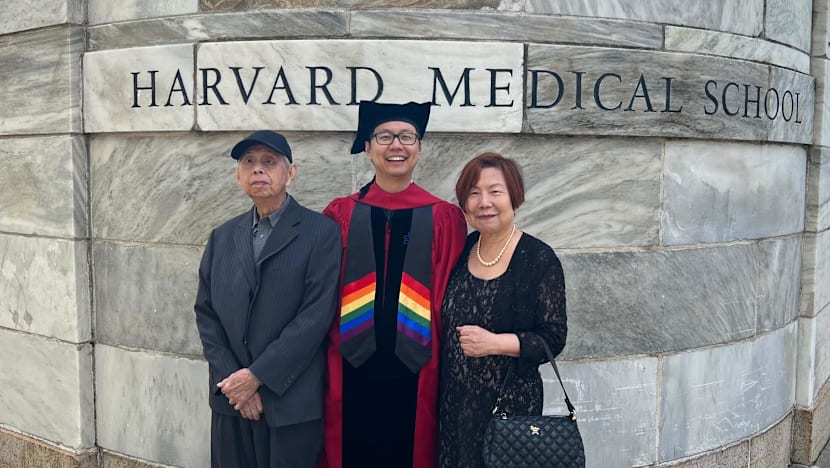
When Dr Joel Tan, 37, took the stage at the Harvard Medical School-Affiliated PhD Programs Hooding Ceremony on May 28, going viral was the last thing on his mind.
To an audience that included 167 of his fellow doctoral students and his beaming parents, he opened up about being rejected from two of Singapore's public universities before making it to the world-renowned Harvard's doctorate programme.
In a matter of days, his speech amassed more than 23,000 views on YouTube and made headlines in Singapore media outlets. Clips from his address were reshared endlessly on social media, particularly the moment where he earnestly proclaimed: "Talent is everywhere; opportunity is not." One LinkedIn think piece quipped: "C's and D's to PhDs".
It's a compelling comeback story: the late bloomer seemingly stifled in Singapore's demanding education system eventually makes it to one of the top universities not just in the United States, but the world.
To date, it's been about 15 years since Dr Tan has been in Singapore. However, his viral speech prompted hundreds of people from his homeland – acquaintances, long-lost friends and even strangers – to reach out to him to congratulate him and also share their own stories.
"That has probably been the most meaningful part of the whole experience,” he told me over a Zoom call from his home in Boston.
For Dr Tan, the experience has been tuning him into the dialogues sparked among Singaporeans on whether all types of learners can thrive in Singapore's carefully structured, high-pressure education system.
It has also taken him on several trips down memory lane, helping him put his past academic struggles into perspective.
"I used to think that my educational path was unusual, but so many people have told me that … they were also late bloomers. They also struggled in school and felt like they were falling behind in Singapore," he said.
"I think (these people) and I are part of a small but important minority for whom the system really didn't work as well as intended."
In Dr Tan's view, however, there's nothing inherently wrong with Singapore’s merit-based system. In fact, he credits a lot of his later success in university to the academic foundation and training he received in Singapore.
"My path was not straightforward, but it definitely taught me a lot of discipline and perseverance, and that no one really gets anywhere by themselves."
I used to think that my educational path was unusual, but so many people have told me that … they also felt like they were falling behind in Singapore.
A CHILDHOOD SHAPED BY CURIOSITY
By most measures, Dr Tan is successful in his field – he has a PhD in biological and biomedical sciences, been published in the prestigious journal Nature and has now even managed to achieve some level of internet renown.
Yet, Dr Tan remains humble, almost to the point of self-deprecation. More than a few times, he apologised for rambling during our chat despite my assurances that I did indeed want to hear all about his life.
As we talked about the elements that paved the way for his perhaps unlikely success, he enthused about the people who had given him opportunities: his parents, mentors, and the educational institutions that opened doors to him.
While the bespectacled scholar was more reticent when it came to discussing his own part in his achievements, he admitted to feeling vindicated.
"None of the things that I've accomplished, especially in Harvard, were easy. I was only able to do these things by putting in a lot of time and a lot of hard work.”
And his vindication is perhaps warranted. After all, there was a time when many – including Dr Tan himself – had felt that he might not be cut out for higher education, let alone a successful career in academia.
According to Dr Tan's old report books, his teachers at Fairfield Methodist School (Primary) all noted that he was an outgoing and friendly child. He excelled in home economics and was good enough at badminton to make the school team.
Even as a boy, he already had an innate curiosity in the world around him. Seeing tree leaves fluttering around the playground would have him wondering how photosynthesis worked. Watching fish dart around under the surface of a lake, he'd puzzle over how fish breathed underwater.
He broke into an easy smile as he recalled his "very active" primary school years. "I just wanted to know everything, and I wanted to talk to everyone."
The youngest of three children, he recalled little academic pressure from his parents. Even though his Malaysian-born father and Taiwanese mother had chosen to settle in Singapore due to its strong education system and economic prospects, they insisted that he find and follow his passions.
Whenever his homemaker mother needed to run errands, she would often drop him off at public libraries, where he frequently gravitated towards the science section.
“I was probably looking at books that were far too advanced for me at the time," he said, grinning, "but I remember loving the feeling that there were answers in those pages.”
STRUGGLING WITH STUDIES
When Dr Tan was aged nine, his father, who worked in the construction industry, was diagnosed with stage four Non-Hodgkin lymphoma, a blood cancer.
For the next three years, his father attended treatments and appointments at National University Hospital. The young Joel often tagged along, absorbing every detail the oncologist conveyed to his mother.
"I remember wanting to know everything about cancer when I was listening to those conversations."
Despite the upheaval of his father's health struggles, Dr Tan ended up doing "well enough", attaining four A's in his Primary School Leaving Examination.
He made it to Chung Cheng High School (Main), where he joined the Chinese orchestra as a percussionist. It was here that he would also encounter his first academic obstacles.
Back then, instead of the current subject-based banding system, students underwent a streaming exercise at the end of Secondary 2 that would determine their subject combinations for their upper secondary years.
Despite his keen interest in science, Dr Tan didn't qualify for the triple science classes that would allow him to study biology, chemistry and physics.
"I think I felt like a failure a little bit because I wasn’t smart enough to get into the good classes," he said.
Limited to two science subjects, he had to choose between biology and physics in addition to chemistry. He was more drawn to biology, but his teachers nudged him towards physics as they thought it would give him the best chance of scoring well for his O-Level exams.
"I ended up really struggling in those classes," he said. He eventually scored an A2 in chemistry and a B3 in physics at the O-Levels, but grimly recalled that "it took a lot of effort, and many, many hours of studying at McDonald's with my friends".
Thanks to his co-curricular activity, he made it to Victoria Junior College through Direct School Admission. There, the stakes felt higher, and the pressure – albeit self-inflicted – was suffocating.
“I focused a lot on trying to get good grades and studying really hard, but I remember just being so stressed. Every time we had an exam, I would do poorly.”
After two years of transcripts filled with failing grades, he eventually managed to scrape together two C's and a D for his A-Levels. He had passed – but his academic struggles were far from over.
THE MANY STINGS OF REJECTION
While serving his National Service (NS) in 2008 and 2009, he applied multiple times to National University of Singapore and Nanyang Technological University, only to be met with repeated rejections.
At first, he tried for programmes he was most interested in, such as life sciences and biological sciences. He knew it would be a long shot – those programmes were known to accept only students with A's and B's.
Dr Tan was clear that he doesn't begrudge any of the universities that rejected him. Still, the rejections stung.
To add salt to his wounds, many of his ex-classmates and NS buddies were getting accepted into university on their first try.
"It felt really personal … I remember thinking maybe I'm just not cut out for higher education."
But giving up wasn't an option. His parents, who met while his father was attending university in Taiwan, were insistent that he at least obtain a bachelor’s degree.
The second time around, he applied to programmes with lower cut‑offs, such as civil engineering, despite his lack of interest. By that point, he was simply hoping to get into any university.
He was repeatedly rejected again. But despite his disappointment, he managed to find new perspective.
"I slowly started to understand that rejection was really not a reflection of me as a person. It was just a reflection of … the fact that I didn't fit into the system that I was trying to enter."
There wasn't any place for him in local universities, so he turned his sights overseas.
MAKING HIS PARENTS' SACRIFICE COUNT
On his third attempt at getting into a university, he was almost reckless.
He admitted, slightly sheepishly, that he sent out only one application – to the University of Toronto, mainly because his older sister was based in the city at the time, working as a flight attendant.
"I remember applying almost as a Hail Mary, not expecting that I would get in."
When he received a thick welcome packet in the mail, his family was overjoyed at this long-awaited acceptance. But even as they celebrated, the heavy financial price tag of an overseas education loomed.
His father had left the construction industry due to his cancer condition several years before, but remained the breadwinner, sustaining the family on odd jobs like janitorial work.
After his father recovered from lymphoma, the family became Singapore citizens. By then, the cancer fight had drained his parents' life savings.
Dr Tan's parents had shielded their children from hardship as much as they could, but with Toronto beckoning, the extent of their financial struggles were laid bare. They looked over the numbers – the total cost of tuition and living expenses at that time was upwards of S$250,000 (US$193,525).
To Dr Tan's parents, it wasn't up for debate. They would make whatever sacrifices they had to for the sake of their son’s education.
They took out bank loans and eventually sold their executive condominium in Jurong West, renting around Singapore and, for a few years, in Johor Bahru. Now, his 76-year-old mother and 87-year-old father have finally settled in a two-room Housing and Development Board flat.
Dr Tan considered working part-time to help finance his studies, having seen some of his peers do so. However, his parents wouldn't stand for it – they wanted him to focus fully on school.
That his parents had to give up so much to afford him this privilege only made him more determined not to let them down.
"When I talk about my success, I never really think of it as mine alone. It really also belongs to my parents as well," he said emphatically.
Fortunately, he found it easy to flourish in the science programme at the University of Toronto. Instead of trees and fishes, he now found himself immersed in the study of proteins and phages.
"It was the first time I felt like I had real autonomy over my education … I was finally able to dig into the answers to a lot of the questions that I was asking a lot as a child."
After securing his degree, he went on to complete his Master of Science in 2019 and spent the next three years working as a lab research project coordinator at The Hospital for Sick Children in Toronto, which kept him very busy especially when the COVID-19 pandemic hit in 2020.
By late 2021, the chaos of the pandemic had calmed a little. It was time for him to set out towards his next goal: a PhD.
CHASING NEW DREAMS
He applied to several Ivy League schools, but despite having achieved some recognition – including getting published in prestigious journals Nature Microbiology and Nature Communications – he was genuinely surprised to secure an interview with Harvard in December 2021.
By Christmas that year, it was official: he would read his PhD at Harvard Medical School.
"My mum was so happy, she was yelling for like five minutes," he recalled with a wide smile.
It was, however, a bittersweet occasion. Dr Tan's father, then 82, had recently been diagnosed with Alzheimer's and had already begun to lose some memory function.
"But I remember him still being really, really happy for me," he said.
"It was almost a way of me repaying all (my parents') sacrifice and all the amazing things that they've done for me. I could tell them: 'I finally made it to Harvard'."
Now, while he celebrates his newly minted title of "doctor", he is already chasing the next pinnacle: pursuing post-doctoral research in the area of neurodegenerative diseases.
According to Dr Tan, his father is now a shell of his former self, having lost a lot of his ability to retain short‑term memories. Having spent the last five years watching his father fight the losing battle against Alzheimer's, he is set on contributing to the birth of a potential therapy.
He dreams of eventually returning to Canada to start his own research lab at the University of Toronto – the same place where he got his start in academia.
"I know that any of the research that I do now probably won't be helping my father directly, but I still want to be able to contribute towards something that is able to cure this disease, hopefully in the future."
Source: CNA/kl
Related stories

TASS
WorldJul 10, 2026 · 1 min
Global crises underscore need for stronger BRICS — expert
TASS

The Moscow Times
WorldJul 10, 2026 · 1 min
Moscow in Talks With Turkey About Possible Resale of Missile Systems
The Moscow Times
Times of Israel
WorldJul 10, 2026 · 1 min
Jewish groups push back against likely next UK PM Burnham over Israel comments
Times of Israel
The Local
WorldJul 10, 2026 · 1 min
How long will Italy’s latest heatwave last?
The Local