Times of Israel
Poll: About 6 in 10 Jews say they feel ‘less safe’ in the US since October 7
WASHINGTON — Many Jewish adults feel unsafe in the United States, a new poll finds, with a majority saying they feel less safe than they did before Hamas’s October 7, 2023, massacre on Israel.
The survey from The Associated Press-NORC Center for Public Affairs Research points to how Jewish adults’ attitudes toward their own personal safety have changed over a relatively short period amid rising antisemitism and as more Americans became critical of the United States’ close alliance with Israel. The war in Gaza sparked US protests over Israel’s military actions in Gaza, as well as calls for the Jewish state’s destruction, and coincided with an increase in violent attacks against US Jewish communities.
The findings highlight the vulnerability that many Jewish adults in the US feel as bipartisan support for Israel erodes and significant divides emerge within the Jewish community about what constitutes antisemitism, particularly when it comes to protesting Israel.
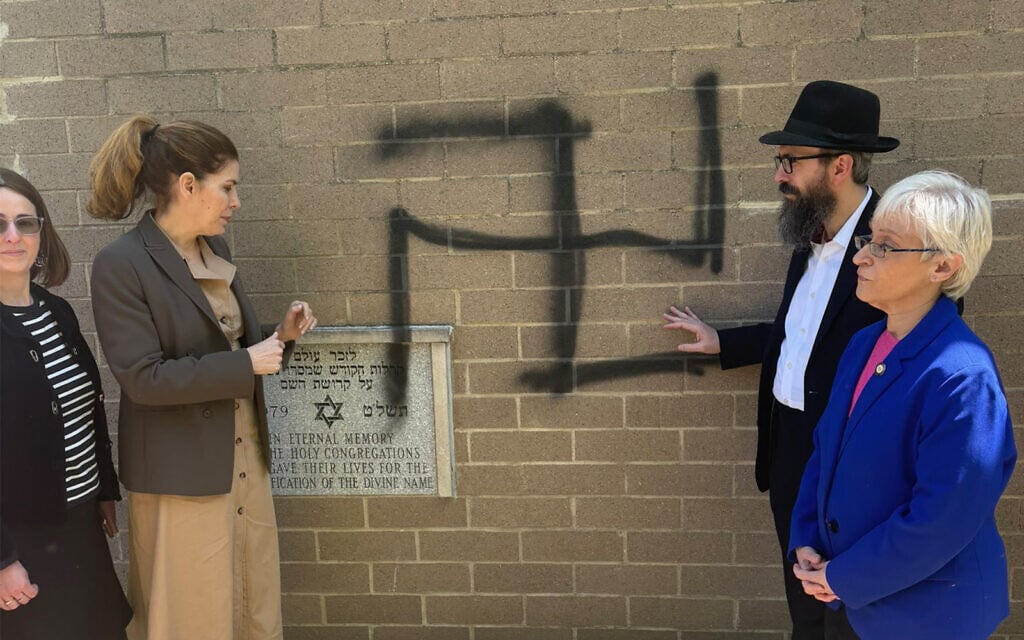
A significant share of Jewish adults, about 3 in 10, say they or someone in their household has experienced physical assault, verbal abuse, online harassment, or damaged property because of their Jewish background over the last year, according to the survey.
Jewish adults see prejudice against Jews as a serious problem, and many feel unsafe
About 6 in 10 Jewish adults say that prejudice against Jewish people is an “extremely” or “very” serious problem in the United States today, a view that is heightened among Jewish adults who say they are “extremely” or “very” emotionally attached to Israel.
Get The Times of Israel's Daily Edition
by email and never miss our top stories
By signing up, you agree to the terms
About one-third of Jewish adults say they feel “very” or “somewhat” safe as a Jewish person in the US today, while about one-third feel “very” or “somewhat” unsafe. The remaining roughly 3 in 10 say they feel neither safe nor unsafe.
Those with a close connection to Israel or who identify as Jewish by religion — instead of saying they are religiously unaffiliated with a cultural, ethnic, or family connection to Judaism — are more likely to feel threatened in the current environment.
About 6 in 10 Jewish adults say they feel “less safe” as a Jewish person in the US than they did before Hamas’s 2023 onslaught, including about 7 in 10 of those who are religiously Jewish. About one-third of Jewish adults say they feel “about as safe,” and very few feel safer.
Some Jewish adults have grown wary of outwardly identifying themselves as Jewish following the October 7 massacre, the survey found.
About 4 in 10 Jewish adults say they are “less likely” to wear, carry, or display things that might identify them as a Jewish person than they were before Hamas’s October 7 onslaught. About half say they are “about as likely” and about 1 in 10 say they are “more likely.”
Many Jews report physical assault, property damage or harassment
About 1 in 10 Jewish adults say that in the past year, they or someone in their household has been physically assaulted. A similar share had property damaged or destroyed specifically because of their Jewish background.
About 2 in 10 Jewish adults say they or someone in their household has been called a slur, threatened, verbally harassed, or verbally abused.
Similarly, about 2 in 10 say they experienced online harassment or cyberbullying. Overall, about 3 in 10 Jewish adults say that they or someone in their household has experienced at least one of these incidents because of their Jewish background.
Jewish adults who attend religious services at least once a month are much likelier than Jewish adults overall to say they or someone in their household has experienced attacks or harassment over their Jewish background — a finding that comes as there have been several targeted attacks on Jewish religious spaces in recent years.
Slightly less than half of Jewish adults who frequently attend religious services say they or someone in their household has faced verbal harassment. A similar share experienced online harassment, and about one-quarter have dealt with physical attacks or property damage.
Jews are divided over whether protesting Israel is a form of antisemitism
Protests surrounding speakers tied to Israel — whether Prime Minister Benjamin Netanyahu’s address to US Congress or college speakers seen as either too supportive or too critical of the country — became more common following the backlash over Israel’s war in Gaza.
Jewish adults, in particular, are divided over whether protesting an event related to Israel is an act of prejudice against Jewish people generally.
About half of Jewish adults say anti-Israel protests are not a form of antisemitism, but roughly 4 in 10 say they are.
Many anti-Israel protests have been tied to criticism of Israel’s military action in Gaza. The Hamas-run Gaza health ministry says more than 73,000 people in the Strip have been killed during the war — including over 1,000 since the October 2025 ceasefire — though the toll is unverified and does not differentiate between civilians and combatants.
The Israeli military believes that Hamas’s overall toll is largely accurate, with IDF officials estimating that two to three civilians were killed for every dead terror operative.
The IDF says it has killed over 23,000 combatants in Gaza and another 1,600 terrorists inside Israel during the October 7 onslaught.
Israel has said it seeks to minimize civilian fatalities and stresses that Hamas uses Gaza’s civilians as human shields, fighting from civilian areas, including homes, hospitals, schools and mosques.
About two-thirds of Jewish adults say criticizing Israel for its military actions is not a form of antisemitism, but Jewish adults with a close emotional connection to Israel are more likely to say that criticism of Israel’s military actions is antisemitic. That said, relatively few Jewish adults say it’s antisemitic just to criticize Israel for “any reason.”
Americans overall are less likely to say it’s antisemitic to protest an event that is supportive of Israel, or to criticize Israel’s military actions — but they are also much less likely to have an opinion.
Jewish adults are more unified in deeming some actions as definitively antisemitic.
The overwhelming majority say vandalizing synagogues or Jewish-owned businesses because of Israel’s actions is antisemitism. The same goes for denying the reality or scope of the Holocaust, putting responsibility for Israel’s actions on Jewish people in the United States, saying Israel shouldn’t exist as a Jewish state, or claiming American Jews are more loyal to Israel than to the US.
There is less consensus among non-Jewish US adults on whether some of these actions constitute antisemitism, with many saying they’re not sure.
View original source — Times of Israel ↗
Related stories

The New York Times
PoliticsJul 10, 2026 · 1 min
Two Days of U.S. Strikes in Iran Signal a Sharp Escalation
The New York Times
BBC
PoliticsJul 10, 2026 · 1 min
Murder investigation launched into death of Ann Widdecombe
BBC
CNA
PoliticsJul 10, 2026 · 1 min
Iran has asked to continue talks and the US agreed, Trump says
CNA
NPR
PoliticsJul 10, 2026 · 1 min
A major housing bill is set to become law at midnight — even though Trump says he won't sign
NPR