Times of Israel
Jerusalem film festival opens 43rd year, honors acclaimed Ukrainian filmmaker
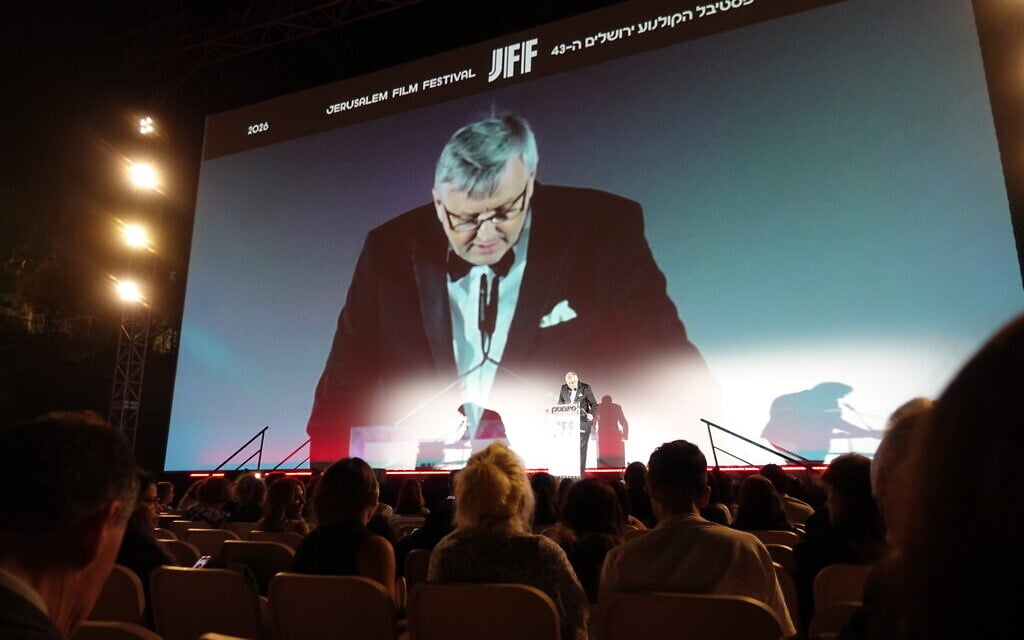
The 43rd Jerusalem Film Festival opened on Thursday with guest of honor Ukrainian filmmaker Sergei Loznitsa telling the crowd that violence has entered our lives instead of love, and “confronting it has become our duty.”
The ceremony and screening for thousands of attendees at Jerusalem’s Sultan’s Pool under the Old City walls marked the opening ceremony of the 10-day festival that is set to screen roughly 200 films and host more than two dozen international filmmakers, with approximately 70,000 audience members expected throughout the event.
Loznitsa was the night’s guest of honor, receiving a lifetime achievement award for his body of work and commitment to the festival. Twelve of his films have been screened over the festival’s history, a feat JFF director Roni Mahadav-Levin told audiences he thinks might be a record.
Loznitsa opened his speech with “Shalom Yerushalyim” (“Hello Jerusalem”) and closed with “Toda rabah” (“Thank you”), in an attempt to use Hebrew at the event.
Known for both his documentaries and fiction films, Loznitsa has been outspoken in his support of freedom of expression and opposition to cultural boycotts.
Get The Times of Israel's Daily Edition
by email and never miss our top stories
By signing up, you agree to the terms
Though Loznitsa did not specifically reference the ongoing wars and tension in Israel or his home country of Ukraine, he spoke of the “difficult time we are living in” in both countries. His films attempt to understand history, which is a step to overcoming these difficulties, he said.
“I am convinced that the reason for what has happened to us now lies deep in our past,” Loznitsa said. “And understanding them is already a step toward overcoming them.”
“It is not love but violence that has entered our lives, and confronting it has become our duty,” he said.
Before presenting Loznitsa with his award, Mahadav-Levin spoke of the power of watching film with others, calling it “almost revolutionary” to come together and be moved by the same moment.
The film festival is not an escape from this reality, Mahadav-Levin said, but an opportunity to examine our world and hope for a better future.
He, too, did not specifically reference war but called it “once again not a normal year” to host the festival.
Amid international anger over Israel’s war against Hamas in Gaza, the country has faced a soft cultural boycott, with calls to exclude the country from events, including global film festivals.
While Mahadav-Levin told The Times of Israel earlier in the week that it isn’t always clear whether an Israeli film isn’t accepted at festival competitions because of its quality or global politics, he described the delicacy with which they invited international guests and chose their film roster for the Jerusalem event.
“If the past few years have taught us anything, it is that even when there are no good answers, it is still essential to keep asking the questions,” he told the crowd. “We hope that this year’s films will do exactly that: question, challenge and refuse to settle for easy answers.”
The event kicked off the festival with a screening of “Tell Me Everything” by Israeli director Moshe Rosenthal, attended by the film’s actors.
The Hebrew film, which recently premiered at the Sundance Film Festival, features 12-year-old Boaz (Yair Mazor), who finds out his father is in a relationship with another man during the height of the HIV epidemic. It follows Boaz and his family through his bar mitzvah soon after the revelation, and again nine years later when he reunites with his estranged father.
“Tell Me Everything” stars Israeli actor Assi Cohen in his first feature film in 15 years.
Cohen took photos with fans before the screening began and officially kicked off the festival alongside the evening’s host.
Audience member Rony Yedidia said she has made it a point to attend the film festival for the past few years.
Yedidia said the open-air location, with its “backdrop of [Jerusalem’s] Old City,” makes the festival atmosphere unique.
“It’s really important to show Israeli culture to as many people as possible around the world,” Yedidia said. “That it’s not just about war and problems, but we have real life here, that we can enjoy life here and we have great culture.”
View original source — Times of Israel ↗
Related stories

Variety
EntertainmentJul 10, 2026 · 1 min
Debbie McWilliams, Former James Bond Casting Director, Sticks to Her Guns
Variety

Deadline
EntertainmentJul 10, 2026 · 1 min
‘Moana’ Sets Sail With $4.5M In Thursday Previews – Box Office
Deadline

Variety
EntertainmentJul 10, 2026 · 1 min
Giona A. Nazzaro on Scoring Caleb Landry Jones’s Passion Project and Why Locarno’s Lineup Reflects the Festival’s New…
Variety

Variety
EntertainmentJul 10, 2026 · 1 min
‘Obsession’ Sets Peacock Streaming Release Date
Variety