Times of India
Ceasefire Declared Over: Trump orders new US strikes after tanker attacks; Iran vows it won’t fold
Donald Trump declared the June 17 ceasefire with Iran 'over', while Iran's new leadership vowed to resist, raising fears of renewed conflict centred on the Strait of Hormuz.
President Donald Trump declared the June 17 ceasefire with Iran "over" on Wednesday, ordering fresh US strikes on Iranian targets after Tehran allegedly fired on tankers in the Strait of Hormuz.
Why it matters
The breakdown threatens the only framework holding back a full return to the war that began on February 28.Oil markets, US midterm politics in November and the fate of Iran's nuclear programme now all hinge on whether it’s Trump’s new rhetoric or he will go for another sustained air campaign.Meanwhile, Iran has finally buried Supreme Leader Ayatollah Ali Khamenei, killed in the war's opening strikes in February. Now, it is being governed by a more militarized leadership, under the name of Mojtaba Khamenei. Will Iran’s new leadership pursue a truce, or escalate the conflict to consolidate its grip at home?
Catch up quick
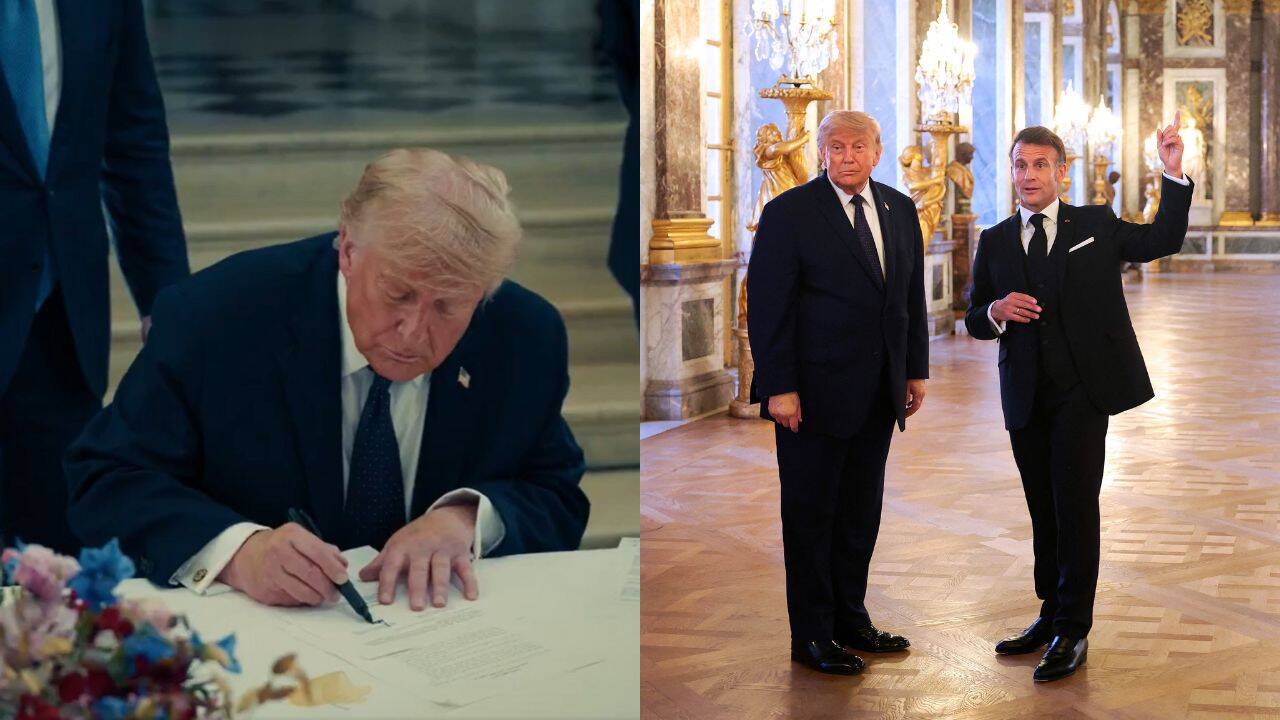
· Trump signed a 14-point memorandum of understanding with Iran on June 17 at the Palace of Versailles, where World War I officially ended. But instead of sustainable peace, the harsh terms of the treaty on Germany ultimately led to the World War II.· The ghost of Versailles seems to haunt Trump as the US-Iran MOU left the Strait of Hormuz management unresolved.
Versailles: Doomed from start?
· Iran wants ships routed along its own coastline so it can monitor.
The US has instead been quietly guiding vessels along Oman's coast, according to the Financial Times.· Iran struck three tankers in the strait this week; the US answered with roughly 90 strikes on Iranian military targets, and Tehran claimed 85 retaliatory hits on Bahrain and Kuwait.
State of play
As per a WSJ report, after being briefed by secretary of state Marco Rubio and defence secretary Pete Hegseth, Trump revoked Iran’s permission to sell oil internationally and ordered new strikes.
Iran responded by targeting US-linked facilities and Gulf states hosting American forces.Asked whether the memorandum was dead at the Nato summit in Ankara, Trump said: “That’s a very interesting question. To me, I think it’s over. I don’t wanna deal with them anymore. They’re scum, you know what scum is? They’re scum. They’re sick people. They’re led by sick people. And they’re vicious, violent people.”
But Trump also left room for talks to continue. US officials told Bloomberg that Washington remained committed to a diplomatic solution and that technical discussions were continuing.
Mediators in Qatar and Pakistan were still working to protect the negotiating process.Trump's position is familiar: Escalate, threaten overwhelming force, preserve an escape route and hope the other side offers terms he can present as victory.
The bigger picture: Who controls the war?
Iran, more than Trump, currently controls the conflict’s tempo because Tehran can disturb the Strait of Hormuz at a lower cost than Washington can guarantee its permanent security.Around a fifth of the world’s oil and liquefied natural gas passed through the waterway before the war. Iran demonstrated that it could turn that dependence into what one Iranian source described to Reuters as its “golden weapon.”Tehran’s objective is not necessarily to close the strait indefinitely. It is to establish that no final agreement is possible unless Iran is acknowledged as the dominant security power in the waterway.That leverage explains why Iran appears willing to endure US strikes. The emerging leadership believes Trump wants an exit more urgently than Iran does. It is betting that rising petrol prices, voter fatigue and the midterm elections will restrict how far he escalates.Iranian parliamentary speaker and chief negotiator Mohammad Bagher Ghalibaf made Tehran’s message explicit after the latest attacks: “We don’t fold.”The Atlantic's Tom Nichols argues Trump has lost whatever grip he had, calling the original ceasefire "just a Trump fantasy" and pointing to the president's contradictory, meandering answers on strikes as evidence he's "reacting to events, rather than guiding them."But Iran does not have complete control. The US can escalate and destroy military infrastructure, tighten sanctions, block Iranian oil exports and help ships bypass Tehran’s preferred routes.
Is Iran overplaying its hand?
Iran’s attacks have reinforced the argument from US hawks that Tehran treats negotiations as an opportunity to regroup. They have also angered Saudi Arabia, Qatar, Bahrain and Kuwait, including states that have served as mediators or sent delegations to Khamenei’s funeral.As per a NYT report, Iranian leaders may have concluded they survived the US-Israeli campaign and therefore could press for more. Suzanne Maloney of the Brookings Institution described the timing of the tanker attacks as evidence of “a bit of triumphalism.”But for Iran, Hormuz could become a source of leverage held beyond the point of maximum return.Oil markets are already showing how that could happen. Tanker traffic has partially recovered, Gulf producers are restarting output and alternative export routes are carrying more crude. Rising supply has created the possibility of an oil glut rather than a prolonged shortage.That matters because Iran’s bargaining power depends on the world believing that renewed disruption in Hormuz would create an intolerable economic shock.As oil becomes cheaper and governments rebuild depleted reserves, the threat loses force.
What they're saying
Mohammad Bagher Ghalibaf, Iran's parliamentary speaker and lead negotiator, said in a post on X: "America still hasn't learned that bullying and breaking promises are no longer cost-free. Let me put it plainly: if you strike, you'll get hit."Ellie Geranmayeh of the European Council on Foreign Relations, told the Financial Times: "Iran does not want to cede its leverage over the strait — its weapon of mass disruption — before a broader deal is reached on US economic relief.
For Trump, the reopening of the strait is at the heart of the memorandum of understanding — and without it, he will be under immense pressure by Republican hawks to resume war with Iran."Richard N Haass, a longtime US diplomat, told the New York Times: "We are at something of a strategic dead-end. The dilemma here is that the more we attack, the more the Iranians attack the Gulf oil and energy infrastructure. And the administration still has not figured out how to defend those sites."
What’s next
For now, it’s likely to be neither peace nor full-scale war. It is managed instability: Periodic attacks, retaliation, threats and negotiations conducted under fire.But more US bombing won’t solve the underlying problem. Trump therefore needs a new plan. It’s possible that Trump may escalate to deescalate.But, Iran’s post-Khamenei order makes that harder. Ali Khamenei’s funeral revealed a system shifting from clerical rule towards Revolutionary Guard commanders.Mojtaba Khamenei has not appeared publicly since succeeding his father. He may retain final authority, but the Revolutionary Guards, Ghalibaf and other wartime institutions appear likely to exercise greater operational power.That creates two competing pressures. Pragmatists know sanctions relief and reconstruction require an agreement with Washington. Hardliners believe Iran’s survival proves that military resistance works and that compromising over Hormuz would surrender the country’s greatest strategic gain.So, neither Trump nor Iran is in a decisive position to end the war. It’s a matter of coming to terms with the new reality. It is about which side first recognises that its strongest weapon — US air power or Iranian control of Hormuz — cannot produce the political settlement it wants.
View original source — Times of India ↗
Related stories

Portugal Resident
PoliticsJul 10, 2026 · 1 min
Invest in affordable housing, improve health care access – EU Council
Portugal Resident
Dawn
PoliticsJul 10, 2026 · 1 min
Trump's promise on Patriots will take time, leaving Ukraine facing tough choices
Dawn

The Moscow Times
PoliticsJul 10, 2026 · 1 min
Anti-War Politician Boris Nadezhdin Branded ‘Foreign Agent’
The Moscow Times

The New York Times
PoliticsJul 10, 2026 · 1 min
U.K. Police Open Murder Investigation Into Death of Politician Ann Widdecombe
The New York Times