The Guardian
After historic World Cup success, why does Cabo Verde still grapple with identity issues?
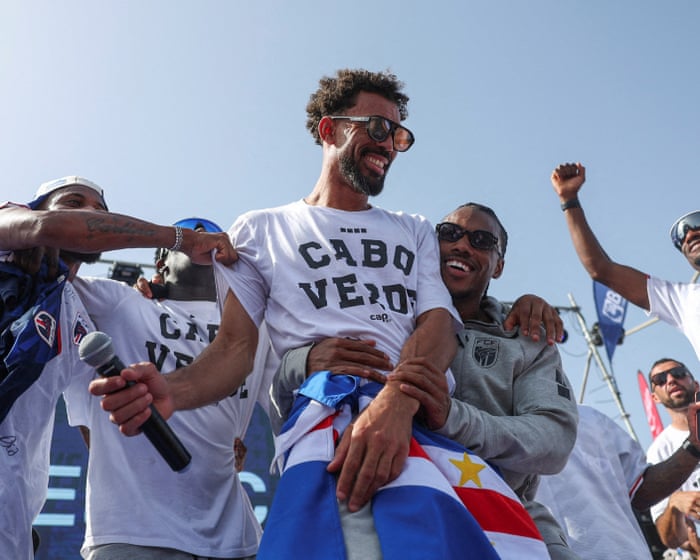
After World Cup debutants Cabo Verde became the smallest country to reach the tournament’s knockout stages, coach Bubista was understandably emotional about his squad’s historic trajectory.
Before the round-of-32 match against the defending champions Argentina, with whom they went toe-to-toe until a goal deep into extra time consigned them to defeat, he spoke about inspiration and a sense of duty.
“We represent our island, but we also represent Africa,” the 56-year-old said in a pre-match press conference. “It’s a source of immense pride.”
Across the world, that easily reinforced feelings of solidarity from Africans at home and in the diaspora who consider them a worthy continental representative. Back in the island nation though, issues of African identity and solidarity are far more complex.
“Some Cabo Verdeans identify as Portuguese and not African, presenting their skin colour and that the islands were uninhabited before Europeans came as proof of their origin,” said António Tavares, a veteran choreographer and director of the cultural centre in the city of Mindelo.
Tavares is dark-skinned in a country of mostly light-skinned people and deep-rooted colourism, a lingering legacy of being a Portuguese colony for more than 500 years, including a period in which it was one of the world’s largest marketplaces for enslaved people.
The Portuguese instituted a hierarchy of enslaved people according to labour roles and skin colour that can still be seen and felt today, experts say.
“Our mentality is very Luso-Tropicalism,” Nardi Sousa, a professor of sociology at the University of Santiago said, referring to a philosophy espoused by the Brazilian sociologist Gilberto Freyre. The Portuguese, Freyre claimed, were better colonisers because their warm climate made them “humane” enough to be friendly with the enslaved to the point of race-mixing.
At Cidade Velha, a Unesco world heritage site on the southernmost tip of Ilha de Santiago, the biggest of its 10 islands, stands a Catholic church. There, thousands of people captured from mainland Africa were baptised to command higher prices elsewhere during the transatlantic slave trade.
“Cidade Velha has a very bad memory because it’s here that the African starts to be dehumanised and to lose its identity. If my name was Balde, when I come to Cabo Verde, Portuguese give me a name like Manuel or Jose,” said Sousa. “Cabo Verde was a laboratory for the Latinisation of Africans, for losing your identity.”
Tavares agrees, asking: “Why am I Antonio? Why do I have only Portuguese name?”
Even after slavery ended, the dictator Salazar established an Auschwitz-style concentration camp in the mountainous city of Tarrafal on the other tip of Santiago. It was there that he shipped detained communists between 1936 and 1954 and from 1961-1974 – prisoners from the colonies.
The prisoners endured inhumane conditions and neglect from the camp’s doctor, who once quipped: “I’m not here to cure, but to sign death certificates.” On the camp grounds today stands Resistance Museum, which is in the process of being recognised as another Unesco world heritage site.
As the debate on reparations for the transatlantic slave trade and colonialism heats up, the African Union (AU) has said its push could possibly involve “diplomatic pressure or legal actions at international courts” in future. The culture minister, Augusto Jorge de Albuquerque Veiga, said the country aligns with the AU’s position.
“The past of slavery is something that we’ve been dealing with for more than 500 years … we are trying to dialogue with all the countries involved in this slave trade and especially with Portugal that was our coloniser,” he said. “[And in] my personal view, I am in favour of reparations for what was taken and stolen from the African continent.”
Some say Cabo Verdeans must first reconnect with their roots to be able to establish their identity and meaningfully contribute to the debate. Reports of Black Africans, especially Nigerians and Senegalese, being targeted for profiling at Cabo Verde’s airports remain frequent. For Tavares, this contravenes the pan-Africanist ideas of the writer Amílcar Cabral, who was pivotal to the independence of Cabo Verde and Guinea-Bissau.
There has also been criticism of the curriculum, as pupils learn a tailored version of European history that some say barely details their crimes on African soil and so inherently do not feel fully African.
“The Portuguese created many problems by creating this system … we need to decolonise our soul,” Tavares said. “The best way to decolonise is to start educating people on our history … there’s a need for us to recover forgotten memories, stolen memories.”
Getting Portugal to acknowledge its wrongs is also a tall order. The Cabo Verdean president, José Maria Neves, told the press in 2023 that the reparation debate is slowing down because of the rise of the rightwing in Europe. That same year, both countries agreed a €12m debt for climate swap, which some critics argue is a soft form of reparations that avoids the actual word.
View original source — The Guardian ↗
Related stories

Sky Sports
SportsJul 10, 2026 · 1 min
England's Woad storms into Evian Championship lead as Korda misses cut
Sky Sports

ESPN
SportsJul 10, 2026 · 1 min
Álvarez's return could be Argentina's antidote to ...
ESPN

Indian Express
SportsJul 10, 2026 · 1 min
Fery’s wheel of fortitude halted by big-serving Zverev who reaches Wimbledon final
Indian Express

ESPNcricinfo
SportsJul 10, 2026 · 1 min
Is Brook ready to lead England across all three formats?
ESPNcricinfo