Indian Express
UPSC Essentials daily subject quiz : Environment and Geography MCQs (Week 170)
UPSC Essentials brings to you its initiative of subject-wise quizzes. These quizzes are designed to help you revise some of the most important topics from the static part of the syllabus. Attempt today’s subject quiz on Environment and Geography to check your progress.
🚨 Click Here to read the UPSC Essentials magazine for June 2026. Share your views and suggestions in the comment box or at [email protected]🚨
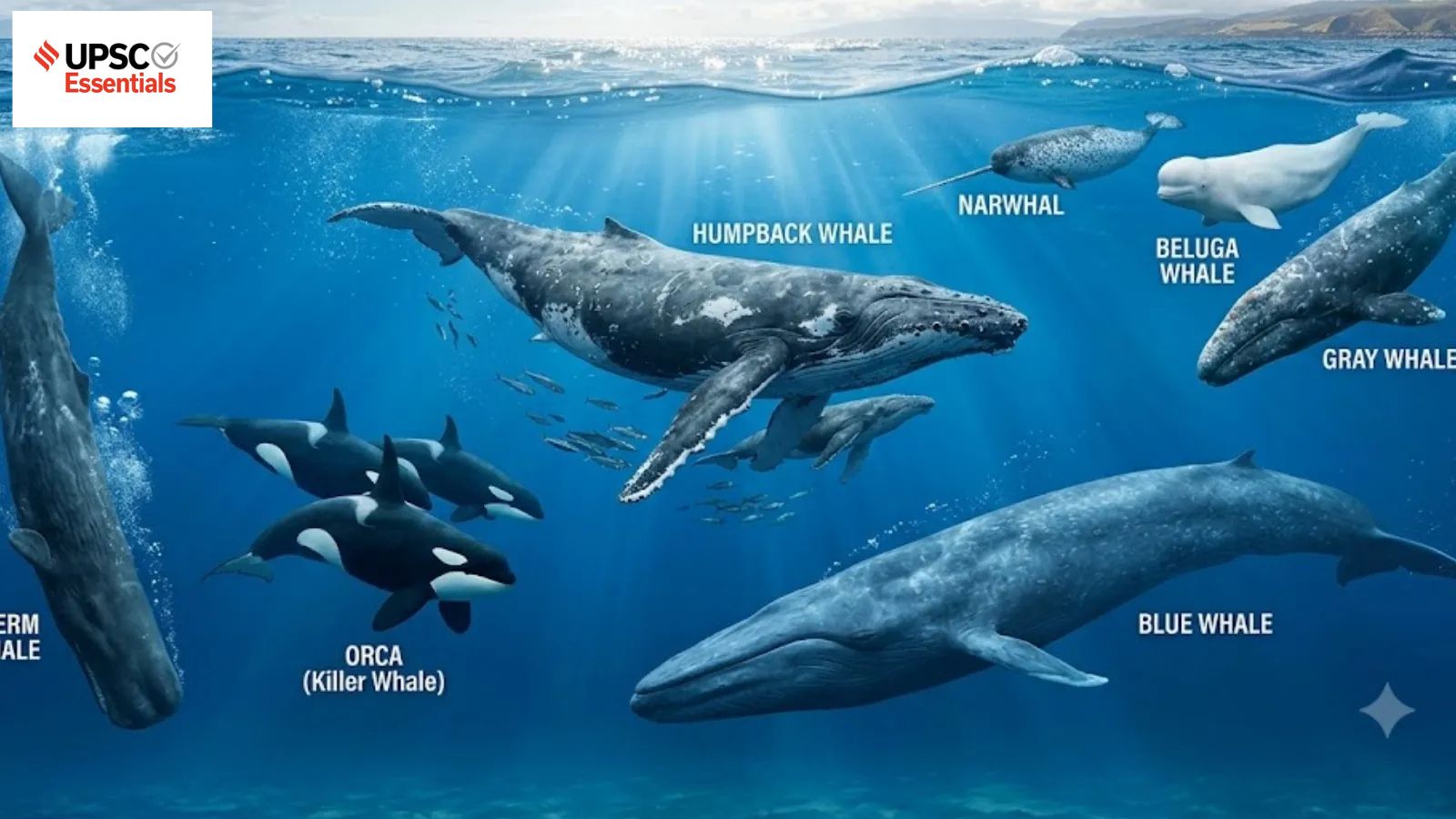
1. The blue whale is the largest animal ever known to have lived on Earth.
2. The humpback whale undertakes one of the longest migrations of any mammal.
3. The sperm whale is the largest toothed predator on Earth.
4. The Gray Whale is mainly found in the North Pacific Ocean.
Story continues below this ad
Which one of the following conclusions based on the above statements is correct?
(a) There are four correct statements.
(b) There is only one correct statement, that is statement 2.
(c) There are two correct statements, that include statement 1.
(d) There is no correct statement.
Relevance: This question tests knowledge of marine biodiversity and important whale species, topics increasingly relevant due to conservation initiatives, climate change, and marine ecosystem discussions. Species-specific characteristics, migration patterns, and habitats can be asked in UPSC Prelims under Environment and Ecology.
Explanation
— Blue Whale: The blue whale is the largest animal ever known to have lived on Earth, reaching lengths of up to 30 metres (98 feet) and weighing as much as 180 tonnes. Despite its enormous size, it feeds almost exclusively on tiny shrimp-like creatures called krill using its baleen plates. It is found in Atlantic, Pacific, Indian and Southern Oceans. Hence, statement 1 is correct.
Story continues below this ad
— Humpback Whale: Known for its breaches and haunting songs, the humpback whale undertakes one of the longest migrations of any mammal, travelling thousands of kilometres between feeding and breeding grounds each year. It is found worldwide. Hence, statement 2 is correct.
— Sperm Whale: The sperm whale is the largest toothed predator on Earth and is famous for its enormous square-shaped head. It can dive more than 2,000 metres deep in search of giant squid. It is found worldwide. Hence, statement 3 is correct.
— Orca (Killer Whale): Although commonly called a whale, the orca is actually the largest member of the dolphin family. Highly intelligent and social, orcas hunt in coordinated family groups known as pods. It is found in every ocean, from polar waters to the tropics.
— Gray Whale: These are famous for undertaking one of the world’s longest annual migrations, travelling up to 20,000 kilometres between Arctic feeding grounds and warm breeding lagoons in Mexico. They are found in the North Pacific Ocean. Hence, statement 4 is correct.
Story continues below this ad
— Beluga Whale: Nicknamed the “canary of the sea,” the beluga whale is known for its wide range of vocal sounds and striking white colour. Unlike most whales, it can move its neck in different directions. It is found in Arctic and sub-Arctic waters.
— Bowhead Whale: This whale is perfectly adapted to Arctic life, with a massive skull capable of breaking through thick sea ice. It is also one of the longest-living mammals, with some individuals believed to live for more than 200 years.
Therefore, option (a) is the correct answer.
QUESTION 2
In which of the following National Parks/Tiger Reserves in India are wild elephants commonly sighted?
1. Kaziranga National Park
2. Bandipur National Park
3. Kalesar National Park
4. Periyar Tiger Reserve
5. Great Himalayan National Park
Select the correct answer:
(a) 1, 2, 3 and 4 only
(b) 1, 4 and 5 only
(c) 2, 3 and 4 only
(d) 1, 2, and 4 only
Relevance: This question tests knowledge of the distribution of flagship fauna across India’s protected areas, a frequently tested theme in UPSC Prelims. It also helps in mapping important National Parks, Tiger Reserves, and Elephant Reserves, which often feature in questions linked to biodiversity conservation and current environmental affairs.
Explanation
Story continues below this ad
— India is home to the Asian elephant, one of the country’s most iconic and intelligent wildlife species. According to the government’s periodic elephant census, India hosts over half of the world’s wild Asian elephant population, spread across forests, grasslands and river valleys. Here are reserves across India where wild elephants are commonly sighted:
— Kaziranga National Park, Assam: Located in the floodplains of the Brahmaputra River, Kaziranga National Park is best known for its population of the one-horned rhinoceros, but it also supports a healthy number of elephants.
— Jim Corbett National Park: India’s oldest national park, Jim Corbett National Park, is part of the Terai Arc landscape, an important corridor for elephant movement. Elephants are frequently spotted in the Dhikala zone, especially near riverbanks and grasslands. The park’s dense sal forests and open plains create excellent wildlife viewing opportunities.
— Bandipur National Park: Situated in the Western Ghats, Bandipur National Park is part of the Nilgiri Biosphere Reserve, one of the largest protected forest landscapes in India. Bandipur supports large elephant herds, and sightings are common during safari drives, particularly near forest clearings and water sources.
Story continues below this ad
— Nagarhole National Park: Also known as Rajiv Gandhi National Park, Nagarhole National Park is another important elephant habitat in southern India. The park’s dense forests, streams and meadows support numerous elephant groups. During summer months, elephants frequently gather around water bodies, making sightings easier for visitors.
— Periyar Tiger Reserve: Nestled in the Western Ghats, Periyar Tiger Reserve is known for its scenic lake and thriving elephant population. Boat safaris across Periyar Lake often offer spectacular views of elephants coming to the water’s edge to drink or bathe, making it one of the most unique ways to observe them.
— Mudumalai National Park: Part of the Nilgiri Biosphere landscape, Mudumalai National Park forms an important elephant corridor connecting Bandipur and Wayanad forests. Its mix of grasslands, bamboo groves and forests creates ideal conditions for elephants, and visitors frequently spot herds grazing near forest roads.
— Wayanad Wildlife Sanctuary: Located in the northern Western Ghats, Wayanad Wildlife Sanctuary is another stronghold for elephants. The sanctuary forms part of a large interconnected elephant landscape, allowing herds to move freely between protected forests. Early morning or evening safaris offer the best chances of sightings.
Story continues below this ad
Note: There are no wild elephants found in Kalesar National Park and Great Himalayan National Park.
Therefore, option (d) is the correct answer.
QUESTION 3
Which of the following factors are responsible for the region’s weather?
1. Latitude
2. Surface Area
3. Population Density
4. Topography
5. Spatial distribution of mountainous regions
6. Prevailing Winds
Select the correct answer using the codes given below:
(a) 1, 2, 3, 4, 5 and 6
(b) 1, 2, 4, 5 and 6 only
(c) 1, 3, 5 and 6 only
(d) 1, 4, 5 and 6 only
Relevance: This question tests the fundamental controls of weather and climate, a core topic in Physical Geography, which can be asked in UPSC Prelims. It also helps in understanding current affairs related to heatwaves, monsoon variability, climate change, and extreme weather events.
Explanation
— Lonavala, Mahabaleshwar, Tamhini, Bhira, and several locations nestled in the Sahyadri ranges and the Western Ghats of Maharashtra experienced historically high rainfall ranging over 600mm in three 24-hour periods between July 6 and 8. This resulted in landslides, mudslides, and flooding, affecting road, rail, and air traffic.
Story continues below this ad
— The geographical location and orography — height, form, and spatial distribution of mountainous regions and elevated terrain — have big roles to play in the region’s weather, particularly on the rainfall during the southwest monsoon season.
— Geographically, the windward side (sea-facing and to be hit by moist winds) receives higher rainfall amounts than the leeward side, often nicknamed as the rain-shadow belt. The difference of rainfall characteristics in July between the western and eastern parts of districts in central Maharashtra adjoining the Western Ghats is mainly owing to the influence of orography on rainfall extending up to a certain distance on the leeward side, according to a 1981 report by IMD, Pune titled “A theoretical study regarding heterogeneity of rainfall over Madhya Maharashtra”.
— Surface Area and Population Density do not affect the weather of the region, while the population density may create localised effects such as the urban heat island.
Therefore, option (d) is the correct answer.
QUESTION 4
With reference to the active volcanoes and their associated regions, consider the following pairs:
1. Sembalun – Philippines
2. Furnas – Portugal
3. Kagoshima – Japan
4. Nicolosi – United States
How many of the pairs given above are correctly matched?
(a) Only one pair
(b) Only two pairs
(c) Only three pairs
(d) All four pairs
Relevance: This question tests knowledge of active volcanoes and their geographical locations, an important topic in World Physical Geography. Such locations are frequently in the news due to volcanic eruptions, seismic activity, and disaster management, making them relevant for UPSC Prelims.
Explanation
— Volcanoes are among nature’s most powerful forces, shaping landscapes and creating some of the world’s most dramatic scenery. While destinations like Mount Fuji and Hawaii attract millions, several lesser-known places offer equally appealing experiences around active volcanoes.
— Sembalun (Indonesia): Located on the eastern slopes of Mount Rinjani, Sembalun is a quiet mountain village surrounded by rolling grasslands and volcanic peaks. It serves as an alternative base for trekking while offering sunrise views and a glimpse into rural Sasak culture. Hence, pair 1 is not correctly matched.
— Chaitén (Chile): Rebuilt after the dramatic 2008 volcanic eruption, Chaitén is now an emerging destination in Chilean Patagonia. Visitors can hike through Pumalín National Park, explore ancient rainforests and witness landscapes reshaped by volcanic activity.
— Furnas (Portugal): Located in the Azores, Furnas sits within an active volcanic region known for bubbling hot springs, fumaroles and geothermal pools. One of its unique attractions is Cozido das Furnas, a traditional stew slow-cooked underground using volcanic heat. Hence, pair 2 is correctly matched.
— Reykjahlíð (Iceland): This peaceful village near Lake Mývatn offers easy access to steaming lava fields, volcanic craters and geothermal landscapes. The nearby Krafla volcanic system remains active, creating one of Iceland’s most fascinating geological regions.
— Kagoshima (Japan): Often overshadowed by Tokyo and Kyoto, Kagoshima offers spectacular views of Sakurajima, one of Japan’s most active volcanoes. Visitors can enjoy volcanic hot springs, lava trails and ash-covered landscapes while experiencing the city’s laid-back atmosphere. Hence, pair 3 is correctly matched.
— Nicolosi (Italy): Located on the southern slopes of Mount Etna, Nicolosi is a charming Sicilian town where visitors can explore lava caves, hike across volcanic terrain, and enjoy local wines produced from fertile volcanic soil. Hence, pair 4 is not correctly matched.
Therefore, option (b) is the correct answer.
QUESTION 5
Which of the following statements correctly defines the ‘Indira Point’?
(a) It is the southernmost point of the Indian mainland, located in Tamil Nadu.
(b) It is the northernmost point of India, located in the Karakoram region.
(c) It is India’s southernmost location on Great Nicobar Island.
(d) It is the easternmost point of India, situated in Arunachal Pradesh.
Relevance: This question tests knowledge of India’s geographical extremities, a recurring theme in UPSC Prelims under Indian Geography. Such locations are frequently in the news due to strategic importance, maritime security, island ecology, and disaster-related developments.
Explanation
— From a fortified lighthouse to a convention centre and museum, the Directorate of Lighthouses and Lightships at Sri Vijaya Puram (Port Blair) has sought clearance from the Andaman and Nicobar Coastal Zone Management Authority and the Environment Ministry to undertake protection and development work at Indira Point, India’s southernmost location, on Great Nicobar Island.
— Under ICRZ-1A, no development activity is permitted except for certain specified purposes such as eco-tourism and the construction of roads and roads on stilts — and, in exceptional cases, for defence, strategic purposes and public utilities, subject to detailed impact assessment. Under ICRZ-IV, several activities, including land reclamation, bunding and control of erosion, are permitted and regulated.
— The development comes against the backdrop of the proposed Great Nicobar Island mega infrastructure project, which involves construction of a transshipment port at Galathea Bay, a greenfield airport, a power plant and an integrated township. Indira Point is located to the south of Galathea Bay.
Therefore, option (c) is the correct answer.
Previous Daily Subject-Wise-Quiz
Daily Subject-wise quiz — History, Culture, and Social Issues (Week 159)
Daily subject-wise quiz — Polity and Governance (Week 170)
Daily subject-wise quiz — Science and Technology (Week 170)
Daily subject-wise quiz — Economy (Week 170)
Daily subject-wise quiz — Environment and Geography (Week 169)
Daily subject-wise quiz – International Relations (Week 169)
Subscribe to our UPSC newsletter and stay updated with the news cues from the past week.
Stay updated with the latest UPSC articles by joining our Telegram channel – IndianExpress UPSC Hub, and follow us on Instagram and X.
View original source — Indian Express ↗
Related stories

The Verge
TechnologyJul 10, 2026 · 1 min
Spotify will let you fine-tune your weekly Release Radar playlist
The Verge

Euronews
TechnologyJul 10, 2026 · 1 min
Ukrainian drone strikes hit southern Russian refineries and Azov port, officials say
Euronews

ZDNet
TechnologyJul 10, 2026 · 1 min
Sony 1000X The Collexion vs. Bowers & Wilkins Px8 S2: Both wow, but one is comfier
ZDNet

TechCrunch
TechnologyJul 10, 2026 · 1 min
China is catching up to Elon Musk’s reusable rockets
TechCrunch